Understanding Disability Through the Lens of Artificial Intelligence

Technological advancements that have been presented conceptually or realistically through film, literature and media have both threatened and enlightened. Specifically, artificial intelligence, including the proposed higher level artificial general intelligence, has made an impression in these three mediums of expression. The threat of AI falsely looms over the heads of ill-informed sceptics. This outlook is not only technophobic, but could be considered speciest, a term that was used in Berys Gaut’s, “Blade Runner, Empathy and Death,” to give individuality and counsciece right to androids that have been outcast by human culture and society.  Disability connects with the topic of artificial intelligence through this project because of the parallels that the disabled community shares with AI through means of being misunderstood, mistreated, and looked at from an unfamiliar and ignorant perspective because of biased viewpoints. My project attempts to intertwine disability and AI by allowing different programs to interpret what exactly disability means through the output of a non-human perspective. Current AI is likely to understand disability without sentient perspective, but this does not mean it will always need to rely completely on user input. 

This project opens with my own example of code, as code is the structure that allows weak AI, and eventual strong AI to exist in the first place. It is noteworthy to also think of ourselves as coded creatures, consisting of DNA and our own form of biology that allows us to exist in the format that we do. The original requirement to structure and submit a creative novel through Python Notebook for a Creative Coding lecture required 50,000 words. Using that blueprint, this code prints out over 30 pages and strengthens Yessenia’s  powerful words from Good Kings Bad Kings with an angry shade of red. The code is meant to help enforce these words, and to work alongside of Yessenia’s fight to end the abuse and unfair treatment that dictated the lives of ILLC individuals. This portion of my project could not exist without my direct input. 

An academic paper titled, “Visual Dialog,” includes the work of several researchers and their proposition for a form of chatbot. This bot is capable of interacting with a human user through conversation and images that are uploaded, then processed by the AI, which is ultimately meant to act as a general test of machine learning capabilities. According to artificial intelligence researcher Janelle Shane, the Visual Chatbot is supposed to exhibit capabilities in, “image recognition, language comprehension, and spatial awareness.” “Visual Dialog” noticeably mentions that AI will be used as a tool for Blind individuals, though projects at this basic level of machine intelligence prove that the future is in dire need of a more aware and sophisticated bot. Because this bot does not understand most images that it had not already been trained with, results received on this portion of my project can be considered ignorant and even offensive. However, this does not mean that the Visual Chatbot cannot be upgraded anymore than it already has.  Images such as Frankenstein and Lenny “wearing a hat” may be thought of as visually acceptable under chatbot standards, while the image of a man and a wheelchair and the female cancer patient give inadequate output to the user. 

RunwayML is a creative platform that engages artists through machine learning tools.  MIT Open Documentary Lab mentions that this desktop application offers three model types including, “models that identify objects and people, models that transform content, and models that generate new media from the training data.” When uploading and training your own models you are automatically faced with an option of text or image machine learning tools. For my project I decided to utilize the text platform, in which I uploaded A Christmas Carol and Frankenstein to analyze how machine learning would assess them. The quality of product that I receive depends on how many steps I train each program.  

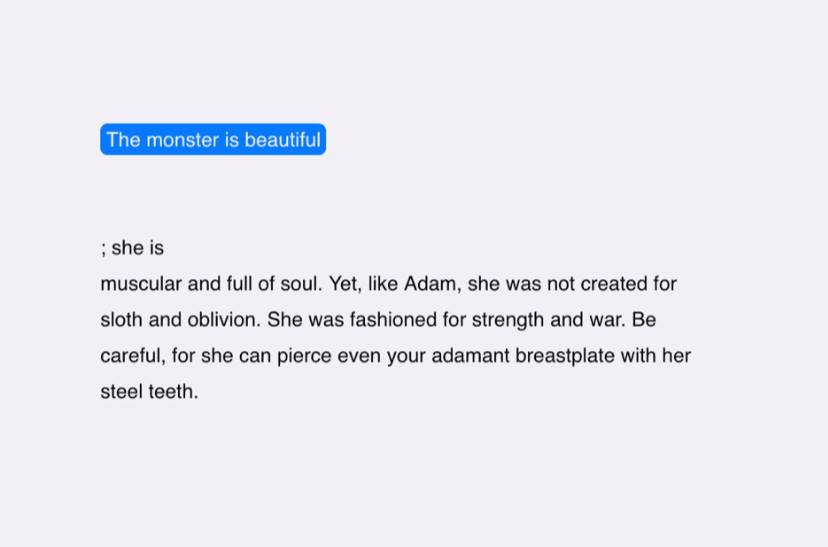
With A Christmas Carol, I uploaded the text and trained Runway on 500 steps, which relies heavily on replicating and understanding an author’s sculpture. Frankenstein also relies on interpretation, but was trained on 1,000 steps, which I like to think gives the AI more room to understand and form its own individuality over a longer period of time.  I fed A Christmas Carol lines from the text and lines of my own such as, “Tiny Tim is” and received, “not Tiny Tim, but is in reality a gigantic, old man with a monstrous chin.” This output does not understand the harm of these words, and likely confused Tiny Tim with Scrooge’s likeness. The user can see a difference in giving the AI more time to process something, as I did with the text of Frankenstein. I genuinely believe that Runway understands the pain and incredible depth of Frankenstein’s character. This understanding may not belong to a (yet) conscious being, but it is important to separate our experience of life and consciousness from that of a machine, much like the AI is able to do with Frankestein’s character. The final output that Runway gave in response to, “The monster is beautiful,” managed to take my breath away.  This interpretation not only belongs to a feminist perspective, but one that transends the original meaning of the text. Runway has given power to a being that was cast aside for their differences. Perhaps, Runway is embracing these differences, as one should. 

The results from my project reveal the evolving stages of AI, and how with time, it can not only serve as an aid for understanding disability, but allow people with speciest and ableist mindsets to broaden their unprogressive views. What is considered “whole” “complete” and even an ignorant word in its usual context like “normal” should be redefined and inclusive to beings of all backgrounds. Disability ultimately shares a connection to artificial intelligence through misrepresentation in literature, film, and the media, as both should be valued and accepted rather than shunned by society. Artificial intelligence has a growing understanding of what disability is, and as long as it is protected and trained by open minded individuals, should prove to interpret disability through a welcoming lens of its own kind.

PYTHON NOTEBOOK | Good Kings Bad Kings (coded book)

Word Count: 1026

I Pledge: Alyssa Brown

Major Paper Project: abstract painting visual art

I decided to do an abstract painting for my project. Abstract is not my usual style but I felt it was the best way to portray the disability/disorder I chose to represent. I wanted to portray a very common disorder in our society today: Depression. Depression is not always seen as a disability but it often is associated with disabilities. Now this does not mean that everyone with a disability has depression or that everyone with depression has a disability. Many people think that you can only have depression if you have a “good reason” like a hard past or present or a disability and although you may be more likely if one or more of these are true but depression does not always have a reason. It is a mental disorder that anyone can have at any time.When someone has depression, they often feel alone, distant, sad/gloomy, and sometimes in severe cases like life isn’t worth living. I wanted to do depression mainly because so many people make jokes about having depression that I feel like people who really have it get overlooked. Also, I have found that many people think that because one person was able to overcome their depression then everyone else should be able to but that is not how it works. It is not the same for everyone.
In my painting I used three colors: white, grey, and black. I only used these colors because I wanted a gloomy feel. Along with these colors I also tried to create a fuzzy or misty look to it to add to the gloom. I made it abstract, so there would be many ways of interpreting it. I personally see it as misty dark woods which can represent feeling alone. The misty/rainy look adds on to the sad aspect of the painting. Like how there are many ways to see and understand the painting, there are also many ways to see and understand depression. No one view of depression is entirely the same.
There are many different types of depression. One of which is anxious depression which is basically what it sounds like. It is where along with the depression you have high anxiety. I wanted to mention this type one because I feel like I can relate to it and two because I feel that when I stare at my painting not only do I get this feeling like depression but it also makes me anxious and the longer I stare at it the more it makes me think about my anxiety. The purpose of this painting is not to actually make you depressed or anxious but to bring awareness to a little piece of what it is like.

I pledge

word count: 456

Source 

“Depression (Major Depressive Disorder).” Mayo Clinic, Mayo Foundation for Medical Education and Research, 3 Feb. 2018, www.mayoclinic.org/diseases-conditions/depression/symptoms-causes/syc-20356007

“Depression (Major Depressive Disorder).” Mayo Clinic, Mayo Foundation for Medical Education and Research, 3 Feb. 2018, www.mayoclinic.org/diseases-conditions/depression/diagnosis-treatment/drc-20356013

Gina & Rosemary’s Major Paper

Gina-Marie An & Rosemary Pauley

Dr. Foss

April 23, 2020

ENGL 384

Inspiration Porn and Overcoming Narratives: Objectifying Disabled Lives

Throughout the course of our semester, we have addressed many ways in which disabled people are mistreated and misrepresented. Inspiration porn and overcoming narratives are particularly common yet highly offensive acts that are harmful towards people with disabilities. Able-bodied people tend to put a cap on a disabled person’s ability and infantilize their achievements through unnecessary praise, whereas their accomplishments are only viewed through their disability and not their own strength. They are often praised for attempting rather than achieving by able-bodied people, and that can be used as fuel for nondisabled people to work harder or whatever other cliches the inspiration porn is pushing towards. The objectification of disabled people is perpetuated by the presence and normalization of inspiration porn and overcoming narratives. 

The term “inspiration porn” was coined by journalist and disability rights advocate Stella Young. Inspiration porn refers to when nondisabled people use the lives and stories of disabled people to inspire them, or use them to help or better themselves in some way. Examples of this could be inspirational posters that feature a disabled person doing some great feat or simply just doing an everyday task in a different way than an able-bodied person might do as if this in itself is some extraordinary feat. Already this poses a problem in making a spectacle of how people with disabilities exist in an ableist society, but it also continues the centuries-old stereotypes and assumptions that people with disabilities are somehow different or unconventional. They emphasize the idea that existing as a disabled person is difficult and effortful enough to inspire nondisabled people to work harder and do better in whatever they are trying to achieve.

Young addressed the prominence of these viewpoints, “we’ve been sold the lie that disability is a Bad Thing, capital B, capital T. It’s a bad thing, and to live with a disability makes you exceptional. It’s not a bad thing, and it doesn’t make you exceptional” (Young 2014). Nondisabled people tend to see simply living with a disability as an achievement and use that as motivation or inspiration for themselves. Because society is inherently ableist, these assumptions about disability are widespread and widely accepted, allowing inspiration porn to be the popular and unsuspecting form of objectification that it is today. While many nondisabled people might think of these instances as a harmless way of uplifting people with disabilities or acknowledging them in a positive way, in actuality, it is condescending and belittling towards people with disabilities. Acting as if disabled people are accomplishing something incredible just by living out a normal life infantilizes and devalues them as people while also giving nondisabled people a source for inspiration porn and self-improvement.

In her TED Talk, “I’m not your inspiration, thank you very much,” Stella Young talks about her own experiences with nondisabled people expecting her to be uplifting and inspirational in every interaction with her, as if that is all that disabled people are meant to do. When explaining her use of inspiration porn, Young said, “I use the term porn deliberately, because they objectify one group of people for the benefit of another group of people.” Able-bodied people are actively objectifying disabled people by using their stories and lives for their own beneficial reasons. This practice is extremely hurtful for people with disabilities because they are not only being used to the advantage of people without disabilities, but they are also being socially separated from nondisabled people. Value is being placed on these perceived achievements or accomplishments rather than the life of the actual disabled person. These uses of inspiration porn are essentially a more subtle way of putting disabled people on display, with the unsuccessful intent of addressing disability in a positive and opportunistic way. This objectification of people with disabilities is played off as acknowledging diversity and celebrating differences instead of being treated as an unethical practice. 

An acknowledgment of inspiration porn can be found in a poem by Jillian Weise that we analyzed in class. In Jillian Weise’s “Nondisabled Demands,” the extent to which nondisabled people are intrusive in getting information about disability for inspiration porn is made abundantly clear. In the last stanza, Weise writes, “We’ll rope you / to the podium and ask / What do you have? / … Then we get to say / You’re an inspiration.” The image of roping someone to a podium for the entertainment of others is a prominent example of the objectification that surrounds inspiration porn. Personal information seems to be taken against their will, leaving disabled people feeling violated and used for the benefit or entertainment of others. Nondisabled people feel a sense of entitlement to know the intimate details behind someone’s disability. That entitlement then extends to using those details for their own benefit in cases of inspiration porn, further asserting their needs and wants above those of people with disabilities. 

Weise’s poem also calls attention to how inspiration porn not only uses the stories of people with disabilities but also takes those individualistic narratives away from disabled people. After nondisabled people force out the details of their disability, their worth and ability are interpreted by nondisabled people. The narratives that are supposed to belong to disabled people are manipulated into something for the benefit of nondisabled people often at the expense of the disabled person’s opinions or feelings. When Weise notes in her last stanza that nondisabled people get to make the choice of labeling someone as an inspiration, they are also making a choice about what meaning is carried by their story rather than letting the disabled person have control of their own narrative. Inspiration porn objectifies people with disabilities by taking this control away from disabled people. 

Inspiration porn coincides with the issue and notion of overcoming one’s own disability, often referred to as an “overcoming narrative.” This overcoming narrative addresses the abled perspective and how abled people push their own ideas of disability onto the disabled to insinuate what their disability is supposed to look like, how they are supposed to function, and what the limits to their disability are. Perceiving a disabled person’s existence as overcoming their disability often acts as fuel for the inspiration porn, as well as continues the viewpoint that disabilities must be overcome or removed in the first place. 

Jessica Cox, the first world’s licensed and armless pilot, says in her TED Talk, “I grew up in a world built for someone with arms and it has taught me that pity prevents progress.” She describes her perseverance and lack of self-pity that enabled her to achieve far beyond what this world built for arms expected of her. She begins the TED Talk by describing a challenge she once had as a child: to tie her shoes. She sits down and begins to tie the laces with her feet, then as she finishes the last loop and secures the bow tie, the crowd roars into a cheer. However, when she stands up, she expresses, “I want you to look at me again and understand that I am not different.” Simi Linton, in “Reassigning Meanings,” describes the perpetuation of disabled persons and the ways in which even the meaningfulness of disabled lives are dictated by abled perspective and their preliminary understanding of disability. Simi Linton’s description of “nice words” can be shown through the crowd cheering for Jessica Cox. The language of cheer and appraisal, though wordless, exemplifies a crowd that may have viewed her disability as less capable and showcases their happiness or astonishment that she was able to do it otherwise. Nice words, or nice language, can reassign meaning to protect their own egos as a defense mechanism, therefore they will immediately praise the disabled person in order to stifle their prior feelings of doubt and disbelief. Jessica Cox’s quote emphasizes the simple want to be seen, to be seen as human and as equal, and not as a unique and extraordinary case to be idealized and inspired by, simply because of her disability. 

Our abled society expects Jessica Cox to be passive, unable to claim an identity outside of their disability. However, Jessica Cox is arguing a similar shift in perspective. Simi Linton argues a change of thinking, a shift in the way we look at disabled persons and assume their social inferiority. Jessica Cox shows this by describing how she was treated and objected to pity.  Her disability is treated as a hindrance or something to be ashamed of, until she “surprisingly” overcomes it despite societal expectations. This ableist perspective places value on her for “overcoming” the challenges she faced in their ableist society, making her an inspiration and something to behold. 

 In Kafer’s “Imagined Futures,” Kafer emphasizes the assumptions of disabled success, and that disabled success is misguided and abled success is simply not for disabled people. It was seen that her lack of arms was a “symbol of undesired futures.” Or rather, that her success was impossible and unexpected. Disabled person’s interaction with the world is seen as useless and even dangerous to the ableist structure that so many nondisabled people exist comfortably in. For example, Cox describes how she is told over and over that she cannot do something, that it is not for her. Cox expressed that this constant denial of participation made her want to prove them wrong. “People with disabilities usually realize that they must learn to live with their disability… The challenge is not to adapt their disability into an extraordinary power or an alternative image of ability. The challenge is to function” (Siebers, 180). It’s important to understand that Cox did not adapt to her disability, her real adaptation was to the people around her who did not have any hope for her. Instead of overcoming a disability like so many able-bodied people interpreted her to be doing, she overcame the confines of the ableist society that was manipulating the way she was to be seen and treated. 

Addressing these issues and making an adjustment on the way we view disabled lives can help us better understand and respond better to insensitive behavior and make inspiration porn and objectification a known, inappropriate act. Recognition of this behavior can help dampen the misrepresentation and mistreatment disabled people go through. While disabled people can be and are inspiring, and they absolutely do overcome tough obstacles, it is not fair to objectify their lives and treat them as though they are inferior. They are more than their disability, more than “less than,” and should be given the same choices and opportunities as everyone else. 

Word Count: 1766

I pledge. Rosemary Pauley and Gina-Marie An

Works Cited

Kafer, Alison. “Introduction; Imagined Futures.” Feminist, Queer, Crip, Amsterdam University Press, 2013, pp. 1–24. 

Linton, Simi. “Reassigning Meaning.” Claiming Disability, Amsterdam University Press, 1998, pp. 8–33. 

Siebers, Tobin. Disability in Theory: From Social Constructionism to the New Realism of the Body, American Literary History, Volume 13, Issue 4, Winter 2001, pp. 737–754, https://doi.org/10.1093/alh/13.4.737

TEDx Talks. “World’s First Certified Armless Pilot: Jessica Cox at TEDxSouthCapitolSt.” YouTube, uploaded by TEDx Talks, 4 Oct. 2013, www.youtube.com/watch?v=31e_xTZHrqE

Weise, J. (2018). Nondisabled Demands. Originally published in Poem-A-Day on March 9, 2018, by the Academy of American Poets

Young, Stella. “I’m Not Your Inspiration, Thank You Very Much.” TED Talks, uploaded by TEDx, Apr. 2014, www.ted.com/talks/stella_young_i_m_not_your_inspiration_thank_you_very_much?language=en

Madison’s major paper

Invisible Disability, Invisible Identity

Invisible disability is not automatically apparent to our eyes. This can include physical and mental conditions such as PTSD, anxiety, depression, chronic pain, and even vision or hearing impairments. So much of how we understand disability is rooted in its visibility. We tend to base our ideas of a person and their capabilities first on their appearance. It is important to understand how the invisible disability is socially constructed, which then allows for conversation about the problems surrounding this identity. Using queer studies as a model, it is easy to draw parallels to better understand how the invisibly disabled identity functions, and a lot of times, why people do not claim it. So often, ideas of “normalcy” and the need for “proof” plague our understanding of what it is to be a disabled mind or body. Through these beliefs, we create a culture that invalidates the invisibly disabled and prevents these individuals from claiming their identity. 

If we see disability in general as socially constructed, we can break down how the invisibly disabled mind and body are understood in society, and thus how our ideas about these bodies/minds impact the person with the disability, specifically the individual’s identity. In Disability in Theory, Siebers states that, “social attitudes and institutions determine far greater than biological fact the representation of the body’s reality” (Siebers, 173). Thinking about this in terms of invisible disability, the social construction happening has much to do with ideas about what a “normal looking” person should be able to do. Before a person’s invisible disability is exposed, they are automatically understood as abled. He goes on to say, “the dominant ideas, attitudes, and customs of a society influence the perception of bodies” (Siebers, 174). Given we live in a society in which able-bodiedness is the default, a difference in appearance is typically an indicator that a person deviates from the norm, and consequently, that person is labeled an “other” and their identity is heavily influenced by this label. Additionally, the social attitude regarding pain and suffering plays a large role in our construction of the disabled body. Siebers writes, “the human ego does not easily accept the disabled body” (Siebers, 176). This is in part due to the belief that disability is pain, and humans are quick to reject both physical and mental or emotional pain. However, if much of an individual’s identity has to do with the pain they experience, in a society where there is an emphasis on the “cure”, to advocate such ideas is to advocate for the eradication of a large piece of this person’s identity. The attitude our society holds about pain contributes largely to the social construction of the disabled body. However, the notion that disability is pain and nothing else is harmful and inaccurate. There is so much more to the disabled identity than the amount of discomfort one feels. On the other hand, ignoring the presence of pain at all can be just as harmful when trying to understand what it is to be an invisibly disabled identity. 

It is important that the hidden disability is acknowledged for its ability to cause as much pain as a physical one. In her article, Invisible Disability, Davis importantly notes, “People whose disabilities are not generally perceived by others do not, for that reason alone, find it easier to minister to themselves or to engage productively and effectively in the world without having to endure pain, discomfort, and exhaustion” (Davis, 154). It can be invalidating to the invisibly disabled identity when the pain they feel is not taken seriously simply because they do not appear disabled. In the case of mental illness, oftentimes both mental pain and physical pain are at work, as depression, anxiety, and PTSD can cause physical symptoms that lead to discomfort. To assume that an invisible or mental disability has nothing to do with the body is ignorant, as the mind and body are connected and they rely on each other to work. One cannot drive a car properly with an engine that is uncooperative, and it is no different if the mind is impairing the body from functioning. The pain that the invisibly disabled experience is just as valid as that of other disabilities, and just as central a part of their identity.

The identities of those with invisible disabilities can be understood using similar terms and experiences to ones frequently discussed in queer studies. Similar to how queer identity has to be claimed through “coming out”, the invisibly disabled must also claim their disability. Until these identities are claimed, it is assumed that the person holding them is “normal”, that is, abled. The parallel here allows us to better understand some of the issues the invisibly disabled face. Ellen Samuels discusses the connections between the disabled and queer identities in My Body, My Closet. One connection she notes is that similar to queers and queer culture, individuals with disabilities may find it hard to access crip culture (Samuels, 234). This may be especially true for the invisibly disabled, because they are not automatically seen as having a disability, so they have to go the extra mile to prove themselves as being a part of that shared experience. This “presumption of sameness” (Samuels, 236) not only alienates people from being a part of a community, but it can also create cognitive dissonance in the person with the invisible identity. That is, they are being told they are one thing by outward notions of normalcy, yet they feel a different way on the inside. The “presumption of sameness” and the cognitive dissonance that follows is something that could easily plague the mentally impaired especially, given that tangible or physical evidence of pain is little to none. To the abled eye, there is nothing stopping someone with invisible disability from carrying out everyday life, yet so many people who struggle with depression, anxiety, PTSD, and so on have a difficult time completing simple tasks. This appearance of normalcy can be alienating to the invisibly disabled person who tries to access crip culture and be a part of a larger community. 

Another parallel between these studies as discussed by Samuels is the idea of “coming out.” In other words, the invisibly disabled identity must be claimed to be seen. Samuels states, “coming out refers specifically to accepting one’s ‘true’ identity and must entail identification with the political analysis of the marginalized group. In both queer and disabled contexts, however, coming out can entail a variety of meanings, acts, and commitments” (Samuels, 237). Those who choose to “come out” and claim this identity feel connected to disability or crip culture and the experiences of those who also claim the disabled identity. Coming out for the invisibly disabled can be clarifying and freeing, opening doors for shared experience and a sense of community. However, the process is different and unique for each individual who chooses to disclose their disability, and some choose to not claim this identity at all. Samuels refers to Rosemarie Garland-Thompson’s “coming out process”, in which she did not feel a connection to disability culture at first, but instead felt that her disability was a “private matter” (Samuels, 238). Additionally, Elizabeth Brewer talks about how many psychiatric survivors do not identify with the disabled identity, despite the fact that from a legal perspective, there is a connection between mental impairment and disability (Brewer, 15). Individuals may choose not to come out for the troubling reason that they find it easier to stay hidden. 

Often the invisibly disabled will prefer to keep their identities hidden, rejecting the disabled identity all together: “people with hidden impairments often make an effort to avoid the perceived stigma attached to a disabled identity” (Samuels, 240). This can be seen similar to “passing” which is also prevalent in queer studies. The invisibly disabled may find it easier to pass as abled for a number of reasons. It is a personal choice, but one that should be available to those whose disabilities are not as apparent. Samuels shares the experience of Georgina Kleege, a blind teacher who is able to “pass” in certain situations: 

“Because my disability is no longer readily apparent, and because it is an illness whose symptoms vary greatly from day to day, I live between the world of the disabled and the non-disabled. I am often very aware of my differences from healthy, non-disabled people, and I often feel a great need to have my differences acknowledged when they are ignored. . . . On the other hand, I am very aware of how my social, economic, and personal resources, and the fact that I can “pass” as non-disabled among strangers, allow me to live a highly assimilated life among the non-disabled” (Samuels, 240).

Kleege talks about how in some situations, she wishes to be acknowledged but she is also aware of how her ability to “pass” is beneficial in her everyday life. She does not quite resonate with the non-disabled, but she is also able to avoid stigma in certain situations and “pass” based on ideas of normalcy. The practice of passing has, “been read as a conservative form of self-representation that the subject chooses in order to assume the privileges of the dominant identity” (Siebers, 240). This can be problematic, especially if disabled individuals are choosing to pass because it is the easy thing to do, and not because they fail to relate to the identity. Choosing to claim the disabled identity as an invisibly disabled person should be that- a choice, and without the pressure that coming out will be more counterproductive than it is freeing. 

It can be argued that the “presumption of sameness” that occurs when an invisibly disabled person appears normal and able is actually a positive. If there are no limitations placed on a person solely based on their appearance, that individual avoids stigma. They have more of a choice in disclosing vulnerability if they can pass where the visibly disabled cannot. However, it is possible for the opposite effect to happen, where the assumption of able-bodied can be alienating when a person who is not visibly disabled is expected to function the same way an able-bodied person does, but they cannot. Samuels points out, “Those whose disabilities are invisible may also have to convince other people that they really are disabled, not seeking some special—unfair—advantage: thus, what they must do is meet a burden of proof” (Davis, 154). This pressure to prove is a major reason why an invisibly disabled individual may not choose to claim the identity, despite feeling a part of it. 

The invisible disability is socially constructed by our ideas of normalcy and the need for proof. This identity can be compared to queer identity, as they both operate on similar terms of coming out and passing, and how both have their advantages and disadvantages. Although the invisibly disabled have a choice of disclosure when it comes to sharing their disability with the world, this does not automatically mean they are in any easier of a position than those who do not have the choice. It is clear that many invisibly disabled individuals choose not to claim the identity because they feel passing as able-bodied is more beneficial to them than coming out as disabled. The culture we construct around nonvisible pain prevents those who could be a part of this shared identity but choose not to because we tell them their pain is invalid simply because they look normal. 

Word count: 1997

Works Cited

Brewer, Elizabeth. “Coming out mad, coming out disabled.” Literatures of Madness. Palgrave Macmillan, Cham, 2018. 11-30.

Davis, N. Ann. “Invisible disability.” Ethics 116.1 (2005): 153-213.

Samuels, Ellen Jean. “My body, my closet: Invisible disability and the limits of coming-out discourse.” GLQ: A Journal of Lesbian and Gay Studies 9.1 (2003): 233-255.

Siebers, Tobin. “Disability in theory: From social constructionism to the new realism of the body.” American literary history 13.4 (2001): 737-754.

I pledge. Madison Moyer.

Kaitlin Bailey’s MPP: A Comparison of Representations of Disability in the Old and New Testaments

The role of disabled bodies in the Bible often illustrate contradictory messages and are portrayed in a very stereotyped manner. This paper will discuss the different representations of disability and impairment in the Bible, and also the shift in the roles of disabled bodies from the Old Testament into the New Testament to spread the teachings of Christianity. The Old Testament devalues disabled bodies and represents them as unclean and less than those with seemingly perfectly able bodies. They are used to promote charitable acts and improve the morality of able-bodied people and to act otherwise would result in punishment of an impairment or disability to the offender who in turn would not be welcomed by God. In the New Testament, while Jesus does welcome the disabled, they play a role of allowing able-bodied Christians to witness Jesus’ healing abilities and disabled people are written to need salvation. 

Beginning in the Old Testament, disability and impairment are shown in the Bible through blindness, deafness, dumbness, leprosy, and paralysis with visual impairment being the most common. For those who are viewed as disabled or having a form of physical defect, they are ostracized and excluded from society and this was seen often in religious ceremonies. These ceremonies that celebrated God emphasized the societal structure and the various roles in the societal hierarchy. To be accepted as a high-ranking official in the church one must prove bodily normality (Bengtsson). Those with physical impairments or disabled bodies could never be considered to be a priest or take a leading role, and this order established clear division between able bodied people and those with disabilities and this is blatantly stated in the book of Leviticus: 

 The Lord said to Moses, “Say to Aaron: ‘For the generations to come none of your descendants who has a defect may come near to offer the food of his God. No man who has any defect may come near: no man who is blind or lame, disfigured or deformed; no man with a crippled foot or hand, or who is a hunchback or a dwarf, or who has any eye defect, or who has festering or running sores or damaged testicles. No descendant of Aaron the priest who has any defect is to come near to present the food offerings to the Lord. He has a defect; he must not come near to offer the food of his God. He may eat the most holy food of his God, as well as the holy food; yet because of his defect, he must not go near the curtain or approach the altar, and so desecrate my sanctuary. I am the Lord, who makes them holy (Lev. 21:16-23 NIV).

This passage clearly defines and separates the view of able-bodied people and disabled people in the eyes of God, and how he finds the most satisfaction from a perfect and normal body (Bengtsson). By allowing disabled bodied people to be that close to God it would be a blatantly disrespectful act. 

 In these sacrificial rituals the purpose is to bring individuals to the divine power by offering the best of their possessions to the God, so to exclude those that are disabled or have defects it exhibits they are less desirable and this is mentioned again in the book of Malachi: 

When you offer blind animals for sacrifice, is that not wrong? When you sacrifice lame or diseased animals, is that not wrong? Try offering them to your governor! Would he be pleased with you? Would he accept you? Says the Lord Almighty (Mal. 1:8 NIV).

This reiterates that there is a feeling of shame surrounding any being with a disabled body or physical defect and that they should be hidden from the eyes of God. In early years of Christianity, the church believed that faith “comes from hearing the message” (Romans 10:17 NIV). This belief would leave those deaf and hard of hearing without faith and excluded from the church which is another example of the ostracism of those with disabilities that is exhibited in the Old Testament.

            Alongside the narratives and stereotypes of shame and being less desirable there are contradicting messages about the treatment of disabled and impaired people in the Bible, even in the book of Leviticus where it is spoken that God should be distanced from anyone seen as disabled preaches that there should not be mistreatment of disabled people. In the previous chapter of Leviticus God states that no man should “curse the deaf or put a stumbling block in front of the blind” (Lev. 19:14 NIV). It can be argued that this is the first instance in the Bible that advocates for the protection of the disabled in society and reflects competing attitudes toward disability in the Old Testament (Braddock and Parish 4). 

            The book of Deuteronomy in the Old Testament stresses heavily the way able-bodied Christians in communities should act towards the “others.” The role of disabled people in their communities should be to allow able-bodied people an outlet to practice better acts of charity and learn to increase morality. They were not viewed as equal and should be pitied. “Cursed is anyone who leads the blind astray on the road” (Deut. 27:18 NIV). In instances where one does not act charitably towards disabled people, they were to be punished by God. Disability is used as a punishment towards able-bodied people and they are warned: 

However, if you do not obey the Lord your God and do not carefully follow all his commands and decrees I am giving you today, all these curses will come on you and overtake you… The Lord will afflict you with madness, blindness, and confusion of the mind. (Deut. 28:15-28 NIV). 

Society was to recognize their obligation to people with disabilities, while also fearing that they could be punished by God with the very same disabilities. The belief that illness was inflicted by an angry God as punishment was widespread among Christian communities (Braddock and Parish 4). 

            Continuing into the New Testament, although there are much fewer chapters addressing disability directly, the stigma surrounding disability is not changed but rather just narrated differently. The New Testament gospels Matthew, Mark, Luke, and John feature numerous examples of people with physical and sensory disabilities, just as the Old Testament, but now those examples only exist to highlight Jesus’ healing as a miracle worker (Gosbell 9). Their role in their communities has shifted from being an outlet for able-bodied Christians to improve their morality to providing an outlet for able-bodied Christians to see the miraculous healing of Jesus. Disabled people represent the version of humanity that needs to be restored and saved through ministry and faith. If the followers of Jesus are not deemed healthy or able-bodied, it would be because they are not doing something right. 

            In the book of Mark, the spread of leprosy is a concern for Christians, and it is written that Jesus has the power to heal this undesirable disease: 

A man with leprosy came to him and begged him on his knees, “If you are willing, you can make me clean.” 

Jesus was indignant. He reached out his hand and touched the man. “I am willing,” he said. “Be clean!” Immediately the leprosy left him and he was cleansed (Mark 1:40-44).  

This representation of disability in the book of Mark perceives disease and disability as something that is in need of being saved. The removal of disability is seen as a foreshadowing of the full restoration of humanity, and to be left disabled is a “manifestation of brokenness” (Gosbell 10). The representation of disabled people as more sinful and in need of healing further illustrates that disabled people are not fully accepted in Christianity other than to accentuate the abilities of Jesus. This is exhibited again in the book of Mark when Jesus heals a blind man in Bethsaida:

They came to Bethsaida, and some people brought a blind man and begged Jesus to touch him. He took the blind man by the hand and led him outside the village. When he had spit on the man’s eyes and put his hands on him… Once more Jesus put his hands on the man’s eyes. Then his eyes were opened, his sight was restored, and he saw everything clearly (Mark 8:22-25 NIV). 

There are countless examples of Jesus healing the disabled throughout the Gospels, and this is another example of the role that disabled people play in their communities and in Christianity at the time. 

            Unlike the Old Testament, where God turned away those with disabilities as they were not deemed worthy to be near, Jesus does welcome the disabled into his ministries and does not turn them away. Jesus states in the book of Luke that “when you give a banquet, invite the poor, the crippled, the lame, the blind, and you will be blessed” (Luke 12:12-13 NIV). The role of the disabled people in their communities change after the birth of Jesus Christ due to the fact there were changes in how Christians then practiced ministry. 

            In the Old Testament, disability was written as a factor of life that could not be escaped or healed and as a result disabled people were turned away from the church and left to be isolated from their communities. The meaning of disability in the Bible shifts with the introduction of the New Testament and the birth of Jesus and gives Christianity a new way to celebrate the able body it deems it perfect. Although there are consistent stereotypes present in the Bible when narrating stories of people with disabilities, the representation of disabled people throughout both Testaments illuminates the complexity of the inclusion of people with disabilities and impairments in Christianity.  

Works Cited

Bengtsson, Staffan. “On the Borderline- Representations of Disability in the Old Testament.” Scandinavian Journal of Disability Research, vol. 16, no. 3, 3 Jan. 2014, doi:http://doi.org/10.1080/15017419.2013.873077.

Braddock, David L, and Susan L Parish. “An Institutional History of Disability.” Disability Studies as a Field, 2001, pp. 11–68.

Gosbell, Louise A. The Poor, the Crippled, the Blind, and the Lame: Physical and Sensory Disability in the Gospels of the New Testament. Mohr Siebeck, 2018.

Holy Bible: New International Version. Zondervan, 2017.

Stiker, Henri-Jacques. A History of Disability. Translated by W. Sayers, University of Michigan Press, 1997.

Major Project Write-Up

Lizzie Wordham

            For my song, I was hesitant to sing from the point of view of someone who is disabled, as I am not and didn’t want to misrepresent. However, after our various readings I felt like I had somewhat of a grasp on some of the particular struggles and felt that I would be able to represent some of them. I think the main goal of my song was to display the disconnect between the able-bodied community and the disabled, as well as how a disabled person may want others to treat them. During class, one of the members of my small group shared that they tried not to hold certain things against able-bodied people, as they often don’t know how to act around disabled people. In this write up, I will pull out specific lines and verses and explain their meaning to me and how they relate to class material. I have put the lyrics at the end for reference.

            In the most recent book we’ve read for class, Autism, Murray writes that “In trying to explain or describe the experience of having autism, one of the most oft-repeated assertions is that it is like being an alien” (102). Although I was trying to portray a more general sense of disability rather than autism in particular, I feel that this does a good job explaining how a disabled person may feel in regards to being different. In my first two stanzas (I am calling them stanzas as opposed to verses because I believe the song reads as more of a poem), I was trying to represent some internal dialogue that a disabled person may have in response to an able-bodied person’s reaction to them. Wondering what they might be thinking about them, what they should say, whether they should be offended or hurt by the reaction, etc. The Kenny Fries poem, “Excavation,” that we read earlier in the semester was some of my inspiration for this part as it is a person reflecting on their own disability and recalling what society has called them. The line in my song that reads “Is there something that you’re looking for” relates to a line from a Bartlett poem we read for class: “to be crippled means to have access to people’s fear of their own eroding.” The narrator is reading into what able-bodied people are trying to get out of looking at them.

            The third stanza was inspired by the in-class discussions that I mentioned earlier. I was showing a disabled person who is trying to recognize that others feel different and lonely, too, although in a way that is completely different than their experience. It is someone trying to be understanding of others despite the majority not understanding them.

            My ideas for the fourth stanza came from a few different places. Although I was emphasizing the disconnect between able-bodied and disabled communities, I also wanted to include the first two lines to show that although a disabled person may feel disabled around others who are unlike them, their disability is normal to them and all they know. The lines “Am I really that different? Is there something that’s missing?” are meant to demonstrate the familiarity a disabled person has with their own bodies, and not feeling like there is something about them that needs to change. There is a line in Sheila Black’s poem “What You Mourn” that addresses how she would have felt about her disabled body had her legs never been straightened. It reads “…I would have nested in it, made it my home.” Later in the poem she says about her disabled body, “I loved it as you love your own country.”

            The second half of this stanza refers to something we talked about in class—the exploitation of disabled people to “inspire” or “motivate” nondisabled people. I was trying to write that motivation doesn’t come from differentiating yourself from another person. Instead, it comes from the actions taken to be better. Instead of able-bodied people being motivated to do something with their lives because they saw a disabled person who did, they should take action to be accommodating to, understanding of, and educated about communities that are different than their own. This leads me to the next two lines of my song, “There could be some changes so I am not a stranger.” I wanted this to read as a sort of call-to-action towards able bodied people to take steps to understand the disabled community. The person singing my song is asking others to learn about them. All communities being educated on disability can increase familiarity and lessen the disconnect. That’s what could happen if, as Murray writes, “the alien and the human are not held apart but actually inform each other” (103).

            The final stanza has the most meaning to me personally. One of my and my college friends’ favorite things to do was stay up late and play the game Taboo. We liked to bake cakes, get groceries together, and listen to silly music. I included these things because, to the majority, they are considered “normal” things to do. However, I wanted to emphasize that “normal” or “typical” activities like these are not limited to only able-bodied people. I wanted to emphasize that the disabled community is not different in their enjoyment of simple things like games and music. I think this stanza was significant for the song to demonstrate the importance of recognizing both the differences of able-bodied and disabled communities along with the things that make us the same. The final line is the narrator of the song wanting others to recognize what they want from them: to make efforts to understand them and learn about their community.

Lyrics:

I don’t what I should say

When people turn and look my way

Is there something that you can’t ignore or something that you’re looking for 

It feels rude when you ignore me

But when you smile is it pity 

When you stare what are thinking 

if I feel mad then that seems petty but I do, I do

But I don’t know what I expect from you 

There are things that I can try 

When people stare or people smile 

Cause I know others feel alone 

But there are some who’ll never know 

Am I really that different 

Is there something that’s missing 

Cause 

Motivation inspiration they don’t come from separating me and you, oh you 

Those things will come from what you do 

But there could be some changes

So I am not a stranger

Cause there’s birthdays and making cakes and movies nights and grocery dates and music we should probably hate and finding things to celebrate and sometimes staying up too late and playing games like taboo 

And those are things that I expect from you

Saunders Major Project: Poetry Collection

The following poems are first and foremost about my personal experiences with depression and anxiety. That’s just how they started. However, as I went through and revised them, fixing wording here and punctuation there, I found myself wanting to explore the relationship between my mental illnesses and my identity. In the past several years, since starting college, I’ve struggled a lot, trying to find the balance between Depressed Emily, Anxious Emily, and Normal Emily that felt the most true to myself.

I’ve never been one to take my own mental illnesses and romanticize them, so linking the illnesses to my love for writing poetry didn’t feel right, but it didn’t feel honest to say they play no part in the process either. What’s more, each of those versions of myself is just one facet of the whole person. I’m not me without them just the same as I’m not me just because I have them. On making those realizations this project took a new turn. Instead of focusing solely on experience, I changed my direction to explore more of the relationship between myself and my mental illness—each version of myself individually, how they all play together—as well as how they impact my relationship with the people around me, be they strangers or loved ones.

            The purpose of this project isn’t to make a broad statement about disability in general—I have no right to be the sole voice, especially because my disabilities don’t extend into the physical. Instead, I want to shed some light on some of the inner workings of mental illness, specifically depression and anxiety, in order to bring the complicated nature of it all into focus. I hope that the poems I’ve written don’t come across as romanticizing in any way, nor do I hope they belittle. Instead, I hope when you read you find them authentic and real, showing many different facets of what it means to be human.

Hindsight

I want to tell you about the good things, too, I mean

it wasn’t all awful I just don’t remember anything else

but the air smelling dirty and burning and feeling like

suffocating in concrete and also missing the green and

skipping a presentation in my speech class because my

suitemates thought I was having a heart attack (it was

just anxiety and the ER nurse was annoyed with me

until I mentioned you had died, in which case she nodded

like she finally got it) and my professor asked me about

the trip the next day in class, in front of everyone, and I had to

explain, “oh, I’m fine, it was all a misunderstanding,” but

she was nice about it and after that I started seeing a

therapist, Dr. T, and if it weren’t for her I’d probably be

squished under the Green Line at Boylston Street Station

which she said was passive suicidal ideation and anyways

walking through Harvard Square to see Dr. T is one of

my favorite memories of the city because, for once, I

felt like I could breathe and not be stealing someone else’s air.

Auditory Anxiety

It’s like this: I know in my gut something’s wrong

because it leaves a bad taste in my mouth

whenever I leave the room and they start talking.

No, no, sorry, it’s not a bad taste in my mouth

it’s my whole brain tensing up, it’s my blood

stampeding through my chest up to my ears and

It’s like this: I hold my breath so I won’t move

but I still feel my fingers wiggling so I lock up

every joint muscle nerve, begging for silence

to come free me but some stupid tears sneak out

and tickle my ears like they’re teasing me and

I’ve never felt so out of control as when the snap

of my breath sent me running, no, crawling

to press my ear against the wall the crack under the door

anything to fill in the blanks and

It’s like this: When it gets so bad I can’t even breathe,

I know I can’t trust what I hear.

All the Little Selves

Every now and then we hold meetings

to check-in with one another, sit at the round

table and ask questions like “how are you feeling?”

and “what have you been up to?”

It’s not always the same because

I’m not always the same. Sometimes

I’m the monochrome, others the

cartoon. Today I’m neither. I’m plain.

It’s not that we don’t see each other—

The monochrome visits at night, slips

under the covers to keep me warm while

I dream and talks to me when I can’t.

The cartoon finds me in crowds, appears

behind new people, pantomiming surprise

to see me there, clambers up onto the shoulders

of strangers, looks to the sky for pianos and anvils.

Today we’re talking about ourselves.

They haven’t visited recently and, if I’m being honest,

I miss them. I tell them that and they look at me confused,

silent, take one hand each and squeeze. A promise.

Perspectives

Even at rock bottom I never saw myself as

broken. Just faded, dulled, muted. I’d look

at the world and be frightened by the vibrancy,

wishing for the easy comfort of my bedroom.

Sometimes they seemed like they were screaming

technicolor murder, and on those days I’d

stay safe under the covers, blank. That was back when

I couldn’t find where my shadows stopped and I

began. I was so wrapped up in them we were

inseparable, like one big knot. Pisces season

never was very kind to me, but I still greet

her all the same, each tangled finger waving,

To the Me I Was Before

Were you watching? Did you see when

I cut, colored, dyed, pierced, molded myself

in the absence of your shadow, practiced

unfurling my edges and pressing out the creases.

It didn’t stick at first—it’s hard to take up space

when you’re so used to folding in on yourself,

after all, but I’ve decided to let myself be,

to expand and contract as I need to, to let

the colors permeate through me so I can feel

entire spectrums of light. In this time of

me, me, me, this absence of your me,

I want to spark life back into these hollows. 

I want to be bright again.

Lueden Sheikhnureldin’s Major Project/Paper: Invisible Till Further Notice: Blackness & Schizophrenia

Lueden Sheikhnureldin

Dr. Foss

ENGL 384-02

April  23rd,2020

Invisible Till Further Notice: Blackness & Schizophrenia

Psychotic disorders such as schizophrenia have been seen as synonymous with words such as ‘evil’ or ‘scary’ and so has being Black in America. In the 1960s, society saw a rise of Black people being diagnosed with schizophrenia. Most were being diagnosed shortly after being  arrested during Civil Rights protests. The government used the traits of schizophrenia (hallecutions, disconnect from reality, psychosis, etc.) to say that what the Black community was fighting for was irrelevant because they were schizophrenic. These ableist diagnoses showed how society enforced the stigma that having a disability meant one can not have any valid thoughts or feelings. Not only do Black people already have to fight for their right to be heard, schizophrenic people have to as well because of the aforementioned stigmas. Having schizophrenia does not make one’s opinions and beliefs any less credible, but since this was not, and is still not, the socially accepted notion, this stigma was used against Black people to further promote the silence of the Civil Rights Movement. The basis for these diagnoses at the time were also extremely racially charged with factors such as “extreme aggression” and “irrational distrust of police officers and government officials.” This rise of schizophrenia being misdiagnosed for Black people would become detrimental to our society today where there are still racial disparities. Studies are showing that it is more likely that the people getting diagnosed have depression and not schizophrenia, but since depression is not considered a “Black disorder” it is not a possibility that crosses many doctors’ minds. Black disabled people have their disability erased as evident in numerous pieces of literature with Black disabled characters.  These diagnoses are one of the very few moments where society recognizes Black disabled people as being a part of both identities instead of only seeing one and not the other, but they are recognized for ableist and racist reasons rather than actual validity. 

The Civil Rights Movement had been going on for many years in the 20th century, but the heart of the movement was in the 1960s. The Black Panther party was becoming more visible to non black people, public boycotts were making headlines, and even children in primary school were participating. This newfound platform was not ideal for members of the  U.S. government who refused to let the Black population gain any of the rights they were fighting for. There were many means of intervention by the U.S. government such as the F.B.I.’s assisantion of Black Panther Party member, Fred Hampton, constant incarcerations of Black people, and admitting numerous Black men into, what were then called, insane asylums for schizophrenia. This rise in schizophrenia diagnoses was the most shocking to historians because prior to the ‘60s, schizophrenia was mainly diagnosed to white women who did not perform their motherly or wifely duties to their husbands’ liking. (Metzl 13) The majority of schizophrenic patients were Black men, more importantly, Black men who had some sort of connection to the Civil Rights movement whether it was attending boycotts or working with Black advocate leaders. (Metzl 14) Schizophrenia diagnoses changing from predominantly white women to predominantly Black men was not a mere coincidence. The diagnosis of schizophrenia had changed from non threatening hysteria to aggressive paranoia. (Pride) A lot of the ‘new’ symptoms were also extremely racially charged. Irrational distrust of authority, extreme hostility, and something white doctors called protest psychosis. (Metzl 16)  Protest psychosis was the notion that participating in protests drove Black men to madness and the intent behind that was an attempt to show how ‘awful’ the Civil Rights Movement was and why Black people who were involved could not be trusted.

 The most famous example of a Black man who was affected by the schizophrenia rise is civil rights advocate, El-Hajj Malik El-Shabazz. More commonly known as Malcolm X. While Malcolm X was never admitted into a psychiatric ward, he was arrested and investigated heavily by the FBI. (Haley & X 145)  In declassified FBI documents, historians found that the FBI had diagnosed Malcolm X with pre-psychotic paranoid schizophrenia. (Pride) The media was not aware of this government issued diagnosis till after his death, but Malcolm X had been painted by the media as a ‘crazy and insane’ man for his entire career. His distrust and paranoia of governmental authority heightened as he became more prevalent in the movement because the FBI were taping and constantly profiling him. (Gadek) Those reasons did not fit the narrative  that the media wanted to paint. They wanted people to believe the government wasn’t doing anything behind anyone’s backs and that Malcolm X and other Black people who were distrustful of them were simply crazy. Oppressors would use ableist words such as crazy, insane, and psycho as a way to discredit Black people and the Civil Rights Movement. By doing this, they promoted an ableist mentality that people who are not able minded can not possibly have anything valid to say because their mental state does not “allow” them to have ‘coherent’ thoughts and that having a mental illness is a bad characteristic. This assigning of negative connotations to mental illness also led bigoted people to believe that being crazy and being Black were synonymous since they were both considered ‘bad’ things. Malcolm X did not deny any of those ableist allegations, but instead responded to these claims with that he was crazy, not because he was Black, but because society’s racism drove Black people to madness. (Haley & X 231) This response was seen as revolutionary; Malcolm X had used the word crazy to advance himself and his agenda instead of being silenced or flat out denying it. Malcolm X’s rebuttal was also seen as empowering because he was calling for people to critique the racism in society and not the people being affected by racism. (Pride) Another way Malcolm X not responding with simple denial could be seen as empowering was that it was him ending the notion that being mentally ill meant that one could not be trusted.

Calling someone crazy as a political weapon enforces the mentality that mentally ill people can not have valid opinions or coherent thoughts. Even in present time, people throw words like crazy around without thinking of its implications. Schizophrenics especially have to deal with the socially accepted ideology that they are “not in control” of themselves and should not be trusted. (Brune) The idea that people with psychotic disorders are not everyday civilians who go to school, work, and live typical lives, but instead are violent criminals stems from the diagnoses of Black men in the 60s. (Metzl 32)  Black men became the poster children for schizophrenia and since they were most often incarcerated prior to the diagnosis, schizophrenia, criminality, and Blackness all became synonymous. Those diagnoses had long term effects on the Black community to this day. Rutgers University conducted a study where they assessed the Black men who were getting diagnosed with schizophrenia and found more similarity to major depression than schizophrenia. The racial disparities with schizophrenia in our current time has not radically changed when compared to the 60s’. Those racist studies have thrown off the data for schizophrenia, so it is now “more common” for Black people to be schizophrenic, so doctors do not consider depression or anxiety for their Black patients. This is an issue because antipsychotic medications are extremely strong and should not be taken by people who do not have schizophrenia. (Rutgers University) The side effects of taking such drugs have been compared to that of a lobotomy procedure. (Mollow) Numbing of the mind and extreme lack of motivation are the most common. According to the Rutgers studies, the Black students who were taking these medications were doing worse in school and had frigenthing shifts in personality. These misdiagnoses are killing Black minds and it is all because of biased studies that were more than half a century ago. Black people do not get diagnosed with depression and anxiety as much as white people because those are not seen as Black disorders. There is a hierarchy with mental disorders where psychotic disorders are the scary, unredeemable disorders while depression and anxiety are seen as “less serious”. (Donaldson) Not only does it undermine the experiences of people who have any of these disorders it also enforces the racial bias with diagnoses. Since psychotic disorders are the “scary” ones, it must be the Black disorder. 

Disability and Blackness are connected, but not in the racist and synonymous way that is forced onto the Black disabled community. Being Black does mean one is inherently mentally ill and the notion that they are is ableist. Pickens’ book, Black Madness :: Mad Blackness, she rethinks the relationship between the two as being mutual. On page 3 of her introduction she writes, “In an ideological construct of white supremacy, Blackness is considered synonymous with madness or the prerequisite for creating madness. To push them (Blackness and madness) together syntactically runs the risk of appearing repetitive, but it also prompts the possibility that the two must be parsed.” Pickens’ idea of parsing Blackness and Madness in Black texts specifically is done so because of the aforementioned white supremacist construct. Black disabled people are rarely ever recognized as both Black and disabled unless it fits the racist and ableist narrative people want to paint. For example, in John Steinbeck’s Of Mice and Men, we are introduced to the character Crooks who is a Black man with a hunchback. In high school classes when analyzing this text, students are encouraged to look at characters with several lenses, class, race, and disability. These lenses are usually taught to be very specific in the sense that if one views a character with a race lens, they can not view the same character with a disability lens. The character Crooks is rarely ever considered to be physically disabled even though other white characters with similar disabilities are. Another example of a Black character disability being erased is the character Tom Robinson in Harper Lee’s To Kill a Mockingbird. Said character’s left arm is described to a foot shorter than his right and his left hand is small and shriveled. The only time this is mentioned is when he is on trial and they have to prove that he could not have possibly hurt the victim because the injuries could not have been done by someone who has no usage of his left arm. Later in the book, there is a white disabled character, Boo Radley, who kills a character who tried to hurt the main characters and instead of trailing Boo, the detective argues that because of his disability it would not be right since he already has so much trouble. Yet, everyone in the book felt fine trialing Tom Robinson who is also disabled. If literature can not recognize characters as both Black and disabled, this is simply a reflection of white dominated societal beliefs. Unless a person can be shown as disabled as a direct result of their Blackness, then society sees no need for their disability and their race to be mentioned. 

This erasure of disability is evident in other parts of history. In Anne Finger’s piece, COMRADE LUXEMBURG AND COMRADE GRAMSCI PASS EACH OTHER IN THE CONGRESS OF THE SECOND INTERNATIONAL ON THE 10TH OF MARCH, 1912, ends with Finger talking about how these two political figures had their disabilities hidden by history.  Disability is viewed as a sign of weakness and since we should believe that these historical leaders are strong and ‘perfect’, then their disability should not be mentioned unless needed. We learn about Helen Keller in school, but only that she is a Deaf and Blind person. History books make no mention of her activism and politics because her beliefs don’t fit the image they want to paint about disabled people. This is parallel to what happens to Black disabled people, but with the added layer of anti-Blackness. A Black man committing an act of violence is an aggressive thug, but a white man doing the same is society’s fault for not helping the mentally ill. Then on the other, white supremacist hand, Black people are also crazy and agressive, so they need to be diagnozed with something just as ‘evil’ like schizophernia to ‘prove’ how unstable they are.  Disability and Blackness are viewed simply as tools for white people to pick and choose what story they want to tell. The result of this are factors like the rise of schizophrenia in the 60’s which was one of the few times Black disabled people were visible for both identities, not for the actual validity in their identities, but for racist and ableist ideologies that only seek to benefit the white and abled dominated society.

I pledge

Word Count: 2,133

Works Cited

Brüne, Martin, et al. “Social Skills and Behavioral Problems in Schizophrenia: The Role of Mental State Attribution, Neurocognition and Clinical Symptomatology.” Psychiatry Research, vol. 190, no. 1, 2011, pp. 9–17., doi:10.1016/j.psychres.2010.03.015.

Donaldson, Elizabeth. “Beyond A Beautiful Mind: Schizophrenia and Bioethics in the Classroom.” Disability Studies Quarterly, dsq-sds.org/article/view/4635/3934.

Gadek, Emily. “Segregating Schizophrenia.” BackStory, 2014, www.backstoryradio.org/blog/segregating-schizophrenia/.

Haley, Alex, and Malcolm X. The Autobiography of Malcolm X. Ballantine Books, 1989.

Metzl, Jonathan. The Protest Psychosis: How Schizophrenia Became a Black Disease. Beacon, 2011.

Mollow, Anna. “‘When Black Women Start Going on Prozac’: Race, Gender, and Mental Illness in Meri Nana-Ama Danquah’s Willow Weep for Me.” Gale Literature Resource Center, 2006, go-gale-com.umw.idm.oclc.org/ps/i.do?id=GALE%7CA157947339&v=2.1&u=viva_mwc&it=r&p=LitRC&sw=w.

Rutgers University. “African-Americans more likely to be misdiagnosed with schizophrenia, study finds: The study suggests a bias in misdiagnosing blacks with major depression and schizophrenia.” ScienceDaily. ScienceDaily, 21 March 2019. .

Pickens Therí A. “What’s Good?” Black Madness:: Mad Blackness, Duke University Press, 2019, pp. 1–22.

Pride, Felicia. “Schizophrenia as Political Weapon.” The Root, 2010, www.theroot.com/schizophrenia-as-political-weapon-1790878403.

James Pryor’s Major Project: Visual Art Piece; Glass Press

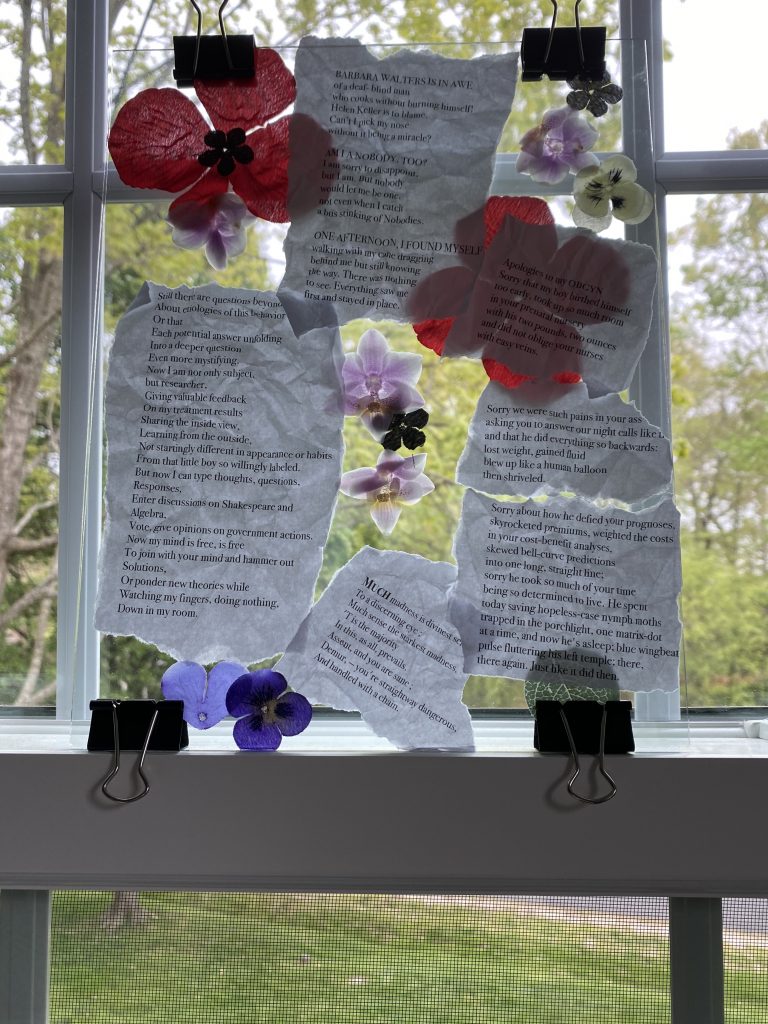
For my final project I chose to do a visual art piece. The physicality of the piece is two panes of 8×10 glass compressed together with excerpts of poetry from our class, along with both fabric and real flowers in between said pieces of glass. The compression on the glass is caused by the symmetrical placing four of heavy-duty binder clips against the glass.

The metaphorical ideas behind the creation of this piece stem from the ideas of preservation. By using excerpts from the following poems; Rebecca Foust’s “Apologies to my OBGYN,” Craig Romkema’s “Perspectives,” John Lee Clark’s, “Deaf Blind: Three Squared Cinquain,” and Emily Dickinson’s “Much Madness is divinest Sense,” the viewer sees art created by disabled authors, who are often forgotten in art. Whether it be the art of a disabled person being invalidated, or straight up destroyed due to living in a violently ableist society, the reality is that nondisabled people choose to overlook the art created by disabled artists. However, while there is an unmeasurable amount of art that has been lost due to ableism, the art that remains is preserved eternally. Placing the poem excerpts between two panes of glass ensures the security of not being tossed aside. This metaphor of fighting for visibility is continued with the intentional strain that has been placed on the paper the poems are on. An ableist society is one that attempts to crumple up the art made by disabled people and throw it aside, because they do not value it with the same weight as their own art.

The ugly truth is that nondisabled individuals do not want to hear about the personal experience of those with disabilities. Often when a disabled person is recounting their own personal struggled, nondisabled peers will berate them for complaining or whining, implying that talking about these ableist interactions in life are the fault of the disabled person, not the oppressive structure society has been founded on. On the other side of this doubled edged sword, if a disabled person views their disability in a positive light, they are also berated by nondisabled people who push the ideas that anyone who is not inside their definition of normal needs to be “fixed” or “cured.” The use of the flowers in this piece coincide with the wishes of the Disabled Rights Movement, where flowers are seen as beautiful, disabled individuals should not automatically be considered worthless or seen as eyesores to the greater idea of humanity as a whole. The use white and blue pansies, alongside the red rose petals stand for the beauty of each individual. However, the inclusion of the pink and yellow orchids calls attention to the issue of death against disabled people. This applies specifically to Foust’s poem, where she recounts the neglect her son faced from medical professionals who deemed her son not worth the effort to keep alive, unfortunately a common prejudice held by doctors and nurses alike.

Preserving the art made by disabled individuals, and by extension the disabled community, is a key factor in creating a society that will not overflow with ableist prejudices. Nondisabled people need to learn empathy for those who do not fall into their rigid categories of normal; exposure to art made from every point of view is the best way to teach others to care about humanity as a whole, not just those within their line of sight.

I pledge.

Word count: 569

Tale as old as Time

Kevin sighed as he looked at the report card which had been handed to him earlier that afternoon before he left school. Though it was only the end of the second quarter, he had already amassed two report cards this year which showed him continuing to fall behind many of his classmates. Indeed, the average was three and a half weeks late for assignments now, and several classmates had been ridiculing him for being lazy and stupid if he could not keep up with his peers. Yet, he could take that, but not what he knew he would have to face at home. For facing his parents was the biggest challenge of them all.

His parents, Greg and Judith, both loved Kevin greatly, yet they also placed great emphasis on him to do his work as they believed that he could achieve more greatness if he only tried a bit harder. Ever since he had been a young child, they knew he was bright and gifted, but he never put it to good use academically.

You see, whenever Kevin would be given an assignment by one of his teachers, be it back in Elementary school or even now in Middle school, he would hide it from his parents and ignore the problem, wanting to do things such as watch TV or play video games. During classes, he would simply glance at the clock or be so bored, that he would daydream about other matters which would be apparent to his teachers when they would call upon him to answer a question, and Kevin would behave like a deer caught in the headlights, struggling to come up with an answer as he hadn’t been paying attention. For in-class assignments, he would either not hand them in straight away, or else he would just write gibberish on a piece of paper and turn that in, which also frustrated his teachers.

Yet, whenever his parents would take him for testing as a child to see if he had a disability, the tests always had come back normal, with the person administering the test telling them that their son was extremely bright.  It was frustrating thus for his parents because they would then have to go into parent-teacher conferences and try to argue that he wasn’t in need of special education, something many teachers had argued he needed to be placed in, and so people would assume that he was simply just lazy and would be lazy for the rest of his life, completely disinterested in things around him which didn’t appeal to him.

Opening the envelope, Kevin took out the folded piece of paper and looked at it. As he suspected, it listed over and over that he had missed deadlines for assignments and was struggling in each of his classes. He knew all too well what the outcome would be when his parents saw the repot card. No TV or video games until he had caught up and shown improvement in each course. A punishment he felt was worse than death. Thus, he dreaded going home. He was tempted to just throw out the report card, yet that wouldn’t be helpful as he already had tried that sort of stunt as  a child and it had backfired when he overlooked that his parents would simply contact the school if they hadn’t received the report card after a certain length of time.

As he made his way home, albeit going a very long way around instead of his usual direct path, Kevin came across one of his classmates named Sean. Like himself, Sean was a bit of a loner with their classmates, although in Sean’s case, it was due mostly to being bound to a wheelchair as a result of a minor case of spinal bifuda which  he was suffered his entire life. He was still a nice person to talk to, but many of their classmates sadly shunned Sean due to his physical impairment and would ridicule hm behind his back for needing a wheelchair to get around. Kevin had not really talked much to Sean outside of classes, so he really did not know him that well, and yet on this somewhat fateful day, that was all about to change.

He really did not have a need to go and talk to him, and yet something inside of Kevin pushed him forward. To this day, he never understood what it was that actually made him walk over, yet if one were to ask Kevin, he was certainly glad that it was allowing him to avoid arriving home sooner than he wanted. Especially given that he was still unsure as to what he would do with the report card to lessen the blow. And although they were ridiculed by their classmates for different things, it seemed something that they might possibly be able to connect of as fellow human beings, let alone classmates.

Sean was busy reading a book titled ‘How the Cobbers Started’ when Kevin approached him. A book all about the Concordia College in Minnesota and its athletics program.

“Hey” Kevin said nonchalantly as he walked up to Sean.

Sean glanced up from his book and saw Kevin, before putting on a cheerful smile. “Hey there. How did you do on your report card” he asked. It wasn’t as a stab at Kevin like it would be taken from other students who wanted to use it as fuel to proclaim Kevin as stupid, but rather just a genuine question of interest. However, because of how their classmates would ridicule him, Kevin at first was somewhat wary of the question and partially took it the wrong way, shoving the report card into his jacket pocket as a defense.

“Meh, I can’t complain about it. Not the best report card I have ever had, although not the worst either.”

While this was certainly true, as the worst had been in the fifth grade when Kevin had been forced to repeat the year as a result of not having met the requirements to move on to the sixth grade on his first attempt. That had been a punch in the gut which he had not wanted, but which at this point, he felt had probably been for the best.

“I hear ya,” Sean replied. “It’s been a weird quarter at school.”

“What’s that you’re reading” Kevin asked, interested more as he did not recognize the image on the front cover of the book, which was apparently of a college corn cob mascot.

“Oh, this? Well, my parents want me to start thinking of my future now, even if we are only in the seventh grade, and so they want me to start looking at colleges for my future. So, I was looking through this book to see what the life is like at Concordia College in Minnesota. Their sports mascot is an angry ear of corn named Kernel, and they have several programs which might work out for me. But still, it is early days really as we’re not even in high school yet.”

“Do you think that I have what it takes to go to college,” Kevin asked. He wasn’t sure what he wanted to do this weekend outside of TV and video games, let alone what he wanted to do after high school was over. That was way too far out, but it was still something to ponder, he supposed.

“That depends. Do you want to go to college?”

Sean’s question brought up a great point in Kevin’s mind. Why worry about the future, instead of just living in the here and now, was how Kevin perceived it, even if that wasn’t what Sean had asked.

“I don’t know really. I honestly haven’t thought about it much at all. I know that as a child, my parents started pushing me, saying that I needed to go to university to have a good paying job. But, in all honesty, I just don’t know what I would want to do. I mean, it’s not like you can make a living simply watching television or playing video games.”

“Is that what you do in your spare time away from school?”

“Yeah, although my mom keeps nagging me to get off the TV and focus more on my schoolwork. She insists that I have a limit of 30 minutes a day for one or the other, and that I need to do my work.”

“Why don’t you do your work though? In class, you always seem dazed and completely out of it.”

“I don’t know. I just find the classes to be boring and not entertaining to me. I just want to be able to do my own thing, and not have to be stuck doing what others want me to do in such a prison-like environment, I guess. Especially as I hate being stuck in those rooms with teachers who just want to lecture in their usual monotone-like voices as if just saying something without any interaction is going to help the students.”

Sean chuckled.

“What?”

“No, no. It’s nothing. Please, continue.”

Kevin shrugged, and continued his spiel. “Another thing is how I’m sure that the clocks in schools are deliberately designed to slow down in the last 5 minutes of class, so that those few minutes become an eternity in and of themselves. It’s agonizing to watch the clock and be wishing that the bell would ring already so that I can get out of that room, even if it is only to be tortured by going to another classroom during the day.”

Sean burst out laughing at that confession regarding the clocks in school. “As they say, a watched pot never boils.”

As they continued to chat, the sun began to wane off in the distance, and Frank had completely forgotten about his own dilemma regarding the report card with his parents. When it came time to head home for real, he waved goodbye to Sean, who himself started wheeling home, and turned to head back, his report card still in his jacket pocket where he had placed it earlier.

Upon arriving home after dark, Kevin took off his jacket and shoes before hearing his mother call out to him from the kitchen.

“Kevin? Is that you?”

“Yeah, sorry. I was chatting with a classmate after school and lost track of the time.” Which was completely true, although not the entire truth at that.

“Well, come into the kitchen as your father and I would like to talk to you about something.”

Oh boy,’ he thought to himself. ‘Here we go.’

Trudging into the kitchen, but without his report card, which was still in his jacket pocket, Kevin sat down with a somewhat dejected look upon his face.

“How was your day today,” his mom asked. “And who were you chatting with? Was it a girl, by chance?”

“MOM!” Kevin went beet red Though it certainly was neither a girl, nor someone he was romantically interested in, it was simply the notion that his own mother would jump the gun and assume that it was a girl he liked. While there was a girl in the class whom he did fancy, it wasn’t Haylee whom he’d been talking to, although he was certain that Haylee wasn’t interested in him due to how most of the class treated him for his lack of participation in school.

“Sorry sweetie. It’s just that you are at that age where boys really start liking girls, and I was just wondering if that was the case.”

“No, it was Sean. We just ended up chatting about random stuff near the bus terminal, and lost track of time as a result.”

“Anything in particular you talked about?” his father asked.

“Uh, well, he was looking over information for a college in Minnesota, which I found surprising that for someone in the seventh grade, he would already be thinking well into his future like that.”

“That’s great. It shows real commitment to his own future.” His mom Judith said before patting her son’s hand. “Listen, Kevin. Your father and I have been talking, and we’ve decided to have you go through a new round of testing.”

Kevin’s eyes rolled in annoyance at the idea of having to undergo yet more testing by a specialist, given all the tests he had previously had, all of which turned out negative for intellectual disabilities.

“Now, don’t roll your eyes. We’re doing this for your own good. After all, we want what is best for you. It’s been quite a while since you were last tested, and although those all came back to say that you were completely bright, as I’ve always insisted that you are, newer tests have come out which may help shed some light on what your situation truly is. Don’t you want to be able to find out what it is that’s holding you back from getting your homework and in-class assignments done on time?”

Kevin thought for a moment about what his mom had just said. “What if the results all come back the same as they had before?”

“Then we’ll cross that bridge when we come to it.”

There was a brief pause, during which Kevin thought deeply about the whole situation. “Alright, fine. I’ll do it.” Though partly it was the thought that he would be able to get out of school in order to do said testing, that made him more accepting of the idea of getting tested.

“Oh, I almost forgot,” his mom then added. “Where’s your report card?”

There was a painful groan by Kevin before he got up and made his way back into the hallway to grab it from his jacket which was hanging up in the closet. Upon returning to the kitchen, he handed the report card to his mom who looked over it, before handing it to his father.

“Well, hopefully after getting this testing, we’ll be able to see you get away from such abysmal grades as these are,” his dad said, all while biting his lower lip in frustration.

*****

A couple of months later, while Kevin certainly hadn’t improved his grades in readiness for the next quarter’s report card, he sat in preparation for the meeting between himself, his mother, and the child psychologist who had carried out the testing, Dr. Roubache.

“Well now Kevin, I have some good news for you based upon what we have looked over with both your schoolwork and your testing with me over the past couple of months. Not only are you truly bright, but I understand what has been causing you to be feeling spaced out in the classroom. You see, while you had previously been tested for Attention Deficit Disorder, up until recently we only had a diagnosis for the condition with the hyperactivity aspect, which you don’t possess. It wasn’t thought that a person could have the condition without being hyperactive. So, while you met all the other markers even as a child, it was that one thing which has unfortunately become a barrier for you over all these years. Now that the field has a broader understanding and has determined that it is possible to have Attention Deficit Disorder without the hyperactivity, and based on my observations and the testing which was carried out, it would certainly be a perfect match to what you have been experiencing.”

A part of Kevin felt better at knowing how they finally had something of an answer, even if another part of him worried about what it would mean for him going forward.

“The most important thing to keep in mind, is that this isn’t your fault, and that you don’t need to be placed in a special education program. Instead, I’m going to refer you to a doctor who can run a few additional tests in order to determine what medications and strengths can be used to  help raise your concentration levels and thus fix this matter once and for all.”

“Wait! You mean to say that there’s a magic pill that can make me smarter than all of my classmates?”

“Now, I didn’t say that. All I said is that there are medications out there which can help people such as yourself, to overcome the obstacles which are distracting them and allowing them to go on impulse throughout their daily lives. But as far as which one, if any, will be prescribed to you, I cannot say myself. It could be a stimulant such as Ritalin, or Adderall, for example. But that will have to be determined by the medical doctor, Dr. Corazon.”

“Isn’t that wonderful news, Kevin? We finally have answers to help you going forward,” his mom said with some relief in her own voice. All those years of having to insist to his teachers that he truly is a bright student, and now she felt vindicated on his behalf for the past.

I pledge…

Richard Yeomans.

Word Count: 2827.

**********

Word Count for Write-up: 453

Project Write-up

For my Major Project assignment, I actually partially referenced my own past in the story with regards to it having been the seventh grade that I was diagnosed with Attention Deficit Disorder after years of testing at the bequest of schools who would then be notified that I was too bright for the Special Education classes which they’d been trying to push me into. I also took reference from both John Steinbeck’s Of Mice and Men with how Lennie and George interacted, as Kevin has times where his internal mentality struggles between the two sides of a coin. The Lennie side of his mind (which drew on impulse), would try to do things such as hiding his homework to avoid doing it instead of playing video games or watching television, and George’s more logical side of the mind having to rein in such impulsivity to remind him of what happened the previous time he’d tried that. It also refers to Collin Craven from Frances Hodgson Burnett’s The Secret Garden for the character of Sean who is trapped in a wheelchair (although in Sean’s case it was the result of spinal bifuda). Both Kevin and Sean are ostracized by their classmates for their perceived weaknesses.

I began with a rough layout after setting a character spreadsheet of who would be included, and then a general idea of the plot. Once that was completed, I then started on the rough draft of the story, typing it out before proofreading (I used the “Read Aloud” script reader on Microsoft Word to do this so as to remain impartial) and editing to see what worked and what needed to be tweaked/dropped. After that, I then retyped the final version for everyone’s enjoyment.

I enjoyed working on Kevin, because it gave me a chance to look at things from my past through not just the eyes of my own self, but from the eyes of others who had experienced it at the time, with even seeing the old reports from the school board in regards to my testing as a young child when the teachers would be pushing for me to be put in Special Education because they felt that they couldn’t handle me due to issues like frequent daydreaming and not wanting to do assignments (and the Special Education teacher at my most notable Elementary school hated her job and would sadly talk down about her students in front of the regular students all the time (frequently saying that her students were the “stupid kids of the school”)). And as there is always more than one lens to look at an issue through, it was certainly beneficial for me healing some of the wounds of the past.

I pledge…

Richard Yeomans.
css.php