Major Paper Project, Tara Platenkamp: The Comparative Mythology of Mental Illness and Curses

Toni Morrison’s work often features myths and mythologization as a theme. While there are several instances of allusion and parallels to Classical mythology in Sula, I was struck by the similarities that can be drawn between the treatment of “madness” (or, realistically, mental illness) and curses. Historically, mental illness has often been treated as a kind of moral failing on the part of the person afflicted, making them dangerous to even associate with, as one does not want to find themselves similarly disposed. There is also significant evidence that many psychiatric disorders have a genetic component, allowing them to run through family’s generationally, similar to many mythological curses. The purpose of assigning a moral valuation to people with mental illness and equating it with a curse is twofold: on the one hand, presenting mental illness as a result of tampering with forces outside of one’s control and subsequently being punished by a higher power functions as a very effective scare tactic in regards to keeping people in line with societal norms. On the other hand, it serves to isolate them from society by presenting them not as a victim, but rather as a perpetrator, and instigator, and someone undeserving of sympathy.

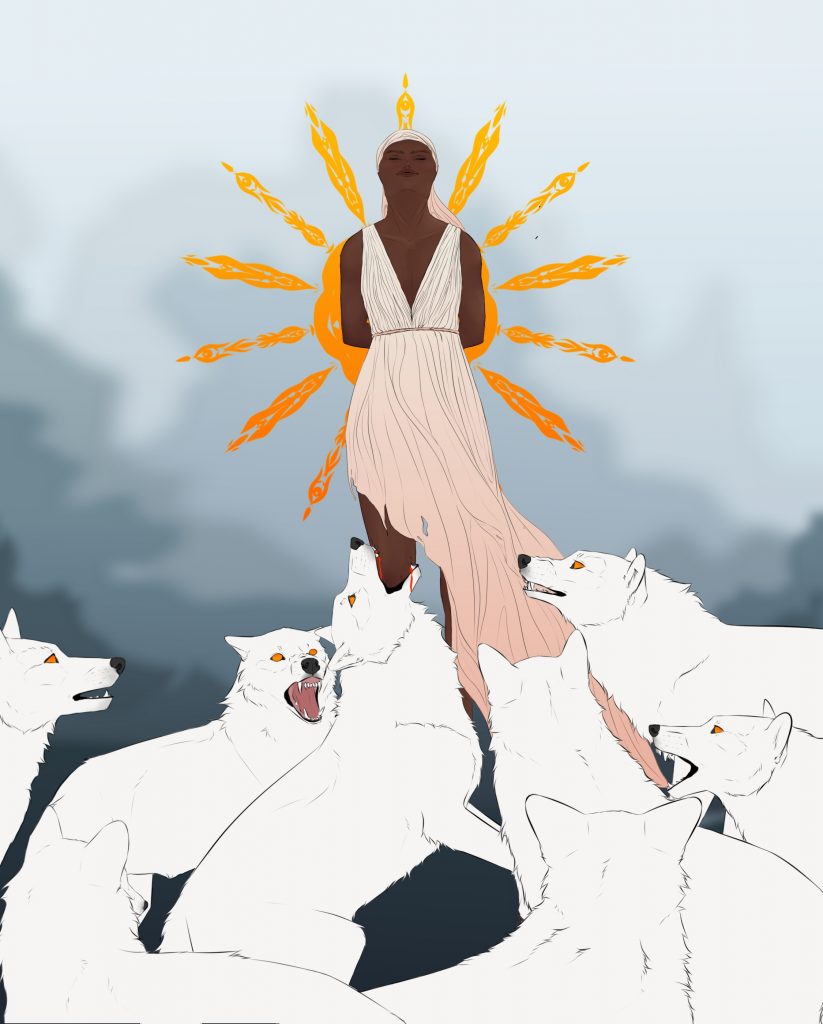
            Of all the curses in Classical mythology to choose from—because the Greeks were viciously bloodthirsty, and very fond of punishment—the one I thought most reminiscent of Eva Peace was the tale of Lycaon, the twisted King of Arcadia who tested the god Zeus and paid dearly for it. Lycaon, in an attempt to trick Zeus, tried to feed the god King the entrails of Lycaon’s own son, Nyctimus, to see if the god was truly omniscient; the end result was, of course, that Zeus recognized the treachery, and as a punishment turned Lycaon and all his children aside from poor Nyctimus into wolves. Eva Peace, the matriarch of the Peace family with a questionable understanding of ethics, is similar in many ways to Lycaon. She falls under a similar role of a person who, while powerful in their own right, does not possess the grand influence that they perhaps believe they do. In the end, both Eva and Lycaon are the victims of their decisions in life, with Eva being left in a nursing home, and Lycaon roaming the wilderness in Greece. She also, like Lycaon, makes multiple sacrifices by way of the flesh, both her own and her son Plum’s, as well as possibly her daughter Hannah’s. While not all of her actions were bad, Eva’s influence deeply affected the lives of her children and grandchildren, and the general misfortune and mediocrity they find in life can, in many ways, be attributed to Eva. She is the first of the ravening wolves, but no one who is under her influence escapes entirely unscathed. While Eva is never explicitly described as being mentally ill in the novel, Sula doesn’t scrimp on showing her as someone with delusions of grandeur (subconsciously placing herself as a God-like figure in the Bottom community), as well as someone fully capable setting her own son on fire and murdering him in cold blood while fully believing it to be the right thing to do.

            In my art, I wanted to present the vision of Eva, torn between two sides; her internal vision of herself as a divine figure, and the monstrous external consequences of her actions. I also wanted to tie in the myth of Lycaon in a rather obvious way. The end goal was to encompass the parallels between mythology, curses, mental health, and Eva’s own story in a way that expresses not only the violence, but also the underlying tragedy and sense of ruination that Eva brings nipping at her heels.

Word Count: 621

Sources:

Ovid, and Rolfe Humphries. Ovid: Metamorphoses. Indiana University Press, 1971.

Hergenhahn, B. R., and Tracy B. Henley. An Introduction to the History of Psychology. Cengage Learning, 2019.

Donaldson, Elizabeth J. Literatures of Madness: Disability Studies and Mental Health. Palgrave Macmillan, 2018.

Erin Smith’s Response to The Yellow Wallpaper

The Yellow Wallpaper is a short story written by Charlotte Perkins Gilman about a woman with an unknown illness. She moves to a summer home with her husband, a physician who believes there is nothing wrong with her, where she is kept in a spacious room without much company besides her husband. She despises the peeling yellow wallpaper in the room, and during an episode she believes there is a woman trapped behind it and tears the rest of it off the wall. At the end of the story, she believes she has become the woman trapped, and her husband faints when he sees her scurrying around the room.

I’ve read this story before in high school and my class took the feminist approach at that time. My first thought after reading this story for this class was how much it reflected the treatment of mentally ill for years, especially women with mental illness. Just like the narrator, their issues were never taken seriously and it was often diagnosed as “female hysteria” which I think we all know is utter nonsense by today’s standards. Even her simple request to take down the wallpaper that bothers her a great deal is denied, her husband insisting that she was “letting it get the better of [her]” (Gilman). Not only that, but she is allowed very little to do while she is “recovering” from her illness. She cannot socialize, cannot write, and seemingly cannot leave the room with the yellow wallpaper. She is like a prisoner in her own home, and arguably the room invokes an image of a mental asylum, with the barred windows being the clearest example.

Being kept away from others only serves to worsen her condition. Humans are social, and we need to interact with more than just the same few people for long periods of time. From experience, you tend to get frustrated easier, like the narrator does with her husband. We also need stimulating activities, and the narrator says she needs it herself, “Personally, I believe that congenial work, with excitement and change, would do me good” (Gilman). She is not even allowed to write while she’s “recovering,” a basic human activity. Mentally ill people were considered unsightly and kept away from others, which often only worsened their illness like the narrator. It’s not really surprising she begins to hallucinate after who knows how long she’s been in that room, having no real activities to do. 

I also couldn’t help but think of current events while reading this short story, especially after seeing a post on social media that said something like, “Whatever you guys do, don’t read The Yellow Wallpaper right now.” I’m sure a lot of people are dealing with new issues during this quarantine (myself included; my mental health has tanked since we moved out of UMW). Cooped up in our own homes, unable to go out and interact with people besides our immediate family, not much to do besides complete school work, watch TV, and/or play some kind of game. “Stir crazy” is what a lot of people are experiencing, although for others there may be hidden issues that they never experienced before because they were stimulated and properly socialized. It may be a reach on my part, but I see a bit of a connection between the story and current events as well as how mentally ill people have been treated in the past.

Word count: 575

I Pledge, Erin Smith

Rachel’s Analysis of Joy Harjo’s The Woman Hanging From the Thirteenth Floor Window and Harper Lee’s To Kill a Mockingbird

In class, we have been talking a lot about the types of disabilities. A conversation has begun about what is considered a disability and the different definitions and models of disability. I have learned about certain illness/disorders that are considered by many to be a disability or disabling that I have never thought of in this context, such as addiction and/or drug abuse, age, etc. Another interesting topic of discussion is invisible disabilities. An invisible disability is a disability which is not immediately apparent to the outside world, and an example of this is mental illness.  

In Joy Harjo’s The Woman Hanging from the Thirteenth Floor Window, the woman being described is not described as having a physical disability. This character is described as having a mind which differs from what society has deemed the normal way of functioning. She “hears voices… [which] come to her in the night when the lights have gone dim” (Harjo). These voices are implied to be auditory hallucinations, but she also hears the voices of the people outside her window. These auditory hallucinations can be caused by any number of things, but in addition to these hallucinations, the woman also seems to be suffering from depression. 

The woman in the window seems to be in a similar situation as some characters from Harper Lee’s To Kill a Mockingbird. Mrs. DuBose, along with some physical disability which causes her to have a mobility impairment, suffers from morphine addiction. Mr. Raymond also seems to have an addiction to alcohol (though we learn later that this is all an act to excuse his behavior). As discussed in our class, addiction is often considered a disability due to the individual having no control over their addiction and the disabling side effects. 

In both of these works, an individual is described as having a disability which is not physical, but mental. It is interesting to look at the ways the characters are described. The general tone of the descriptions is different in each work. In Harper Lee’s novel, the characters who are suffering with their mental health issues are not very good characters. Mrs. DuBose is a mean old woman who throws around insults and is just generally crotchety, and Mr. Raymond, while not actually a drunk, still is representative of the connection between alcohol/drug addiction and ‘bad’ behavior. The representation is all around negative.  

In Harjo’s piece about the woman hanging from the window, the tone is definitely a little bit depressing, but overall is not being judgmental and negative. There is a sense of hope at the end, where Harjo writes “as she falls from the 13th floor window on the east side of Chicago, or as she climbs back up to claim herself again” (Harjo). The woman is not with certainty doomed to fall to the ground. She is not set to meet the same fate as Mrs. Dubose, who would inevitably die regardless of whether or not she kicked her addiction, or as Mr. Raymond would spend the rest of his life pretending to be an alcoholic and acting the part. This woman was a daughter, a mother, a wife, and many other things other than just someone suffering. I think an even closer look at these characters would be a good idea. 

Word Count- 548 

I pledge 

Nondisabled Demands and Mental Illnesses

“Nondisabled Demands” reminded me of how mental illnesses, much like disabilities in general, can be turned into a “situation” in which the tables are turned: the disabled person is no longer valid for their feelings, and they’d be better of they if just got out with it. Spill your heart on the table – everything that makes you, you – otherwise, you are hurting the people who are “trying” to help you.

Sometimes people aren’t ready. Sometimes, the right people aren’t coming to you, or they’re coming at you from a completely wrong angle. No matter the excuse of “we’re trying to help,” “I know somebody (like the uncle) who has experienced (say…) depression… We know how you feel.” It’s clumping all people with disabilities into a box and neglecting their individual experience. This negative type of intervention style is so common, and despite many persons who might try to help, the lack of understanding, frankly – nosiness, – is suffocating. People don’t owe anybody an explanation for their experiences in life.

little tiny mini munchkin blurb

css.php