Anyone with the link can view writeup:
https://docs.google.com/document/d/1Qub8FEghExeVZ5_grJttHn_4hY2LHtIc0wR0TqzmnxU/edit?usp=sharing
not just another wordpress site
Anyone with the link can view writeup:
https://docs.google.com/document/d/1Qub8FEghExeVZ5_grJttHn_4hY2LHtIc0wR0TqzmnxU/edit?usp=sharing
Word count: 530
Chapter 17 of The Secret Garden is what I consider the defining chapter of the novel’s theme of disability and its treatment of it. In the beginning scene, Mary wakes up to hear Colin crying again at night. He’s throwing a tantrum because he thinks he’s found the lump on his spine that will turn him into a hunchback like his father and he will die. Mary’s approach to calming him down is to scream right back at him, and when she looks on his back, she finds that the only lumps there are his bones sticking out. Everything is just dandy, and the nurse tells him that he’ll be able to grow up as long as he goes out and gets fresh air. He decides he’s going to go out with Mary and Dickon in the Garden, and later on the novel ends with both children, once spoiled and angry, living happily at Misselthwaite! Yay, right?
This scene’s approach to potential disability is abhorrent (in my opinion at least), but it is very telling of the author’s opinion on disability in children: kids who are supposedly disabled are only overreacting. There’s actually nothing wrong with them at all! All they need is some fresh air and good meals, and they’ll function like any other child. Maybe some love from adults in their life too, as both Mary and Colin were neglected by their parents. Mary was the first to transform and be “cured” this way. She even says so herself in the scene. She used to be like Colin until she came to Misselthwaite Manor and “got fatter.” Once she’d started going outside, eating more, and making friends with people like Dickon and Martha, she was a perfectly normal child. Now it’s Colin’s turn to be “cured” of his illness, so that he can be normal like her and not throw as many tantrums.
The movies often don’t hold true to the scene in the book. Out of the multiple I watched, the closest to the dialogue of the scene was in the 1993 adaptation, but much of it was still changed. Judging from the trailer, I doubt the 2020 adaptation will be any better. Therefore, my goal for this project was to create a more accurate portrayal of the scene (though I realized I missed a bit of dialogue after I had finished editing the video, sorry about that). I drew all the panels myself, and edited in voice acting (none of us are pros so be easy on us there), sound effects, and music for ambiance.
The Secret Garden was one of my favorite books when I was little, and I still enjoy it despite the new view I have on the novel. I wanted to keep the seemingly uplifting atmosphere the scene has when Colin discovers he’s not sick at all, despite my disagreement with what is being implied. Because despite how bad it sounds — Children aren’t disabled; they just need fresh air and food — the author still portrays it in a positive light. I wanted to keep it as accurate to the book as possible whether or not I agreed with what was being said.
I did my major project as a paper on the perception of those with disabilities, focusing on Harper Lee’s To Kill a Mockingbird. I drew on different charecters, their lives, and their backgrounds to find examples and similarities with the perception disabled individuals. I also touched on how society has a tendency to place disabilites on people who may otherwise not have one in order to make sense of who that person is.
ATypical
Disability & Literature
An Episode Review: S1, E5 “That’s my Sweatshirt”


To bring awareness to Autism, I have dedicated a review poster of the show, Atypical. A show which brings attention to the everyday life of Sam Gardner, a teenager who is on the spectrum. By talking about Sam’s symptoms, lifestyle, and the community that interacts with him, readers will get a better understanding with people with this disability. By watching this series, viewers will realize that Sam Gardner doesn’t need to be treated any differently than your friends or neighbors. I am very passionate about bringing attention to those with disabilities, and telling the world that those who have disabilities do not want to be fixed by anyone that they encounter.
The main character of this television series, Atypical, stars a high schooler on the Autism spectrum. Autism defined is a “developmental disability that affects an individual’s ability to communicate and the ability to engage in social interaction” (2). Sam Gardner is 18 years old, and is eager to explore newer things while he grows to be more mature. Sam works at a technology store called “Techtropolis” with his best friend, Zahid, and enjoys listening to Zahid’s stories about girls. Listening to these anecdotes, Sam brings up to his therapist (in previous episodes) on how he would get a girlfriend. In this episode, Sam gets a girlfriend that he so much wanted.. However, he gets seriously frustrated when his new girlfriend takes his green hoodie.
Little did Sam know, girls love having something of their man’s to feel closer to them!
Another thing viewers should know is that Sam is very passionate about Antarctica, and it’s wondrous penguins that live there! He often relates his own life to the animals that live in the Arctic. With his fascinating memory, and genuine heart, Sam is not afraid to speak his own truth whether somebody wants to hear it or not.
People with autism have different ways of learning, paying attention, and reacting to situations. Signs of autism last throughout a person’s life, so I broke this review down by titling the symptoms that Sam Gardner shows in Atypical.
In the beginning of the episode, Sam says that before he started working at Techtropolis, he learned about every detail within the store. Including the products, the store’s rules, and procedures. Sam even included in his thoughts that he had to watch what he says to customers. Like, not telling customers they smell bad when they seriously do!
A common trait that people with autism struggle with is being unemotionally blunt. While some of Sam’s bluntness can be harsh, some of it can be rather funny. Sam described his boss as “having hairy knuckles, but being very nice” (0:26). Something like noticing someone with hairy knuckles as a first impression is very unusual but comical. Oftentimes, people on the spectrum will avoid eye contact in first times of meeting. Which carries into an assumption that people like Sam are “socially awkward.” Sam often notices other particular things that most people don’t in social interactions. Which makes his character unique and fun to learn more about. Makes viewers wonder what Sam Gardner has to say about you?
After Sam’s first shift, he explains to his audience how he doesn’t enjoy new things coming into his life. But, then relates his situation to how arctic animals need to experience newness to survive (1:25). Sam is also encouraged by his therapist to explore new things as he grows up. Two of the things being a job, and getting a girlfriend.
Paige Hardaway, Sam’s girlfriend, is super controlling when it comes to being in a relationship. In this particular episode, Paige attempts to control Sam and his “arctic talk” by giving him an amount of cards. Each time Sam talks about Antarctica or animals that live there, he has to give up a card to Paige. Once he runs out, he cannot talk about the Arctic anymore. Paige manipulates the fact that Sam likes to follow rules, and feels that his factual information is annoying, and irritating to others. Sam is questioned by his mother if he likes this method or not, and Sam bluntly states that “it’s annoying, but it makes everyone happy” (6:50). Sam clearly doesn’t like when others try to fix what he is passionate about. Let alone, Sam doesn’t want anyone to mess up on his idea of order. When Paige walks into his room, she starts to fidget with every single one of his things (7:14). This irritates Sam, and causes him to do the only thing he feels that would work: locking Paige in the closet. The only way Sam knows how to express his emotions is by simply doing. Finding comical relief in this scene, Paige, oddly accepts that Sam needed to be alone. But, still, doesn’t seem to respect Sam’s personal space. While she is locked in the closet, Paige secretly takes Sam’s sweatshirt.
The following day, Paige prances up to Sam at school wearing his green hoodie. Sam immediately notices, and can’t stand the thought of somebody wearing a piece of his clothing (12:17). After Paige rambles about how cool it is to wear this sweatshirt, Sam physically leaves the conversation without an explanation. Thus, showing viewers the best way Sam can handle that situation, was to just take himself out of the problem physically (12:50).
Towards the end, Paige wonders why Sam has distanced himself from her. So, she goes to Sam’s sister, Casey, for advice. Casey bluntly tells her that she needed to lay off her brother because he didn’t eat his lunch the other day. As she continued, Casey reminded Paige that “this is what you get with Sam”, giving her brother a negative connotation (19:20). Being the protective sister she is, Casey then questions why Paige is with him in the first place.
Paige describes Sam with such positive qualities. But then, describes Sam’s way of thinking as interesting.
Casey warns Paige one last time that if she leaves, Sam will be more hurt than anyone else. People with autism barely like change, so Casey assumed that it would be best if that relationship stopped (20:25). While some with autism might struggle with serious and emotional feelings. Sam certainly wants to explore that on his own. Just like no one should make those sorts of assumptions about anyone.
Sam makes that known to Casey that she was wrong for pushing Paige away, and that he is well-off (23:19). Go Sam!!
When Sam finally realizes that he wants to keep Paige around, he interrupts the French class she is currently in. Not giving one single care in the world that he is showing inappropriate behavior. Sam confesses that even though Paige can be a handful, he’d much rather have her around than not (27:40). Also, so Paige doesn’t steal anything of his, Sam kindly bought her something that would remind her of him when they are a part. At the end of his speech, Paige, being the highly emotional girl she is, proceeds to kiss Sam. But, get this! Sam doesn’t close his eyes or kiss her back (28:40). Two very common reactions to being kissed by someone. Not Sam! Which makes this scene hilarious but also letting the viewers know that Sam doesn’t really appreciate affection unless he asks for it. And you can tell, he’s totally not into it!
Sam Gardner is a bright, honest, and courageous man. He isn’t afraid to tell people what he thinks of them, and stands up for himself when he feels that he isn’t being treated equally. While his family is protective of him, Sam shows that he is bold enough to explore the unknown; mostly Paige and that handful.
By reading this review, readers will entail: the signs and symptoms of those with autism, how others feel that they have to treat those with autism, and how assumptions should not be made.
Just like anyone, no one wants to be treated any differently than your friend or neighbor.
Season 1-3 are streaming on Netflix.
500 Word Write Up –
Atypical Episode Review: “That’s my sweatshirt”
I am a sucker for a good Netflix binge, and I also love reading into T.V. and movie reviews. So when I was brainstorming for project ideas, I thought what could be better than doing a review on not only one of my favorite Netflix shows, but a show that supported the awareness of people with autism. I am also a staff writer and editor for the Blue & Gray Press. So I felt that I had the skills to bring this T.V. poster to life with my journalism background.
Sam Gardner, which is the main character of the series, is on the Autism spectrum. Sam is an 18 year-old, going through everyday life as a high schooler. Of course, he finds himself in drama with his girlfriend, Paige. Along with some other troubles, like defending himself with the help of his sister, and the affair in his family. Sam is super independent, and can tell you the hard truth without even asking for it! I admire Sam’s character because of his eagerness and heart for others and of course, his love for penguins! He is brilliant in the ways he can recall any fact about Antarctica, and it’s arctic animals.
My process for this project was to find a layout that was easily presentable and with a big image. I found a poster layout on Google Docs, that presents a picture, along with titles that provided sections of the poster. Making this review pretty, and organized will attract readers and interest into watching the series. I also decided instead of focusing on the entire show, I chose an episode from season one that showed a lot on what I wanted to focus on: Sam’s signs and symptoms with autism (within this particular episode). Stating these signs and symptoms can bring attention to those who don’t know what people with autism struggle with. It’s important that disability studies should be known, and what better way to learn than to watch a fictional, fun and informational series? I also wanted to include in my review how others talk and approach a person with a disability like autism. In this particular episode: how Paige and Casey (Sam’s sister) talk about Sam.
In “That’s my Sweatshirt”, Sam’s girlfriend, Paige, doesn’t respect Sam’s personal space at home. Sam locks Paige in his closet for punishment, because he claimed that he didn’t like others in his “den”. He uses the word, ‘den’, to relate himself to the animals he studies. Which I think is a fascinating thing that Sam does on a normal basis. Paige, a controlling girlfriend, creates a “game” on how much Sam can talk about his Arctic facts by giving Sam a certain amount of cards. Paige then takes them away each time he says something about the Arctic.
I felt that talking about how others feel as if they can “help fix or save” people with disabilities should be mentioned in my project. The significance and importance of my T.V. review is to reach out to people who don’t know much about autism. By watching this Netflix series, people can experience a real and raw show that will present the everyday life of a teenageer with autism. It’s important that we don’t treat people like Sam differently or feel as if we have to fix them. Instead we should treat them equally, and with kindness.
Write up – Word Count: 566
T.V. Review – Word Count: 1371
“I hereby declare upon my word of honor that I have neither given nor received unauthorized help on this work.”
X Tori Percherke
Citations:
“Signs and Symptoms.” Autism Society, www.autism-society.org/what-is/symptoms/.
“What Is Autism Spectrum Disorder?” Centers for Disease Control and Prevention, Centers for Disease Control and Prevention, 25 Mar. 2020, www.cdc.gov/ncbddd/autism/facts.html.
3. “That’s My Sweatshirt” Atypical, Robia Rashid, Dennis Saldua, 11 Aug. 2017, www.Netflix.com
(Picture) “Atypical.” IMDb, IMDb.com, 11 Aug. 2017, www.imdb.com/title/tt6315640/.
Technological advancements that have been presented conceptually or realistically through film, literature and media have both threatened and enlightened. Specifically, artificial intelligence, including the proposed higher level artificial general intelligence, has made an impression in these three mediums of expression. The threat of AI falsely looms over the heads of ill-informed sceptics. This outlook is not only technophobic, but could be considered speciest, a term that was used in Berys Gaut’s, “Blade Runner, Empathy and Death,” to give individuality and counsciece right to androids that have been outcast by human culture and society. Disability connects with the topic of artificial intelligence through this project because of the parallels that the disabled community shares with AI through means of being misunderstood, mistreated, and looked at from an unfamiliar and ignorant perspective because of biased viewpoints. My project attempts to intertwine disability and AI by allowing different programs to interpret what exactly disability means through the output of a non-human perspective. Current AI is likely to understand disability without sentient perspective, but this does not mean it will always need to rely completely on user input.
This project opens with my own example of code, as code is the structure that allows weak AI, and eventual strong AI to exist in the first place. It is noteworthy to also think of ourselves as coded creatures, consisting of DNA and our own form of biology that allows us to exist in the format that we do. The original requirement to structure and submit a creative novel through Python Notebook for a Creative Coding lecture required 50,000 words. Using that blueprint, this code prints out over 30 pages and strengthens Yessenia’s powerful words from Good Kings Bad Kings with an angry shade of red. The code is meant to help enforce these words, and to work alongside of Yessenia’s fight to end the abuse and unfair treatment that dictated the lives of ILLC individuals. This portion of my project could not exist without my direct input.
An academic paper titled, “Visual Dialog,” includes the work of several researchers and their proposition for a form of chatbot. This bot is capable of interacting with a human user through conversation and images that are uploaded, then processed by the AI, which is ultimately meant to act as a general test of machine learning capabilities. According to artificial intelligence researcher Janelle Shane, the Visual Chatbot is supposed to exhibit capabilities in, “image recognition, language comprehension, and spatial awareness.” “Visual Dialog” noticeably mentions that AI will be used as a tool for Blind individuals, though projects at this basic level of machine intelligence prove that the future is in dire need of a more aware and sophisticated bot. Because this bot does not understand most images that it had not already been trained with, results received on this portion of my project can be considered ignorant and even offensive. However, this does not mean that the Visual Chatbot cannot be upgraded anymore than it already has. Images such as Frankenstein and Lenny “wearing a hat” may be thought of as visually acceptable under chatbot standards, while the image of a man and a wheelchair and the female cancer patient give inadequate output to the user.
RunwayML is a creative platform that engages artists through machine learning tools. MIT Open Documentary Lab mentions that this desktop application offers three model types including, “models that identify objects and people, models that transform content, and models that generate new media from the training data.” When uploading and training your own models you are automatically faced with an option of text or image machine learning tools. For my project I decided to utilize the text platform, in which I uploaded A Christmas Carol and Frankenstein to analyze how machine learning would assess them. The quality of product that I receive depends on how many steps I train each program.
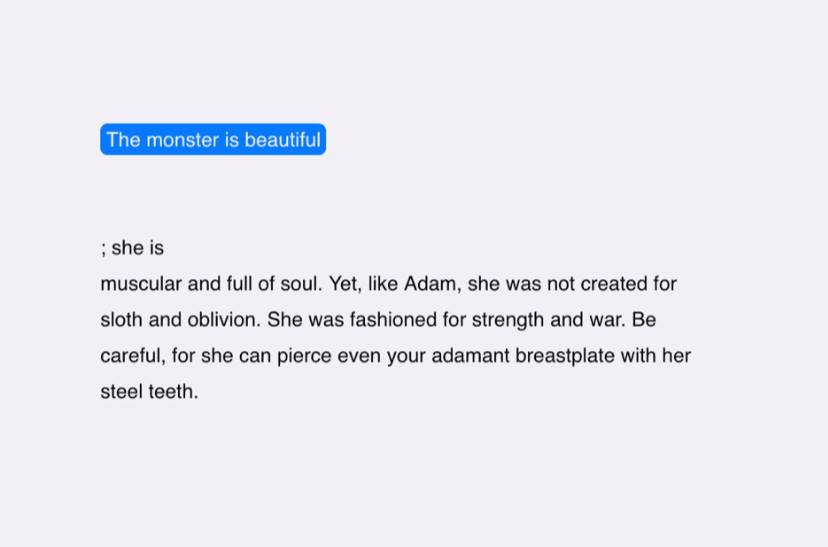
With A Christmas Carol, I uploaded the text and trained Runway on 500 steps, which relies heavily on replicating and understanding an author’s sculpture. Frankenstein also relies on interpretation, but was trained on 1,000 steps, which I like to think gives the AI more room to understand and form its own individuality over a longer period of time. I fed A Christmas Carol lines from the text and lines of my own such as, “Tiny Tim is” and received, “not Tiny Tim, but is in reality a gigantic, old man with a monstrous chin.” This output does not understand the harm of these words, and likely confused Tiny Tim with Scrooge’s likeness. The user can see a difference in giving the AI more time to process something, as I did with the text of Frankenstein. I genuinely believe that Runway understands the pain and incredible depth of Frankenstein’s character. This understanding may not belong to a (yet) conscious being, but it is important to separate our experience of life and consciousness from that of a machine, much like the AI is able to do with Frankestein’s character. The final output that Runway gave in response to, “The monster is beautiful,” managed to take my breath away. This interpretation not only belongs to a feminist perspective, but one that transends the original meaning of the text. Runway has given power to a being that was cast aside for their differences. Perhaps, Runway is embracing these differences, as one should.
The results from my project reveal the evolving stages of AI, and how with time, it can not only serve as an aid for understanding disability, but allow people with speciest and ableist mindsets to broaden their unprogressive views. What is considered “whole” “complete” and even an ignorant word in its usual context like “normal” should be redefined and inclusive to beings of all backgrounds. Disability ultimately shares a connection to artificial intelligence through misrepresentation in literature, film, and the media, as both should be valued and accepted rather than shunned by society. Artificial intelligence has a growing understanding of what disability is, and as long as it is protected and trained by open minded individuals, should prove to interpret disability through a welcoming lens of its own kind.
PYTHON NOTEBOOK | Good Kings Bad Kings (coded book)
Word Count: 1026
I Pledge: Alyssa Brown
Gina-Marie An & Rosemary Pauley
Dr. Foss
April 23, 2020
ENGL 384
Inspiration Porn and Overcoming Narratives: Objectifying Disabled Lives
Throughout the course of our semester, we have addressed many ways in which disabled people are mistreated and misrepresented. Inspiration porn and overcoming narratives are particularly common yet highly offensive acts that are harmful towards people with disabilities. Able-bodied people tend to put a cap on a disabled person’s ability and infantilize their achievements through unnecessary praise, whereas their accomplishments are only viewed through their disability and not their own strength. They are often praised for attempting rather than achieving by able-bodied people, and that can be used as fuel for nondisabled people to work harder or whatever other cliches the inspiration porn is pushing towards. The objectification of disabled people is perpetuated by the presence and normalization of inspiration porn and overcoming narratives.
The term “inspiration porn” was coined by journalist and disability rights advocate Stella Young. Inspiration porn refers to when nondisabled people use the lives and stories of disabled people to inspire them, or use them to help or better themselves in some way. Examples of this could be inspirational posters that feature a disabled person doing some great feat or simply just doing an everyday task in a different way than an able-bodied person might do as if this in itself is some extraordinary feat. Already this poses a problem in making a spectacle of how people with disabilities exist in an ableist society, but it also continues the centuries-old stereotypes and assumptions that people with disabilities are somehow different or unconventional. They emphasize the idea that existing as a disabled person is difficult and effortful enough to inspire nondisabled people to work harder and do better in whatever they are trying to achieve.
Young addressed the prominence of these viewpoints, “we’ve been sold the lie that disability is a Bad Thing, capital B, capital T. It’s a bad thing, and to live with a disability makes you exceptional. It’s not a bad thing, and it doesn’t make you exceptional” (Young 2014). Nondisabled people tend to see simply living with a disability as an achievement and use that as motivation or inspiration for themselves. Because society is inherently ableist, these assumptions about disability are widespread and widely accepted, allowing inspiration porn to be the popular and unsuspecting form of objectification that it is today. While many nondisabled people might think of these instances as a harmless way of uplifting people with disabilities or acknowledging them in a positive way, in actuality, it is condescending and belittling towards people with disabilities. Acting as if disabled people are accomplishing something incredible just by living out a normal life infantilizes and devalues them as people while also giving nondisabled people a source for inspiration porn and self-improvement.
In her TED Talk, “I’m not your inspiration, thank you very much,” Stella Young talks about her own experiences with nondisabled people expecting her to be uplifting and inspirational in every interaction with her, as if that is all that disabled people are meant to do. When explaining her use of inspiration porn, Young said, “I use the term porn deliberately, because they objectify one group of people for the benefit of another group of people.” Able-bodied people are actively objectifying disabled people by using their stories and lives for their own beneficial reasons. This practice is extremely hurtful for people with disabilities because they are not only being used to the advantage of people without disabilities, but they are also being socially separated from nondisabled people. Value is being placed on these perceived achievements or accomplishments rather than the life of the actual disabled person. These uses of inspiration porn are essentially a more subtle way of putting disabled people on display, with the unsuccessful intent of addressing disability in a positive and opportunistic way. This objectification of people with disabilities is played off as acknowledging diversity and celebrating differences instead of being treated as an unethical practice.
An acknowledgment of inspiration porn can be found in a poem by Jillian Weise that we analyzed in class. In Jillian Weise’s “Nondisabled Demands,” the extent to which nondisabled people are intrusive in getting information about disability for inspiration porn is made abundantly clear. In the last stanza, Weise writes, “We’ll rope you / to the podium and ask / What do you have? / … Then we get to say / You’re an inspiration.” The image of roping someone to a podium for the entertainment of others is a prominent example of the objectification that surrounds inspiration porn. Personal information seems to be taken against their will, leaving disabled people feeling violated and used for the benefit or entertainment of others. Nondisabled people feel a sense of entitlement to know the intimate details behind someone’s disability. That entitlement then extends to using those details for their own benefit in cases of inspiration porn, further asserting their needs and wants above those of people with disabilities.
Weise’s poem also calls attention to how inspiration porn not only uses the stories of people with disabilities but also takes those individualistic narratives away from disabled people. After nondisabled people force out the details of their disability, their worth and ability are interpreted by nondisabled people. The narratives that are supposed to belong to disabled people are manipulated into something for the benefit of nondisabled people often at the expense of the disabled person’s opinions or feelings. When Weise notes in her last stanza that nondisabled people get to make the choice of labeling someone as an inspiration, they are also making a choice about what meaning is carried by their story rather than letting the disabled person have control of their own narrative. Inspiration porn objectifies people with disabilities by taking this control away from disabled people.
Inspiration porn coincides with the issue and notion of overcoming one’s own disability, often referred to as an “overcoming narrative.” This overcoming narrative addresses the abled perspective and how abled people push their own ideas of disability onto the disabled to insinuate what their disability is supposed to look like, how they are supposed to function, and what the limits to their disability are. Perceiving a disabled person’s existence as overcoming their disability often acts as fuel for the inspiration porn, as well as continues the viewpoint that disabilities must be overcome or removed in the first place.
Jessica Cox, the first world’s licensed and armless pilot, says in her TED Talk, “I grew up in a world built for someone with arms and it has taught me that pity prevents progress.” She describes her perseverance and lack of self-pity that enabled her to achieve far beyond what this world built for arms expected of her. She begins the TED Talk by describing a challenge she once had as a child: to tie her shoes. She sits down and begins to tie the laces with her feet, then as she finishes the last loop and secures the bow tie, the crowd roars into a cheer. However, when she stands up, she expresses, “I want you to look at me again and understand that I am not different.” Simi Linton, in “Reassigning Meanings,” describes the perpetuation of disabled persons and the ways in which even the meaningfulness of disabled lives are dictated by abled perspective and their preliminary understanding of disability. Simi Linton’s description of “nice words” can be shown through the crowd cheering for Jessica Cox. The language of cheer and appraisal, though wordless, exemplifies a crowd that may have viewed her disability as less capable and showcases their happiness or astonishment that she was able to do it otherwise. Nice words, or nice language, can reassign meaning to protect their own egos as a defense mechanism, therefore they will immediately praise the disabled person in order to stifle their prior feelings of doubt and disbelief. Jessica Cox’s quote emphasizes the simple want to be seen, to be seen as human and as equal, and not as a unique and extraordinary case to be idealized and inspired by, simply because of her disability.
Our abled society expects Jessica Cox to be passive, unable to claim an identity outside of their disability. However, Jessica Cox is arguing a similar shift in perspective. Simi Linton argues a change of thinking, a shift in the way we look at disabled persons and assume their social inferiority. Jessica Cox shows this by describing how she was treated and objected to pity. Her disability is treated as a hindrance or something to be ashamed of, until she “surprisingly” overcomes it despite societal expectations. This ableist perspective places value on her for “overcoming” the challenges she faced in their ableist society, making her an inspiration and something to behold.
In Kafer’s “Imagined Futures,” Kafer emphasizes the assumptions of disabled success, and that disabled success is misguided and abled success is simply not for disabled people. It was seen that her lack of arms was a “symbol of undesired futures.” Or rather, that her success was impossible and unexpected. Disabled person’s interaction with the world is seen as useless and even dangerous to the ableist structure that so many nondisabled people exist comfortably in. For example, Cox describes how she is told over and over that she cannot do something, that it is not for her. Cox expressed that this constant denial of participation made her want to prove them wrong. “People with disabilities usually realize that they must learn to live with their disability… The challenge is not to adapt their disability into an extraordinary power or an alternative image of ability. The challenge is to function” (Siebers, 180). It’s important to understand that Cox did not adapt to her disability, her real adaptation was to the people around her who did not have any hope for her. Instead of overcoming a disability like so many able-bodied people interpreted her to be doing, she overcame the confines of the ableist society that was manipulating the way she was to be seen and treated.
Addressing these issues and making an adjustment on the way we view disabled lives can help us better understand and respond better to insensitive behavior and make inspiration porn and objectification a known, inappropriate act. Recognition of this behavior can help dampen the misrepresentation and mistreatment disabled people go through. While disabled people can be and are inspiring, and they absolutely do overcome tough obstacles, it is not fair to objectify their lives and treat them as though they are inferior. They are more than their disability, more than “less than,” and should be given the same choices and opportunities as everyone else.
Word Count: 1766
I pledge. Rosemary Pauley and Gina-Marie An
Works Cited
Kafer, Alison. “Introduction; Imagined Futures.” Feminist, Queer, Crip, Amsterdam University Press, 2013, pp. 1–24.
Linton, Simi. “Reassigning Meaning.” Claiming Disability, Amsterdam University Press, 1998, pp. 8–33.
Siebers, Tobin. Disability in Theory: From Social Constructionism to the New Realism of the Body, American Literary History, Volume 13, Issue 4, Winter 2001, pp. 737–754, https://doi.org/10.1093/alh/13.4.737
TEDx Talks. “World’s First Certified Armless Pilot: Jessica Cox at TEDxSouthCapitolSt.” YouTube, uploaded by TEDx Talks, 4 Oct. 2013, www.youtube.com/watch?v=31e_xTZHrqE.
Weise, J. (2018). Nondisabled Demands. Originally published in Poem-A-Day on March 9, 2018, by the Academy of American Poets
Young, Stella. “I’m Not Your Inspiration, Thank You Very Much.” TED Talks, uploaded by TEDx, Apr. 2014, www.ted.com/talks/stella_young_i_m_not_your_inspiration_thank_you_very_much?language=en.
Invisible Disability, Invisible Identity
Invisible disability is not automatically apparent to our eyes. This can include physical and mental conditions such as PTSD, anxiety, depression, chronic pain, and even vision or hearing impairments. So much of how we understand disability is rooted in its visibility. We tend to base our ideas of a person and their capabilities first on their appearance. It is important to understand how the invisible disability is socially constructed, which then allows for conversation about the problems surrounding this identity. Using queer studies as a model, it is easy to draw parallels to better understand how the invisibly disabled identity functions, and a lot of times, why people do not claim it. So often, ideas of “normalcy” and the need for “proof” plague our understanding of what it is to be a disabled mind or body. Through these beliefs, we create a culture that invalidates the invisibly disabled and prevents these individuals from claiming their identity.
If we see disability in general as socially constructed, we can break down how the invisibly disabled mind and body are understood in society, and thus how our ideas about these bodies/minds impact the person with the disability, specifically the individual’s identity. In Disability in Theory, Siebers states that, “social attitudes and institutions determine far greater than biological fact the representation of the body’s reality” (Siebers, 173). Thinking about this in terms of invisible disability, the social construction happening has much to do with ideas about what a “normal looking” person should be able to do. Before a person’s invisible disability is exposed, they are automatically understood as abled. He goes on to say, “the dominant ideas, attitudes, and customs of a society influence the perception of bodies” (Siebers, 174). Given we live in a society in which able-bodiedness is the default, a difference in appearance is typically an indicator that a person deviates from the norm, and consequently, that person is labeled an “other” and their identity is heavily influenced by this label. Additionally, the social attitude regarding pain and suffering plays a large role in our construction of the disabled body. Siebers writes, “the human ego does not easily accept the disabled body” (Siebers, 176). This is in part due to the belief that disability is pain, and humans are quick to reject both physical and mental or emotional pain. However, if much of an individual’s identity has to do with the pain they experience, in a society where there is an emphasis on the “cure”, to advocate such ideas is to advocate for the eradication of a large piece of this person’s identity. The attitude our society holds about pain contributes largely to the social construction of the disabled body. However, the notion that disability is pain and nothing else is harmful and inaccurate. There is so much more to the disabled identity than the amount of discomfort one feels. On the other hand, ignoring the presence of pain at all can be just as harmful when trying to understand what it is to be an invisibly disabled identity.
It is important that the hidden disability is acknowledged for its ability to cause as much pain as a physical one. In her article, Invisible Disability, Davis importantly notes, “People whose disabilities are not generally perceived by others do not, for that reason alone, find it easier to minister to themselves or to engage productively and effectively in the world without having to endure pain, discomfort, and exhaustion” (Davis, 154). It can be invalidating to the invisibly disabled identity when the pain they feel is not taken seriously simply because they do not appear disabled. In the case of mental illness, oftentimes both mental pain and physical pain are at work, as depression, anxiety, and PTSD can cause physical symptoms that lead to discomfort. To assume that an invisible or mental disability has nothing to do with the body is ignorant, as the mind and body are connected and they rely on each other to work. One cannot drive a car properly with an engine that is uncooperative, and it is no different if the mind is impairing the body from functioning. The pain that the invisibly disabled experience is just as valid as that of other disabilities, and just as central a part of their identity.
The identities of those with invisible disabilities can be understood using similar terms and experiences to ones frequently discussed in queer studies. Similar to how queer identity has to be claimed through “coming out”, the invisibly disabled must also claim their disability. Until these identities are claimed, it is assumed that the person holding them is “normal”, that is, abled. The parallel here allows us to better understand some of the issues the invisibly disabled face. Ellen Samuels discusses the connections between the disabled and queer identities in My Body, My Closet. One connection she notes is that similar to queers and queer culture, individuals with disabilities may find it hard to access crip culture (Samuels, 234). This may be especially true for the invisibly disabled, because they are not automatically seen as having a disability, so they have to go the extra mile to prove themselves as being a part of that shared experience. This “presumption of sameness” (Samuels, 236) not only alienates people from being a part of a community, but it can also create cognitive dissonance in the person with the invisible identity. That is, they are being told they are one thing by outward notions of normalcy, yet they feel a different way on the inside. The “presumption of sameness” and the cognitive dissonance that follows is something that could easily plague the mentally impaired especially, given that tangible or physical evidence of pain is little to none. To the abled eye, there is nothing stopping someone with invisible disability from carrying out everyday life, yet so many people who struggle with depression, anxiety, PTSD, and so on have a difficult time completing simple tasks. This appearance of normalcy can be alienating to the invisibly disabled person who tries to access crip culture and be a part of a larger community.
Another parallel between these studies as discussed by Samuels is the idea of “coming out.” In other words, the invisibly disabled identity must be claimed to be seen. Samuels states, “coming out refers specifically to accepting one’s ‘true’ identity and must entail identification with the political analysis of the marginalized group. In both queer and disabled contexts, however, coming out can entail a variety of meanings, acts, and commitments” (Samuels, 237). Those who choose to “come out” and claim this identity feel connected to disability or crip culture and the experiences of those who also claim the disabled identity. Coming out for the invisibly disabled can be clarifying and freeing, opening doors for shared experience and a sense of community. However, the process is different and unique for each individual who chooses to disclose their disability, and some choose to not claim this identity at all. Samuels refers to Rosemarie Garland-Thompson’s “coming out process”, in which she did not feel a connection to disability culture at first, but instead felt that her disability was a “private matter” (Samuels, 238). Additionally, Elizabeth Brewer talks about how many psychiatric survivors do not identify with the disabled identity, despite the fact that from a legal perspective, there is a connection between mental impairment and disability (Brewer, 15). Individuals may choose not to come out for the troubling reason that they find it easier to stay hidden.
Often the invisibly disabled will prefer to keep their identities hidden, rejecting the disabled identity all together: “people with hidden impairments often make an effort to avoid the perceived stigma attached to a disabled identity” (Samuels, 240). This can be seen similar to “passing” which is also prevalent in queer studies. The invisibly disabled may find it easier to pass as abled for a number of reasons. It is a personal choice, but one that should be available to those whose disabilities are not as apparent. Samuels shares the experience of Georgina Kleege, a blind teacher who is able to “pass” in certain situations:
“Because my disability is no longer readily apparent, and because it is an illness whose symptoms vary greatly from day to day, I live between the world of the disabled and the non-disabled. I am often very aware of my differences from healthy, non-disabled people, and I often feel a great need to have my differences acknowledged when they are ignored. . . . On the other hand, I am very aware of how my social, economic, and personal resources, and the fact that I can “pass” as non-disabled among strangers, allow me to live a highly assimilated life among the non-disabled” (Samuels, 240).
Kleege talks about how in some situations, she wishes to be acknowledged but she is also aware of how her ability to “pass” is beneficial in her everyday life. She does not quite resonate with the non-disabled, but she is also able to avoid stigma in certain situations and “pass” based on ideas of normalcy. The practice of passing has, “been read as a conservative form of self-representation that the subject chooses in order to assume the privileges of the dominant identity” (Siebers, 240). This can be problematic, especially if disabled individuals are choosing to pass because it is the easy thing to do, and not because they fail to relate to the identity. Choosing to claim the disabled identity as an invisibly disabled person should be that- a choice, and without the pressure that coming out will be more counterproductive than it is freeing.
It can be argued that the “presumption of sameness” that occurs when an invisibly disabled person appears normal and able is actually a positive. If there are no limitations placed on a person solely based on their appearance, that individual avoids stigma. They have more of a choice in disclosing vulnerability if they can pass where the visibly disabled cannot. However, it is possible for the opposite effect to happen, where the assumption of able-bodied can be alienating when a person who is not visibly disabled is expected to function the same way an able-bodied person does, but they cannot. Samuels points out, “Those whose disabilities are invisible may also have to convince other people that they really are disabled, not seeking some special—unfair—advantage: thus, what they must do is meet a burden of proof” (Davis, 154). This pressure to prove is a major reason why an invisibly disabled individual may not choose to claim the identity, despite feeling a part of it.
The invisible disability is socially constructed by our ideas of normalcy and the need for proof. This identity can be compared to queer identity, as they both operate on similar terms of coming out and passing, and how both have their advantages and disadvantages. Although the invisibly disabled have a choice of disclosure when it comes to sharing their disability with the world, this does not automatically mean they are in any easier of a position than those who do not have the choice. It is clear that many invisibly disabled individuals choose not to claim the identity because they feel passing as able-bodied is more beneficial to them than coming out as disabled. The culture we construct around nonvisible pain prevents those who could be a part of this shared identity but choose not to because we tell them their pain is invalid simply because they look normal.
Word count: 1997
Works Cited
Brewer, Elizabeth. “Coming out mad, coming out disabled.” Literatures of Madness. Palgrave Macmillan, Cham, 2018. 11-30.
Davis, N. Ann. “Invisible disability.” Ethics 116.1 (2005): 153-213.
Samuels, Ellen Jean. “My body, my closet: Invisible disability and the limits of coming-out discourse.” GLQ: A Journal of Lesbian and Gay Studies 9.1 (2003): 233-255.
Siebers, Tobin. “Disability in theory: From social constructionism to the new realism of the body.” American literary history 13.4 (2001): 737-754.
I pledge. Madison Moyer.
The role of disabled bodies in the Bible often illustrate contradictory messages and are portrayed in a very stereotyped manner. This paper will discuss the different representations of disability and impairment in the Bible, and also the shift in the roles of disabled bodies from the Old Testament into the New Testament to spread the teachings of Christianity. The Old Testament devalues disabled bodies and represents them as unclean and less than those with seemingly perfectly able bodies. They are used to promote charitable acts and improve the morality of able-bodied people and to act otherwise would result in punishment of an impairment or disability to the offender who in turn would not be welcomed by God. In the New Testament, while Jesus does welcome the disabled, they play a role of allowing able-bodied Christians to witness Jesus’ healing abilities and disabled people are written to need salvation.
Beginning in the Old Testament, disability and impairment are shown in the Bible through blindness, deafness, dumbness, leprosy, and paralysis with visual impairment being the most common. For those who are viewed as disabled or having a form of physical defect, they are ostracized and excluded from society and this was seen often in religious ceremonies. These ceremonies that celebrated God emphasized the societal structure and the various roles in the societal hierarchy. To be accepted as a high-ranking official in the church one must prove bodily normality (Bengtsson). Those with physical impairments or disabled bodies could never be considered to be a priest or take a leading role, and this order established clear division between able bodied people and those with disabilities and this is blatantly stated in the book of Leviticus:
The Lord said to Moses, “Say to Aaron: ‘For the generations to come none of your descendants who has a defect may come near to offer the food of his God. No man who has any defect may come near: no man who is blind or lame, disfigured or deformed; no man with a crippled foot or hand, or who is a hunchback or a dwarf, or who has any eye defect, or who has festering or running sores or damaged testicles. No descendant of Aaron the priest who has any defect is to come near to present the food offerings to the Lord. He has a defect; he must not come near to offer the food of his God. He may eat the most holy food of his God, as well as the holy food; yet because of his defect, he must not go near the curtain or approach the altar, and so desecrate my sanctuary. I am the Lord, who makes them holy (Lev. 21:16-23 NIV).
This passage clearly defines and separates the view of able-bodied people and disabled people in the eyes of God, and how he finds the most satisfaction from a perfect and normal body (Bengtsson). By allowing disabled bodied people to be that close to God it would be a blatantly disrespectful act.
In these sacrificial rituals the purpose is to bring individuals to the divine power by offering the best of their possessions to the God, so to exclude those that are disabled or have defects it exhibits they are less desirable and this is mentioned again in the book of Malachi:
When you offer blind animals for sacrifice, is that not wrong? When you sacrifice lame or diseased animals, is that not wrong? Try offering them to your governor! Would he be pleased with you? Would he accept you? Says the Lord Almighty (Mal. 1:8 NIV).
This reiterates that there is a feeling of shame surrounding any being with a disabled body or physical defect and that they should be hidden from the eyes of God. In early years of Christianity, the church believed that faith “comes from hearing the message” (Romans 10:17 NIV). This belief would leave those deaf and hard of hearing without faith and excluded from the church which is another example of the ostracism of those with disabilities that is exhibited in the Old Testament.
Alongside the narratives and stereotypes of shame and being less desirable there are contradicting messages about the treatment of disabled and impaired people in the Bible, even in the book of Leviticus where it is spoken that God should be distanced from anyone seen as disabled preaches that there should not be mistreatment of disabled people. In the previous chapter of Leviticus God states that no man should “curse the deaf or put a stumbling block in front of the blind” (Lev. 19:14 NIV). It can be argued that this is the first instance in the Bible that advocates for the protection of the disabled in society and reflects competing attitudes toward disability in the Old Testament (Braddock and Parish 4).
The book of Deuteronomy in the Old Testament stresses heavily the way able-bodied Christians in communities should act towards the “others.” The role of disabled people in their communities should be to allow able-bodied people an outlet to practice better acts of charity and learn to increase morality. They were not viewed as equal and should be pitied. “Cursed is anyone who leads the blind astray on the road” (Deut. 27:18 NIV). In instances where one does not act charitably towards disabled people, they were to be punished by God. Disability is used as a punishment towards able-bodied people and they are warned:
However, if you do not obey the Lord your God and do not carefully follow all his commands and decrees I am giving you today, all these curses will come on you and overtake you… The Lord will afflict you with madness, blindness, and confusion of the mind. (Deut. 28:15-28 NIV).
Society was to recognize their obligation to people with disabilities, while also fearing that they could be punished by God with the very same disabilities. The belief that illness was inflicted by an angry God as punishment was widespread among Christian communities (Braddock and Parish 4).
Continuing into the New Testament, although there are much fewer chapters addressing disability directly, the stigma surrounding disability is not changed but rather just narrated differently. The New Testament gospels Matthew, Mark, Luke, and John feature numerous examples of people with physical and sensory disabilities, just as the Old Testament, but now those examples only exist to highlight Jesus’ healing as a miracle worker (Gosbell 9). Their role in their communities has shifted from being an outlet for able-bodied Christians to improve their morality to providing an outlet for able-bodied Christians to see the miraculous healing of Jesus. Disabled people represent the version of humanity that needs to be restored and saved through ministry and faith. If the followers of Jesus are not deemed healthy or able-bodied, it would be because they are not doing something right.
In the book of Mark, the spread of leprosy is a concern for Christians, and it is written that Jesus has the power to heal this undesirable disease:
A man with leprosy came to him and begged him on his knees, “If you are willing, you can make me clean.”
Jesus was indignant. He reached out his hand and touched the man. “I am willing,” he said. “Be clean!” Immediately the leprosy left him and he was cleansed (Mark 1:40-44).
This representation of disability in the book of Mark perceives disease and disability as something that is in need of being saved. The removal of disability is seen as a foreshadowing of the full restoration of humanity, and to be left disabled is a “manifestation of brokenness” (Gosbell 10). The representation of disabled people as more sinful and in need of healing further illustrates that disabled people are not fully accepted in Christianity other than to accentuate the abilities of Jesus. This is exhibited again in the book of Mark when Jesus heals a blind man in Bethsaida:
They came to Bethsaida, and some people brought a blind man and begged Jesus to touch him. He took the blind man by the hand and led him outside the village. When he had spit on the man’s eyes and put his hands on him… Once more Jesus put his hands on the man’s eyes. Then his eyes were opened, his sight was restored, and he saw everything clearly (Mark 8:22-25 NIV).
There are countless examples of Jesus healing the disabled throughout the Gospels, and this is another example of the role that disabled people play in their communities and in Christianity at the time.
Unlike the Old Testament, where God turned away those with disabilities as they were not deemed worthy to be near, Jesus does welcome the disabled into his ministries and does not turn them away. Jesus states in the book of Luke that “when you give a banquet, invite the poor, the crippled, the lame, the blind, and you will be blessed” (Luke 12:12-13 NIV). The role of the disabled people in their communities change after the birth of Jesus Christ due to the fact there were changes in how Christians then practiced ministry.
In the Old Testament, disability was written as a factor of life that could not be escaped or healed and as a result disabled people were turned away from the church and left to be isolated from their communities. The meaning of disability in the Bible shifts with the introduction of the New Testament and the birth of Jesus and gives Christianity a new way to celebrate the able body it deems it perfect. Although there are consistent stereotypes present in the Bible when narrating stories of people with disabilities, the representation of disabled people throughout both Testaments illuminates the complexity of the inclusion of people with disabilities and impairments in Christianity.
Works Cited
Bengtsson, Staffan. “On the Borderline- Representations of Disability in the Old Testament.” Scandinavian Journal of Disability Research, vol. 16, no. 3, 3 Jan. 2014, doi:http://doi.org/10.1080/15017419.2013.873077.
Braddock, David L, and Susan L Parish. “An Institutional History of Disability.” Disability Studies as a Field, 2001, pp. 11–68.
Gosbell, Louise A. The Poor, the Crippled, the Blind, and the Lame: Physical and Sensory Disability in the Gospels of the New Testament. Mohr Siebeck, 2018.
Holy Bible: New International Version. Zondervan, 2017.
Stiker, Henri-Jacques. A History of Disability. Translated by W. Sayers, University of Michigan Press, 1997.
The following poems are first and foremost about my personal experiences with depression and anxiety. That’s just how they started. However, as I went through and revised them, fixing wording here and punctuation there, I found myself wanting to explore the relationship between my mental illnesses and my identity. In the past several years, since starting college, I’ve struggled a lot, trying to find the balance between Depressed Emily, Anxious Emily, and Normal Emily that felt the most true to myself.
I’ve never been one to take my own mental illnesses and romanticize them, so linking the illnesses to my love for writing poetry didn’t feel right, but it didn’t feel honest to say they play no part in the process either. What’s more, each of those versions of myself is just one facet of the whole person. I’m not me without them just the same as I’m not me just because I have them. On making those realizations this project took a new turn. Instead of focusing solely on experience, I changed my direction to explore more of the relationship between myself and my mental illness—each version of myself individually, how they all play together—as well as how they impact my relationship with the people around me, be they strangers or loved ones.
The purpose of this project isn’t to make a broad statement about disability in general—I have no right to be the sole voice, especially because my disabilities don’t extend into the physical. Instead, I want to shed some light on some of the inner workings of mental illness, specifically depression and anxiety, in order to bring the complicated nature of it all into focus. I hope that the poems I’ve written don’t come across as romanticizing in any way, nor do I hope they belittle. Instead, I hope when you read you find them authentic and real, showing many different facets of what it means to be human.
Hindsight
I want to tell you about the good things, too, I mean
it wasn’t all awful I just don’t remember anything else
but the air smelling dirty and burning and feeling like
suffocating in concrete and also missing the green and
skipping a presentation in my speech class because my
suitemates thought I was having a heart attack (it was
just anxiety and the ER nurse was annoyed with me
until I mentioned you had died, in which case she nodded
like she finally got it) and my professor asked me about
the trip the next day in class, in front of everyone, and I had to
explain, “oh, I’m fine, it was all a misunderstanding,” but
she was nice about it and after that I started seeing a
therapist, Dr. T, and if it weren’t for her I’d probably be
squished under the Green Line at Boylston Street Station
which she said was passive suicidal ideation and anyways
walking through Harvard Square to see Dr. T is one of
my favorite memories of the city because, for once, I
felt like I could breathe and not be stealing someone else’s air.
Auditory Anxiety
It’s like this: I know in my gut something’s wrong
because it leaves a bad taste in my mouth
whenever I leave the room and they start talking.
No, no, sorry, it’s not a bad taste in my mouth
it’s my whole brain tensing up, it’s my blood
stampeding through my chest up to my ears and
It’s like this: I hold my breath so I won’t move
but I still feel my fingers wiggling so I lock up
every joint muscle nerve, begging for silence
to come free me but some stupid tears sneak out
and tickle my ears like they’re teasing me and
I’ve never felt so out of control as when the snap
of my breath sent me running, no, crawling
to press my ear against the wall the crack under the door
anything to fill in the blanks and
It’s like this: When it gets so bad I can’t even breathe,
I know I can’t trust what I hear.
All the Little Selves
Every now and then we hold meetings
to check-in with one another, sit at the round
table and ask questions like “how are you feeling?”
and “what have you been up to?”
It’s not always the same because
I’m not always the same. Sometimes
I’m the monochrome, others the
cartoon. Today I’m neither. I’m plain.
It’s not that we don’t see each other—
The monochrome visits at night, slips
under the covers to keep me warm while
I dream and talks to me when I can’t.
The cartoon finds me in crowds, appears
behind new people, pantomiming surprise
to see me there, clambers up onto the shoulders
of strangers, looks to the sky for pianos and anvils.
Today we’re talking about ourselves.
They haven’t visited recently and, if I’m being honest,
I miss them. I tell them that and they look at me confused,
silent, take one hand each and squeeze. A promise.
Perspectives
Even at rock bottom I never saw myself as
broken. Just faded, dulled, muted. I’d look
at the world and be frightened by the vibrancy,
wishing for the easy comfort of my bedroom.
Sometimes they seemed like they were screaming
technicolor murder, and on those days I’d
stay safe under the covers, blank. That was back when
I couldn’t find where my shadows stopped and I
began. I was so wrapped up in them we were
inseparable, like one big knot. Pisces season
never was very kind to me, but I still greet
her all the same, each tangled finger waving,
To the Me I Was Before
Were you watching? Did you see when
I cut, colored, dyed, pierced, molded myself
in the absence of your shadow, practiced
unfurling my edges and pressing out the creases.
It didn’t stick at first—it’s hard to take up space
when you’re so used to folding in on yourself,
after all, but I’ve decided to let myself be,
to expand and contract as I need to, to let
the colors permeate through me so I can feel
entire spectrums of light. In this time of
me, me, me, this absence of your me,
I want to spark life back into these hollows.
I want to be bright again.
Lueden Sheikhnureldin
Dr. Foss
ENGL 384-02
April 23rd,2020
Invisible Till Further Notice: Blackness & Schizophrenia
Psychotic disorders such as schizophrenia have been seen as synonymous with words such as ‘evil’ or ‘scary’ and so has being Black in America. In the 1960s, society saw a rise of Black people being diagnosed with schizophrenia. Most were being diagnosed shortly after being arrested during Civil Rights protests. The government used the traits of schizophrenia (hallecutions, disconnect from reality, psychosis, etc.) to say that what the Black community was fighting for was irrelevant because they were schizophrenic. These ableist diagnoses showed how society enforced the stigma that having a disability meant one can not have any valid thoughts or feelings. Not only do Black people already have to fight for their right to be heard, schizophrenic people have to as well because of the aforementioned stigmas. Having schizophrenia does not make one’s opinions and beliefs any less credible, but since this was not, and is still not, the socially accepted notion, this stigma was used against Black people to further promote the silence of the Civil Rights Movement. The basis for these diagnoses at the time were also extremely racially charged with factors such as “extreme aggression” and “irrational distrust of police officers and government officials.” This rise of schizophrenia being misdiagnosed for Black people would become detrimental to our society today where there are still racial disparities. Studies are showing that it is more likely that the people getting diagnosed have depression and not schizophrenia, but since depression is not considered a “Black disorder” it is not a possibility that crosses many doctors’ minds. Black disabled people have their disability erased as evident in numerous pieces of literature with Black disabled characters. These diagnoses are one of the very few moments where society recognizes Black disabled people as being a part of both identities instead of only seeing one and not the other, but they are recognized for ableist and racist reasons rather than actual validity.
The Civil Rights Movement had been going on for many years in the 20th century, but the heart of the movement was in the 1960s. The Black Panther party was becoming more visible to non black people, public boycotts were making headlines, and even children in primary school were participating. This newfound platform was not ideal for members of the U.S. government who refused to let the Black population gain any of the rights they were fighting for. There were many means of intervention by the U.S. government such as the F.B.I.’s assisantion of Black Panther Party member, Fred Hampton, constant incarcerations of Black people, and admitting numerous Black men into, what were then called, insane asylums for schizophrenia. This rise in schizophrenia diagnoses was the most shocking to historians because prior to the ‘60s, schizophrenia was mainly diagnosed to white women who did not perform their motherly or wifely duties to their husbands’ liking. (Metzl 13) The majority of schizophrenic patients were Black men, more importantly, Black men who had some sort of connection to the Civil Rights movement whether it was attending boycotts or working with Black advocate leaders. (Metzl 14) Schizophrenia diagnoses changing from predominantly white women to predominantly Black men was not a mere coincidence. The diagnosis of schizophrenia had changed from non threatening hysteria to aggressive paranoia. (Pride) A lot of the ‘new’ symptoms were also extremely racially charged. Irrational distrust of authority, extreme hostility, and something white doctors called protest psychosis. (Metzl 16) Protest psychosis was the notion that participating in protests drove Black men to madness and the intent behind that was an attempt to show how ‘awful’ the Civil Rights Movement was and why Black people who were involved could not be trusted.
The most famous example of a Black man who was affected by the schizophrenia rise is civil rights advocate, El-Hajj Malik El-Shabazz. More commonly known as Malcolm X. While Malcolm X was never admitted into a psychiatric ward, he was arrested and investigated heavily by the FBI. (Haley & X 145) In declassified FBI documents, historians found that the FBI had diagnosed Malcolm X with pre-psychotic paranoid schizophrenia. (Pride) The media was not aware of this government issued diagnosis till after his death, but Malcolm X had been painted by the media as a ‘crazy and insane’ man for his entire career. His distrust and paranoia of governmental authority heightened as he became more prevalent in the movement because the FBI were taping and constantly profiling him. (Gadek) Those reasons did not fit the narrative that the media wanted to paint. They wanted people to believe the government wasn’t doing anything behind anyone’s backs and that Malcolm X and other Black people who were distrustful of them were simply crazy. Oppressors would use ableist words such as crazy, insane, and psycho as a way to discredit Black people and the Civil Rights Movement. By doing this, they promoted an ableist mentality that people who are not able minded can not possibly have anything valid to say because their mental state does not “allow” them to have ‘coherent’ thoughts and that having a mental illness is a bad characteristic. This assigning of negative connotations to mental illness also led bigoted people to believe that being crazy and being Black were synonymous since they were both considered ‘bad’ things. Malcolm X did not deny any of those ableist allegations, but instead responded to these claims with that he was crazy, not because he was Black, but because society’s racism drove Black people to madness. (Haley & X 231) This response was seen as revolutionary; Malcolm X had used the word crazy to advance himself and his agenda instead of being silenced or flat out denying it. Malcolm X’s rebuttal was also seen as empowering because he was calling for people to critique the racism in society and not the people being affected by racism. (Pride) Another way Malcolm X not responding with simple denial could be seen as empowering was that it was him ending the notion that being mentally ill meant that one could not be trusted.
Calling someone crazy as a political weapon enforces the mentality that mentally ill people can not have valid opinions or coherent thoughts. Even in present time, people throw words like crazy around without thinking of its implications. Schizophrenics especially have to deal with the socially accepted ideology that they are “not in control” of themselves and should not be trusted. (Brune) The idea that people with psychotic disorders are not everyday civilians who go to school, work, and live typical lives, but instead are violent criminals stems from the diagnoses of Black men in the 60s. (Metzl 32) Black men became the poster children for schizophrenia and since they were most often incarcerated prior to the diagnosis, schizophrenia, criminality, and Blackness all became synonymous. Those diagnoses had long term effects on the Black community to this day. Rutgers University conducted a study where they assessed the Black men who were getting diagnosed with schizophrenia and found more similarity to major depression than schizophrenia. The racial disparities with schizophrenia in our current time has not radically changed when compared to the 60s’. Those racist studies have thrown off the data for schizophrenia, so it is now “more common” for Black people to be schizophrenic, so doctors do not consider depression or anxiety for their Black patients. This is an issue because antipsychotic medications are extremely strong and should not be taken by people who do not have schizophrenia. (Rutgers University) The side effects of taking such drugs have been compared to that of a lobotomy procedure. (Mollow) Numbing of the mind and extreme lack of motivation are the most common. According to the Rutgers studies, the Black students who were taking these medications were doing worse in school and had frigenthing shifts in personality. These misdiagnoses are killing Black minds and it is all because of biased studies that were more than half a century ago. Black people do not get diagnosed with depression and anxiety as much as white people because those are not seen as Black disorders. There is a hierarchy with mental disorders where psychotic disorders are the scary, unredeemable disorders while depression and anxiety are seen as “less serious”. (Donaldson) Not only does it undermine the experiences of people who have any of these disorders it also enforces the racial bias with diagnoses. Since psychotic disorders are the “scary” ones, it must be the Black disorder.
Disability and Blackness are connected, but not in the racist and synonymous way that is forced onto the Black disabled community. Being Black does mean one is inherently mentally ill and the notion that they are is ableist. Pickens’ book, Black Madness :: Mad Blackness, she rethinks the relationship between the two as being mutual. On page 3 of her introduction she writes, “In an ideological construct of white supremacy, Blackness is considered synonymous with madness or the prerequisite for creating madness. To push them (Blackness and madness) together syntactically runs the risk of appearing repetitive, but it also prompts the possibility that the two must be parsed.” Pickens’ idea of parsing Blackness and Madness in Black texts specifically is done so because of the aforementioned white supremacist construct. Black disabled people are rarely ever recognized as both Black and disabled unless it fits the racist and ableist narrative people want to paint. For example, in John Steinbeck’s Of Mice and Men, we are introduced to the character Crooks who is a Black man with a hunchback. In high school classes when analyzing this text, students are encouraged to look at characters with several lenses, class, race, and disability. These lenses are usually taught to be very specific in the sense that if one views a character with a race lens, they can not view the same character with a disability lens. The character Crooks is rarely ever considered to be physically disabled even though other white characters with similar disabilities are. Another example of a Black character disability being erased is the character Tom Robinson in Harper Lee’s To Kill a Mockingbird. Said character’s left arm is described to a foot shorter than his right and his left hand is small and shriveled. The only time this is mentioned is when he is on trial and they have to prove that he could not have possibly hurt the victim because the injuries could not have been done by someone who has no usage of his left arm. Later in the book, there is a white disabled character, Boo Radley, who kills a character who tried to hurt the main characters and instead of trailing Boo, the detective argues that because of his disability it would not be right since he already has so much trouble. Yet, everyone in the book felt fine trialing Tom Robinson who is also disabled. If literature can not recognize characters as both Black and disabled, this is simply a reflection of white dominated societal beliefs. Unless a person can be shown as disabled as a direct result of their Blackness, then society sees no need for their disability and their race to be mentioned.
This erasure of disability is evident in other parts of history. In Anne Finger’s piece, COMRADE LUXEMBURG AND COMRADE GRAMSCI PASS EACH OTHER IN THE CONGRESS OF THE SECOND INTERNATIONAL ON THE 10TH OF MARCH, 1912, ends with Finger talking about how these two political figures had their disabilities hidden by history. Disability is viewed as a sign of weakness and since we should believe that these historical leaders are strong and ‘perfect’, then their disability should not be mentioned unless needed. We learn about Helen Keller in school, but only that she is a Deaf and Blind person. History books make no mention of her activism and politics because her beliefs don’t fit the image they want to paint about disabled people. This is parallel to what happens to Black disabled people, but with the added layer of anti-Blackness. A Black man committing an act of violence is an aggressive thug, but a white man doing the same is society’s fault for not helping the mentally ill. Then on the other, white supremacist hand, Black people are also crazy and agressive, so they need to be diagnozed with something just as ‘evil’ like schizophernia to ‘prove’ how unstable they are. Disability and Blackness are viewed simply as tools for white people to pick and choose what story they want to tell. The result of this are factors like the rise of schizophrenia in the 60’s which was one of the few times Black disabled people were visible for both identities, not for the actual validity in their identities, but for racist and ableist ideologies that only seek to benefit the white and abled dominated society.
I pledge
Word Count: 2,133
Works Cited
Brüne, Martin, et al. “Social Skills and Behavioral Problems in Schizophrenia: The Role of Mental State Attribution, Neurocognition and Clinical Symptomatology.” Psychiatry Research, vol. 190, no. 1, 2011, pp. 9–17., doi:10.1016/j.psychres.2010.03.015.
Donaldson, Elizabeth. “Beyond A Beautiful Mind: Schizophrenia and Bioethics in the Classroom.” Disability Studies Quarterly, dsq-sds.org/article/view/4635/3934.
Gadek, Emily. “Segregating Schizophrenia.” BackStory, 2014, www.backstoryradio.org/blog/segregating-schizophrenia/.
Haley, Alex, and Malcolm X. The Autobiography of Malcolm X. Ballantine Books, 1989.
Metzl, Jonathan. The Protest Psychosis: How Schizophrenia Became a Black Disease. Beacon, 2011.
Mollow, Anna. “‘When Black Women Start Going on Prozac’: Race, Gender, and Mental Illness in Meri Nana-Ama Danquah’s Willow Weep for Me.” Gale Literature Resource Center, 2006, go-gale-com.umw.idm.oclc.org/ps/i.do?id=GALE%7CA157947339&v=2.1&u=viva_mwc&it=r&p=LitRC&sw=w.
Rutgers University. “African-Americans more likely to be misdiagnosed with schizophrenia, study finds: The study suggests a bias in misdiagnosing blacks with major depression and schizophrenia.” ScienceDaily. ScienceDaily, 21 March 2019. <www.sciencedaily.com/releases/2019/03/190321130300.htm>.
Pickens Therí A. “What’s Good?” Black Madness:: Mad Blackness, Duke University Press, 2019, pp. 1–22.
Pride, Felicia. “Schizophrenia as Political Weapon.” The Root, 2010, www.theroot.com/schizophrenia-as-political-weapon-1790878403.

You must be logged in to post a comment.