Erin’s Major Project: The Secret Garden Storyboard

Word count: 530

Chapter 17 of The Secret Garden is what I consider the defining chapter of the novel’s theme of disability and its treatment of it. In the beginning scene, Mary wakes up to hear Colin crying again at night. He’s throwing a tantrum because he thinks he’s found the lump on his spine that will turn him into a hunchback like his father and he will die. Mary’s approach to calming him down is to scream right back at him, and when she looks on his back, she finds that the only lumps there are his bones sticking out. Everything is just dandy, and the nurse tells him that he’ll be able to grow up as long as he goes out and gets fresh air. He decides he’s going to go out with Mary and Dickon in the Garden, and later on the novel ends with both children, once spoiled and angry, living happily at Misselthwaite! Yay, right?

This scene’s approach to potential disability is abhorrent (in my opinion at least), but it is very telling of the author’s opinion on disability in children: kids who are supposedly disabled are only overreacting. There’s actually nothing wrong with them at all! All they need is some fresh air and good meals, and they’ll function like any other child. Maybe some love from adults in their life too, as both Mary and Colin were neglected by their parents. Mary was the first to transform and be “cured” this way. She even says so herself in the scene. She used to be like Colin until she came to Misselthwaite Manor and “got fatter.” Once she’d started going outside, eating more, and making friends with people like Dickon and Martha, she was a perfectly normal child. Now it’s Colin’s turn to be “cured” of his illness, so that he can be normal like her and not throw as many tantrums.

The movies often don’t hold true to the scene in the book. Out of the multiple I watched, the closest to the dialogue of the scene was in the 1993 adaptation, but much of it was still changed. Judging from the trailer, I doubt the 2020 adaptation will be any better. Therefore, my goal for this project was to create a more accurate portrayal of the scene (though I realized I missed a bit of dialogue after I had finished editing the video, sorry about that). I drew all the panels myself, and edited in voice acting (none of us are pros so be easy on us there), sound effects, and music for ambiance. 

The Secret Garden was one of my favorite books when I was little, and I still enjoy it despite the new view I have on the novel. I wanted to keep the seemingly uplifting atmosphere the scene has when Colin discovers he’s not sick at all, despite my disagreement with what is being implied. Because despite how bad it sounds — Children aren’t disabled; they just need fresh air and food — the author still portrays it in a positive light. I wanted to keep it as accurate to the book as possible whether or not I agreed with what was being said. 
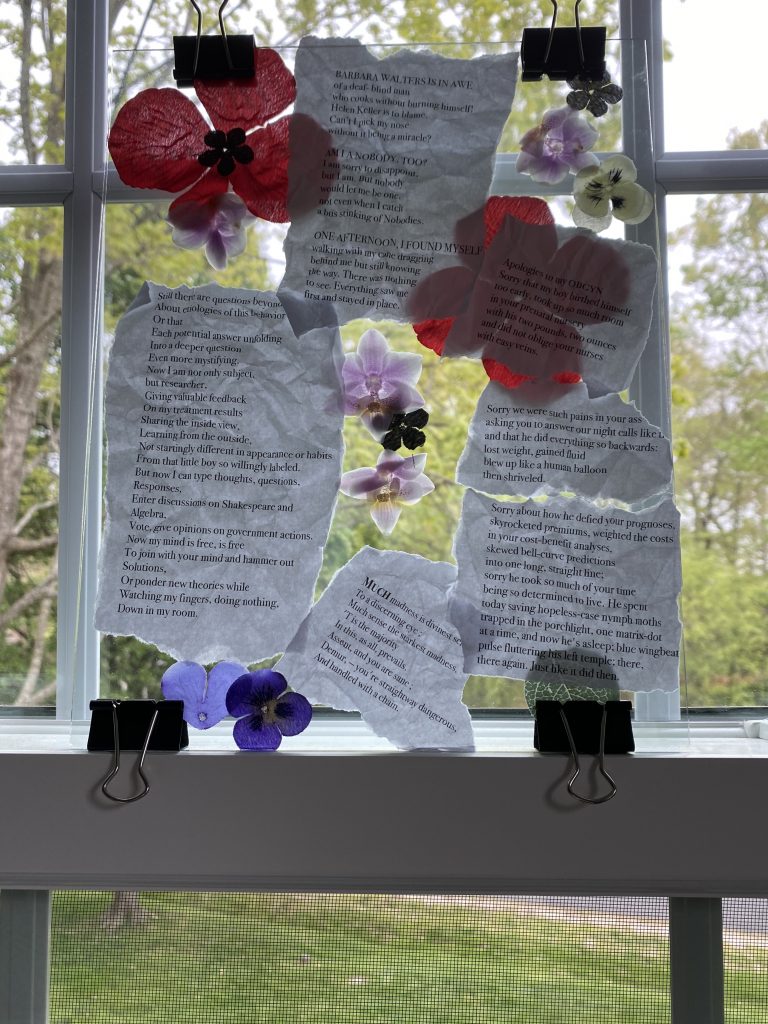
James Pryor’s Major Project: Visual Art Piece; Glass Press

For my final project I chose to do a visual art piece. The physicality of the piece is two panes of 8×10 glass compressed together with excerpts of poetry from our class, along with both fabric and real flowers in between said pieces of glass. The compression on the glass is caused by the symmetrical placing four of heavy-duty binder clips against the glass.

The metaphorical ideas behind the creation of this piece stem from the ideas of preservation. By using excerpts from the following poems; Rebecca Foust’s “Apologies to my OBGYN,” Craig Romkema’s “Perspectives,” John Lee Clark’s, “Deaf Blind: Three Squared Cinquain,” and Emily Dickinson’s “Much Madness is divinest Sense,” the viewer sees art created by disabled authors, who are often forgotten in art. Whether it be the art of a disabled person being invalidated, or straight up destroyed due to living in a violently ableist society, the reality is that nondisabled people choose to overlook the art created by disabled artists. However, while there is an unmeasurable amount of art that has been lost due to ableism, the art that remains is preserved eternally. Placing the poem excerpts between two panes of glass ensures the security of not being tossed aside. This metaphor of fighting for visibility is continued with the intentional strain that has been placed on the paper the poems are on. An ableist society is one that attempts to crumple up the art made by disabled people and throw it aside, because they do not value it with the same weight as their own art.

The ugly truth is that nondisabled individuals do not want to hear about the personal experience of those with disabilities. Often when a disabled person is recounting their own personal struggled, nondisabled peers will berate them for complaining or whining, implying that talking about these ableist interactions in life are the fault of the disabled person, not the oppressive structure society has been founded on. On the other side of this doubled edged sword, if a disabled person views their disability in a positive light, they are also berated by nondisabled people who push the ideas that anyone who is not inside their definition of normal needs to be “fixed” or “cured.” The use of the flowers in this piece coincide with the wishes of the Disabled Rights Movement, where flowers are seen as beautiful, disabled individuals should not automatically be considered worthless or seen as eyesores to the greater idea of humanity as a whole. The use white and blue pansies, alongside the red rose petals stand for the beauty of each individual. However, the inclusion of the pink and yellow orchids calls attention to the issue of death against disabled people. This applies specifically to Foust’s poem, where she recounts the neglect her son faced from medical professionals who deemed her son not worth the effort to keep alive, unfortunately a common prejudice held by doctors and nurses alike.

Preserving the art made by disabled individuals, and by extension the disabled community, is a key factor in creating a society that will not overflow with ableist prejudices. Nondisabled people need to learn empathy for those who do not fall into their rigid categories of normal; exposure to art made from every point of view is the best way to teach others to care about humanity as a whole, not just those within their line of sight.

I pledge.

Word count: 569

css.php