James Pryor’s Major Project: Visual Art Piece; Glass Press

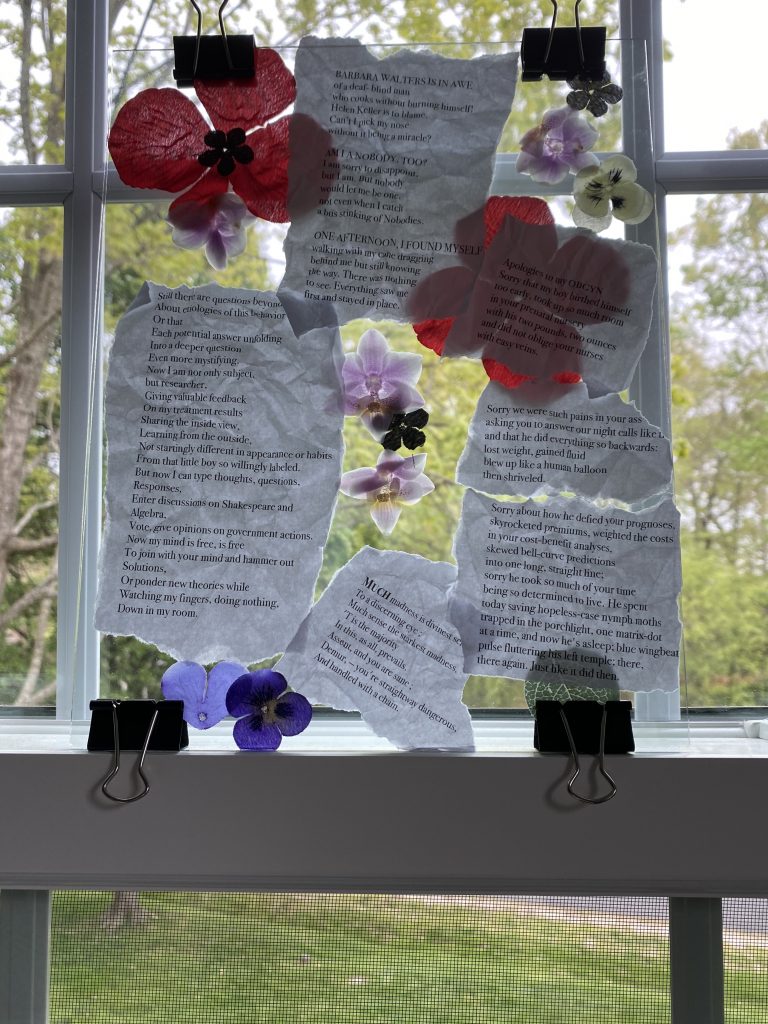
For my final project I chose to do a visual art piece. The physicality of the piece is two panes of 8×10 glass compressed together with excerpts of poetry from our class, along with both fabric and real flowers in between said pieces of glass. The compression on the glass is caused by the symmetrical placing four of heavy-duty binder clips against the glass.

The metaphorical ideas behind the creation of this piece stem from the ideas of preservation. By using excerpts from the following poems; Rebecca Foust’s “Apologies to my OBGYN,” Craig Romkema’s “Perspectives,” John Lee Clark’s, “Deaf Blind: Three Squared Cinquain,” and Emily Dickinson’s “Much Madness is divinest Sense,” the viewer sees art created by disabled authors, who are often forgotten in art. Whether it be the art of a disabled person being invalidated, or straight up destroyed due to living in a violently ableist society, the reality is that nondisabled people choose to overlook the art created by disabled artists. However, while there is an unmeasurable amount of art that has been lost due to ableism, the art that remains is preserved eternally. Placing the poem excerpts between two panes of glass ensures the security of not being tossed aside. This metaphor of fighting for visibility is continued with the intentional strain that has been placed on the paper the poems are on. An ableist society is one that attempts to crumple up the art made by disabled people and throw it aside, because they do not value it with the same weight as their own art.

The ugly truth is that nondisabled individuals do not want to hear about the personal experience of those with disabilities. Often when a disabled person is recounting their own personal struggled, nondisabled peers will berate them for complaining or whining, implying that talking about these ableist interactions in life are the fault of the disabled person, not the oppressive structure society has been founded on. On the other side of this doubled edged sword, if a disabled person views their disability in a positive light, they are also berated by nondisabled people who push the ideas that anyone who is not inside their definition of normal needs to be “fixed” or “cured.” The use of the flowers in this piece coincide with the wishes of the Disabled Rights Movement, where flowers are seen as beautiful, disabled individuals should not automatically be considered worthless or seen as eyesores to the greater idea of humanity as a whole. The use white and blue pansies, alongside the red rose petals stand for the beauty of each individual. However, the inclusion of the pink and yellow orchids calls attention to the issue of death against disabled people. This applies specifically to Foust’s poem, where she recounts the neglect her son faced from medical professionals who deemed her son not worth the effort to keep alive, unfortunately a common prejudice held by doctors and nurses alike.

Preserving the art made by disabled individuals, and by extension the disabled community, is a key factor in creating a society that will not overflow with ableist prejudices. Nondisabled people need to learn empathy for those who do not fall into their rigid categories of normal; exposure to art made from every point of view is the best way to teach others to care about humanity as a whole, not just those within their line of sight.

I pledge.

Word count: 569
James’ Response to Frances Hodgson Burnett’s The Secret Garden

In the first ten chapters of The Secret Garden by Frances Hodgson Burnett, I struggled to find exactly where I should be looking to view this text in regards to the disability lens. I was looking for a single point to narrow my focus on, but as I read I soon realized how this text intersects with disability was going to be a little less obvious than I had originally assumed.

To begin, the introduction of Mary Lennox as the main character, calling her the “most disagreeable-looking child ever seen” and saying that “her face was yellow because she had been born in India and had always been ill in one way or another” struck me as some sort of chronic illness, but now I think the terms of her negative physical features stemmed from the neglect she faced from her parents and growing up without learning empathy for others, making her appear ugly on the outside to reflect the harsh prejudices she held internally.

Before the passing of both her parents and the remaining servants at the Lennox’s home in India, Mary does not cry for the loss of Ayah, the nurse who took care of her, but she cries as the house is in a panic due to a cholera outbreak, and she realizes she is forgotten. As it was said in the text, “Nobody thought of her, nobody wanted her.”

When Mary is found to be the sole survivor of the Lennox house, she is sent to a home filled with children who tease her for her temperamental nature, calling her “Mistress Mary, quite contrary.” This is the first instance of Mary’s slow but steady realization that she is not the center of the universe, and she reacts immediately with anger. She is then taken away by Mrs. Medlock who is the one to tell her that she will be moving to England to be with her Uncle, Mr. Archibald Craven. The description of Mr. Archibald Craven caught my attention the most, as they mention his physical disability, and then immediately the fact that he was married, implying that usually people with disabilities do not get to find true love, “… an he’d have walked the world over to get her a blade o’ grass she wanted. Nobody thought she’d marry him, but she did, and people said she married him for his money. But she didn’t – she didn’t.”

Upon finding this out, Mary immediately connects the idea of her Uncle with a French fairytale about a poor hunchback and a beautiful princess. She learns that Mr. Archibald Craven refuses to come out of the West Wing of his estate following the death of his wife, and also notes it sounds like something out of a book, but did not make her feel cheerful. She does all she can to hide any outward displays of interest, and stays fast to her default setting of apathy towards others.

This attitude stays the same for the first few weeks Mary lives in her Uncle’s estate. She is rude to the servant Martha, who she compares to the servants she lived with in India, and this is one of the starkest examples of Mary’s racism and entitlement. Her rage flies wild and she says “You don’t know anything about natives! They are not people- they’re servants who must salaam to you.”

This is where I’d like to introduce the idea that Mary is a metaphor for the secret garden itself. The garden that had belonged to Mr. Archibald Craven’s wife, which following her death had been locked and forgotten for ten years, the same age as Mary. The garden was allowed to fall into disarray, growing wild without the care of the wife. Mary was also allowed to grow wild, without a loving hand to guide her towards compassion and empathy for others.

As Mary grows, so does the garden. She learns how to connect with others and how to take care of herself. She learns about different lifestyles and realizes that happiness isn’t always equated to wealth. Not only viewing this story through a disability lens, but a lens that brings issues of race and class into the light as well has really helped me understand this story so far and hopefully will continue to do so as we read more.

I pledge.

Word count: 723

css.php