Alyssa Brown
Dr. Foss
Disability & Literature
April 30, 2020
Prompt Three: Utopia Redefined in Rebecca Foust’s, “Apologies to my OBGYN”
Disability, as discussed in Rosemarie Garland Thomson’s paper, “The Case for Conserving Disability,” is threatened by religious teachings, the science and medical field as well as general ableist perspectives. This danger appears through the promotion and possible progression of a eugenics movement that agrees with the research and potential removal towards disabilities that could be ‘eradicated’ from existence entirely. The piece connects with Rebecca Foust’s, “Apologies to my OBGYN,” as the speaker tells the story of cruel behavior endured by a discriminatory doctor and staff. People in positions of power may feel their actions are justified because of their outlook on Autism, and the ways in which they believe that child may or may not end up living their lives. The speaker suggests a redefined utopia exists with the presence of disability in our world; A utopia that appreciates and celebrates difference rather than rejects the notion entirely for a “normal” world.
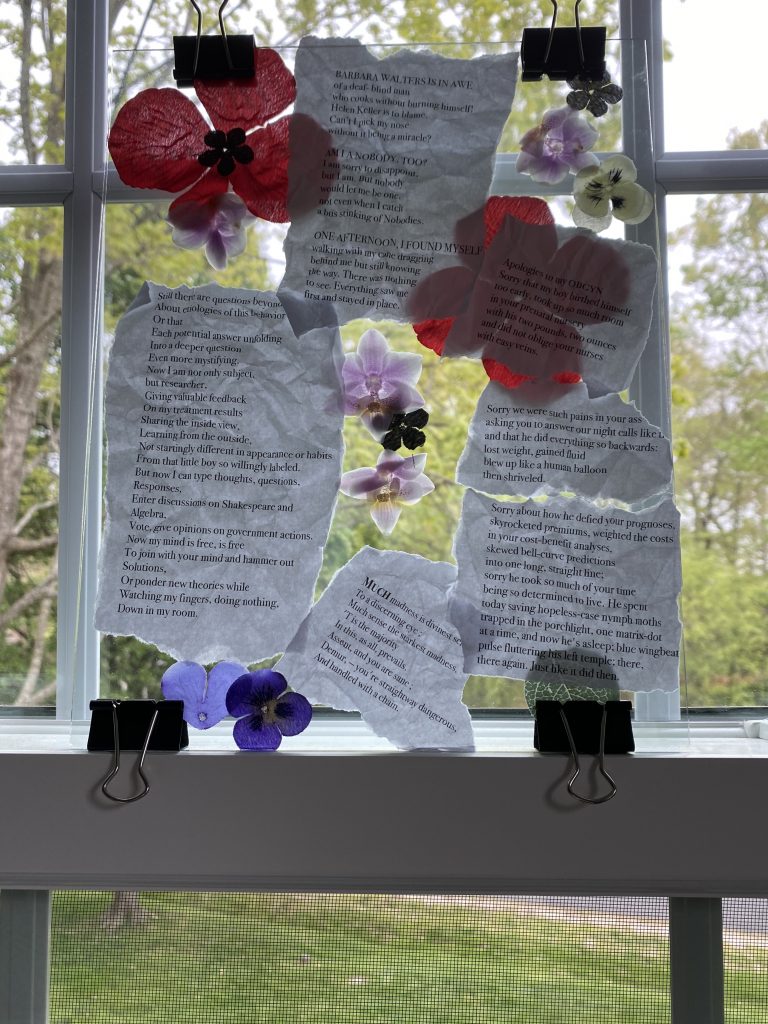
The speaker’s emphasis of apology chooses to acknowledge their doctor’s belief that the child they have birthed is a burden to the medical staff. The repetition is orchestrated in a manner that allows the practices’ ableist mindset of the child being a “burden” or “failure” to make the reader sick to their stomach. The frustrated and Truth unraveling voice of the speaker in “Apologies to my OBGYN” belongs to Rebecca Foust, as disclosed in an early 2015 reading of her poetry. She calls it a specieses of rant and curse poem, in which she addresses negligent behaviour of her male doctor towards herself and her child, as well as the treatment of male doctors towards female patients. It is important to consider that women find it necessary to apologize in situations that do not need to be forgiven, because they are expected to humble and redeem themselves from “being in the wrong” when they were not in the wrong to begin with. Expanding on the nature of her apology, Foust’s son was belittled and stigmatized because of his “difficulty” being premature and Autistic, which inspired the writing of her profound poem. She makes sure to focus on the irony of the anaphora used through repetition of the word “Sorry” in nearly every stanza. “Sorry that my boy birthed himself too early / Sorry we were such pains in your ass / Sorry about how he defied your prognoses / sorry he took so much of your time …” The sarcasm of this apology sheds light on what couldn’t be predicted, and shouldn’t be blamed for, but was made to feel like a source of shame because of her doctor’s view of an Autistic child.
The idea of preserving, rather than opening a door for eugenics and eliminating disabilities such as Autism all together is threatening to doctors like the one that has been mentioned by the speaker. The lines that follow the speaker’s apology include, “Took up so much room in your prenatal nursery / that he did everything backwards / skyrocketed premiums, weighted the costs.” This general kind of doctor to patient attitude is the same kind in Thomson’s piece that speaks for genetic manipulation and selective abortion to get the mother of a disabled child to not take up so much space or become an expense rather than a newborn deserving of the same care as every child that is birthed in their care. As mentioned in “The Case for Conserving Disability” on page 340, when a child with a disability or presumed disability enters this world, they can be seen as a “catastrophe or a failing.” This coincides with the view of the doctor’s treatment towards the speaker and their child. Because they are already seen as a weight in our society, and a failure by the doctor, they come to recognize that they have been abused by the system.” The male doctor has a preconceived idea of how his authoritarian behavior, that is based off of a belief that an Autistic child is not “normal” by medical standards, is benefiting this child and his mother. He is cold rather than welcoming, discouraging rather than supportive. Instead of progressing our species towards a utopia, he is enabling a dystopia that is built on the foundation of ableist ideals.
The original concept of utopia operates under the idea that everybody is equal, and all live in harmony, yet exclusion of Autism and disability in general completely rejects this notion. The final stanzas of Foust’s poem reveal that the existence of her Autistic child in this world has not and will never be a burden. Instead, his differences contribute to the overall message of a redefined utopianism that is brought to life by the speaker when they state, “He spent / today saving hopeless-case nymph moths trapped in the porchlight, one matrix-dot / at a time, and now he’s asleep; blue wingbeat pulse fluttering his left temple; there, / there again. Just like it did then.” His life was always enough, his existence was enough. The hospital staff treated an Autistic individual like a hopeless specimen, destined for failure just like one might treat the moths moving towards porchlight. The Truth that should have been acknowledged is this: We cannot experience a bright and progressive future for humankind if we are not inclusive of disability, and the differences that our species should accept instead of eradicate overtime. Much like what is mentioned in August’s and Ronan’s story on page 351 of “The Case for Conserving Disability,” human relationships give us, “the opportunity to profoundly love another human being.” This was never considered or cared about by the male doctor or hospital staff addressed in Foust’s poem. The utopia we should envision is one that seeks harmony and equal opportunity of people, no matter what their differences may be.
Rosemarie Garland Thomson’s paper, “The Case for Conserving Disability,” introduces an ableist idea of what utopia could be if disability was eradicated entirely. However, Rebecca Foust’s, “Apologies to my OBGYN” ultimately offers a redefined version of what a “perfect” world should be, as it’s ending rejects the negative treatment towards the speaker when her Autistic child was born into this world. The idea of a utopia that is “inclusive,” yet rejects the differences of human beings, needs to be seen as dystopian and prejudiced. The hospital staff in Foust’s poem needed to appreciate differences, rather than despise them, and value the existence of an Autistic child as enough.
Word Count: 1061
I Pledge: Alyssa Brown
Works Cited
Foust, R. (2018, January 09). Poems. Retrieved April 30, 2020, from http://rebeccafoust.com/poems/
Garland-Thomson, Rosemarie. (2012). The Case for Conserving Disability. Journal of bioethical inquiry. 9. 339-55. 10.1007/s11673-012-9380-0.
Rebecca Foust. “Anaphora second person in “Apologies to my OBGYN” by Rebecca Foust” Youtube, 27 Mar. 2015, https://www.youtube.com/watch?v=pk_zgz0szXI

You must be logged in to post a comment.