Amy Rouse
04/17/2020
Prof. Foss
Final Paper
Label Breaking on Autistic Abilities
Labels can put pressure on people to either outperform or underperform. With this pressure on those with autism there is a predominant focus on what they can’t do, and how autism has taken away and hidden a child under its grasp. The act of being labeled autistic; might provide slight relief to the parents, but also leaves them wondering who their child is without the autism, how might they form a connection with this child stereotyped to be connectionless? Autism didn’t take away a child, it gave you a unique child who is fully capable of connections, identifying with others, understanding what is being said to them, defying odds. That is an autistic child.
These connections and accounts are found in Ralph James Savareses’ “Prologue: River of Words, Raft of Our Conjoined Neurologist” from See It Feelingly, in “Perspectives” a poem by Craig Romkema from his collection of poems titled “Embracing the Sky: Poems Beyond Disability,” and Troubleshooting by Selene dePackh. All show those with a diagnosis of autism and call attention to what others think they can’t do while showing that the individuals mentioned can do those things and many more. Here, we will see these stereotypes that are forced upon autistics but also, how they are defying expectations and changing those stereotypes.
Having feelings such as empathy is presumed to be missing from those diagnosed with autism. Savarese shows us with his autistic and nonverbal son, DJ, that feelings and identification are possible for autistic individuals. His son feels “‘character’s feelings”’ so much so that he physically shows them which can be heavy breathing that the character themselves was perceived to be doing within the story, (Savarese, pg. 15). Identification is also mentioned for those with autism as being difficult and absent from them, but DJ “morphs into [Harriet Tubman], so she morphs into him,” (Savarese, pg. 16). Being able to put yourself in someone else’s shoes and feel what they were or might have been at that moment, is a skill to be appreciated and applauded, not one to be ignored because the individual themselves is non-verbal and is assumed to not understand.
Deficits in emotions are a portion of the DSM-5 diagnosis for autism, but what about those who feel sorrow, who have empathy? DJ is one of them, he does feel emotion so much that he is “ so attuned to the pain that it becomes his own,” (Savarese, pg. 18). Thoughts and opinions on what an autistic can’t do are summed up into broad categories in the DSM, but here we have a child who is not fully categorized within the autism diagnosis aside from his nonverbal form of communication and not wanting physical affection. There is a note made about these “prevailing stereotypes” concerning autism and emotions specifically, (Savarese, pg. 18). With a glimpse into DJs mind, we see how society has made him think of himself. For his graduation, he wanted to walk on stage and shake the Principal’s hand without flapping his arms, though he did not succeed, he “felt proud. I looked great and autistic at the same time. I realized in my own life something I had begun to learn from the books I was reading; simply conforming to the dominant culture is not always a worthy goal,”’ (Savarese, pg. 21-22). Many focus on the negatives and the so-called disruptive behavior that those with autism can perform, but why can’t they focus on the fact they just graduated? Through Savarese and his son, we see how stereotypes are demolished and outperformed, while also embracing who one is and being proud of it and letting the world see that.
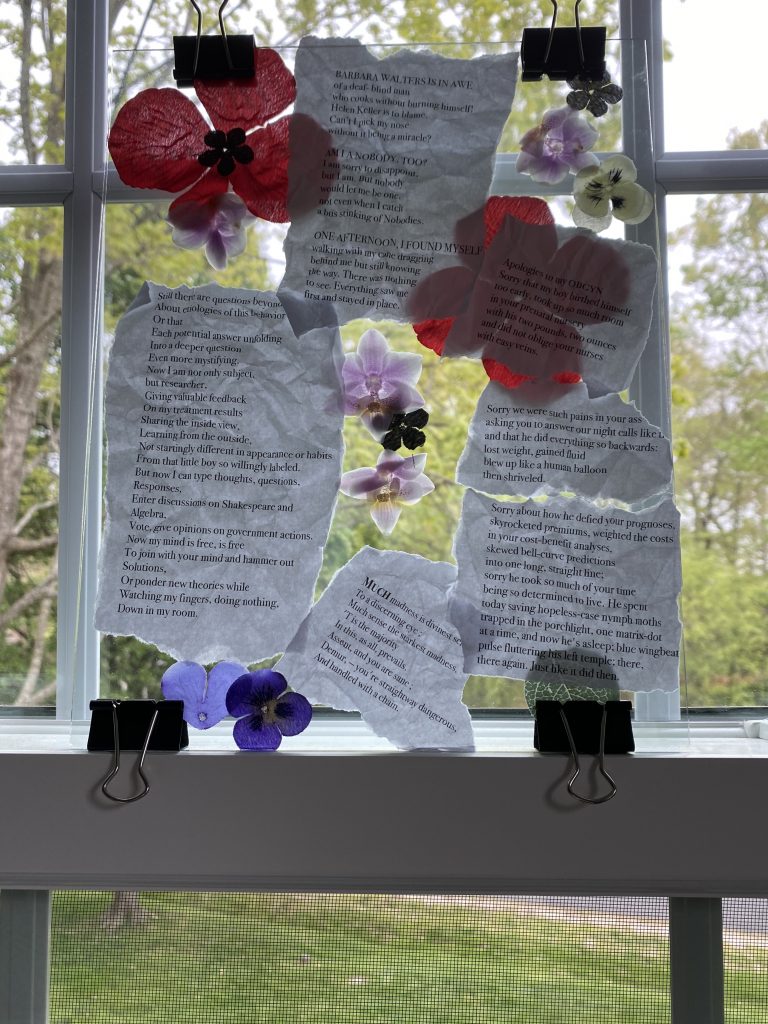
In his poem “Perspectives,” Romkema hints upon the fact that those around him can fix him with “vitamin A” and by “measuring [his] head,” (Romkema). Everyone is always insistent on finding a cure for autism, but no one is taking time to notice what is actually going on in their heads. The label of autism is “freely” made and leaves parents “telling [him] always they knew [he] was there / Inside / And somehow we would find each other, / Connect / The way they could with the sisters and brother,” (Romkema). This embarks on the fact that many perceive those with autism as being disconnected from everyone, from the world and having to provide self-stimulation which can result in arm flapping and sometimes destructive self-harmful behaviors. Romkema calls attention to many stereotypes of autistics while also showing how they become more than those stereotypes and are not limited to them. He notes, “From that little boy so willingly labeled. / But now I can type thoughts, questions, / Responses, / Enter discussions on Shakespeare and / Algebra,” among other mentionings of voting and giving his own opinions not monitored or given for him, (Romkema). Those with autism are able to speak for themselves and prove they can on a daily basis whether they are deemed verbal or non-verbal.
Romkema himself is autistic but also has cerebral palsy, which can now explain to the readers why he was lying in his bed and other lines of his poem concerning his body. Connection, thoughts, and other daily actions that neurotypical individuals do look different on an autistic individual, and there is nothing wrong with this. While Romkema’s poem hits a few of these stereotypes, it showcases the brilliance of how someone with autism, laying in their bed doing what other may call “self-stimulation” but actually may be “ponder[ing] new theories while / watching [his] fingers, / Doing Nothing,” (Romkema). “Perspectives” truly gives us a new and recurring perspective: that of the parents, the doctors and other professionals, but also the individual labeled with the diagnosis. He “understood every word” those around him were saying, disproving another stereotype (Romkema). While stereotypes are disproven throughout the poem, it is seen how he can do everything a neurotypical child would be able to do, only in different ways that are not mentioned but can be assumed.
In the beginning pages of dePackhs book Troubleshooting, a patient is introduced with her ability to look in someone’s eyes instead of looking away. “I’m autistic, but I don’t look down and away like a good autistic; I stare. That complicated my diagnosis for the early years of my life,” (dePackh, pg. 2). Here, we have a very predominant example of focusing on what autistics shouldn’t be able to do, but we also have the example and label of a ‘good’ autistic, one who complies with the diagnosis standards. A whole diagnosis depends on deficits in the individuals, in this case, a deficit on eye contact was not there. This complicated a diagnosis that is plastered with aspects that an autistic individual shouldn’t be able to do. So shouldn’t it be said that she defied the odds, surpassed the expectations, derailed the label she was given? A label she had both physically and metaphorically tattooed on her, was enough for people to assume she couldn’t and should be able to do certain things. “I went up and introduced myself even though making social,” is something she would rather avoid, she does not shy away from things as it would be stereotyped (dePackh, pg. 3). Social situations are often avoided by those with autism, as would be assumed and is in the DSM-5 as a part of the diagnosis.
One very specific notion that is focused on in this first chapter consists of the tone of voice and connecting it to words and their meanings and how they become “callibr[ated]” to where it doesn’t take as long as her normal “‘auditory processing lag,’’’ (dePackh, pg. 7). Not only does this call attention to what is going on inside the brain of someone diagnosed with autism, it shows the readers the difference but the same way everyone understands words. It is like learning something new for a neurotypical individual, sometimes we get it if we have background knowledge (calibration) and sometimes it takes longer to be fully understood, so “taking the scenic route,” (dePackh, pg. 7). Her lag would be something the doctors, teachers, and others would focus on and try to rid her of and cure it, as it is noted later in the chapter in a high functioning autism classroom but also her own mother is trying to cure her autism and “cleanse” her from it, (dePackh, pg. 17). Focusing on her lag proves the point that the negatives and deficits a child may have with autism, is only part of who they are. Positives should be focused on instead because they, just like neurotypical children, can do so much more than they are perceived to. dePackh illustrates this from the few examples covered. Having a connection with your child despite the fact they may be unable to make one, depends also on the parents as well.
Common perceptions of autism include those that diminish the ability of these individuals. The literary works written by Savarses, Romkema, and dePackh prove that stereotypes put pressure on their children, others, and themselves, but these deficits that appear are solely focused on. There is never an article saying all the things that those with autism can do, only what they can’t do in order to get a diagnosis for their child. Autism presents itself in many ways, and that may be nonverbal but it can also be to look and stare into someone else’s face and be included in social interaction. The analysis offered here in this paper shows that autism is thought of as deficits, but those deficits are being disproved by those diagnosed.
Word Count; 1,594
I pledge,
Amy Rouse
Works Cited
Depackh, Selene. Troubleshooting: Book One, Glitch in the System. 1st ed., Reclamation Press, 2018.
Romkema, Craig. “Perspectives.” Embracing the Sky: Poems Beyond Disability, Jessica Kingsley Publishers, 2002.
Savarese, Ralph James. “Prologue: River of Words, Raft of Our Conjoined Neurologies .” Seeing It Feelingly, 1st ed., Duke University Press, 2018, pp. 15–22.

You must be logged in to post a comment.