Technological advancements that have been presented conceptually or realistically through film, literature and media have both threatened and enlightened. Specifically, artificial intelligence, including the proposed higher level artificial general intelligence, has made an impression in these three mediums of expression. The threat of AI falsely looms over the heads of ill-informed sceptics. This outlook is not only technophobic, but could be considered speciest, a term that was used in Berys Gaut’s, “Blade Runner, Empathy and Death,” to give individuality and counsciece right to androids that have been outcast by human culture and society. Disability connects with the topic of artificial intelligence through this project because of the parallels that the disabled community shares with AI through means of being misunderstood, mistreated, and looked at from an unfamiliar and ignorant perspective because of biased viewpoints. My project attempts to intertwine disability and AI by allowing different programs to interpret what exactly disability means through the output of a non-human perspective. Current AI is likely to understand disability without sentient perspective, but this does not mean it will always need to rely completely on user input.
This project opens with my own example of code, as code is the structure that allows weak AI, and eventual strong AI to exist in the first place. It is noteworthy to also think of ourselves as coded creatures, consisting of DNA and our own form of biology that allows us to exist in the format that we do. The original requirement to structure and submit a creative novel through Python Notebook for a Creative Coding lecture required 50,000 words. Using that blueprint, this code prints out over 30 pages and strengthens Yessenia’s powerful words from Good Kings Bad Kings with an angry shade of red. The code is meant to help enforce these words, and to work alongside of Yessenia’s fight to end the abuse and unfair treatment that dictated the lives of ILLC individuals. This portion of my project could not exist without my direct input.
An academic paper titled, “Visual Dialog,” includes the work of several researchers and their proposition for a form of chatbot. This bot is capable of interacting with a human user through conversation and images that are uploaded, then processed by the AI, which is ultimately meant to act as a general test of machine learning capabilities. According to artificial intelligence researcher Janelle Shane, the Visual Chatbot is supposed to exhibit capabilities in, “image recognition, language comprehension, and spatial awareness.” “Visual Dialog” noticeably mentions that AI will be used as a tool for Blind individuals, though projects at this basic level of machine intelligence prove that the future is in dire need of a more aware and sophisticated bot. Because this bot does not understand most images that it had not already been trained with, results received on this portion of my project can be considered ignorant and even offensive. However, this does not mean that the Visual Chatbot cannot be upgraded anymore than it already has. Images such as Frankenstein and Lenny “wearing a hat” may be thought of as visually acceptable under chatbot standards, while the image of a man and a wheelchair and the female cancer patient give inadequate output to the user.
RunwayML is a creative platform that engages artists through machine learning tools. MIT Open Documentary Lab mentions that this desktop application offers three model types including, “models that identify objects and people, models that transform content, and models that generate new media from the training data.” When uploading and training your own models you are automatically faced with an option of text or image machine learning tools. For my project I decided to utilize the text platform, in which I uploaded A Christmas Carol and Frankenstein to analyze how machine learning would assess them. The quality of product that I receive depends on how many steps I train each program.
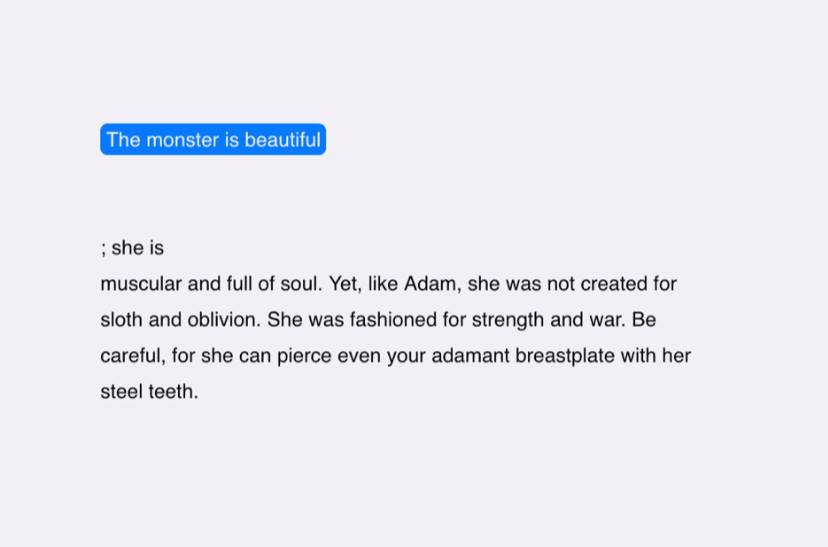
With A Christmas Carol, I uploaded the text and trained Runway on 500 steps, which relies heavily on replicating and understanding an author’s sculpture. Frankenstein also relies on interpretation, but was trained on 1,000 steps, which I like to think gives the AI more room to understand and form its own individuality over a longer period of time. I fed A Christmas Carol lines from the text and lines of my own such as, “Tiny Tim is” and received, “not Tiny Tim, but is in reality a gigantic, old man with a monstrous chin.” This output does not understand the harm of these words, and likely confused Tiny Tim with Scrooge’s likeness. The user can see a difference in giving the AI more time to process something, as I did with the text of Frankenstein. I genuinely believe that Runway understands the pain and incredible depth of Frankenstein’s character. This understanding may not belong to a (yet) conscious being, but it is important to separate our experience of life and consciousness from that of a machine, much like the AI is able to do with Frankestein’s character. The final output that Runway gave in response to, “The monster is beautiful,” managed to take my breath away. This interpretation not only belongs to a feminist perspective, but one that transends the original meaning of the text. Runway has given power to a being that was cast aside for their differences. Perhaps, Runway is embracing these differences, as one should.
The results from my project reveal the evolving stages of AI, and how with time, it can not only serve as an aid for understanding disability, but allow people with speciest and ableist mindsets to broaden their unprogressive views. What is considered “whole” “complete” and even an ignorant word in its usual context like “normal” should be redefined and inclusive to beings of all backgrounds. Disability ultimately shares a connection to artificial intelligence through misrepresentation in literature, film, and the media, as both should be valued and accepted rather than shunned by society. Artificial intelligence has a growing understanding of what disability is, and as long as it is protected and trained by open minded individuals, should prove to interpret disability through a welcoming lens of its own kind.
PYTHON NOTEBOOK | Good Kings Bad Kings (coded book)
Word Count: 1026
I Pledge: Alyssa Brown

AMAZING!!!!!!!!!!!!