Alyssa’s Final Exam

Alyssa Brown 

Dr. Foss

Disability & Literature

April 30, 2020 

Prompt Three: Utopia Redefined in Rebecca Foust’s, “Apologies to my OBGYN”

Disability, as discussed in Rosemarie Garland Thomson’s paper, “The Case for Conserving Disability,” is threatened by religious teachings, the science and medical field as well as general ableist perspectives. This danger appears through the promotion and possible progression of a eugenics movement that agrees with the research and potential removal towards disabilities that could be ‘eradicated’ from existence entirely.  The piece connects with Rebecca Foust’s, “Apologies to my OBGYN,” as the speaker tells the story of cruel behavior endured by a discriminatory doctor and staff.  People in positions of power may feel their actions are justified because of their outlook on Autism, and the ways in which they believe that child may or may not end up living their lives. The speaker suggests a redefined utopia exists with the presence of disability in our world; A utopia that appreciates and celebrates difference rather than rejects the notion entirely for a “normal” world. 

The speaker’s emphasis of apology chooses to acknowledge their doctor’s belief that the child they have birthed is a burden to the medical staff. The repetition is orchestrated in a manner that allows the practices’ ableist mindset of the child being a “burden” or “failure” to make the reader sick to their stomach. The frustrated and Truth unraveling voice of the speaker in “Apologies to my OBGYN” belongs to Rebecca Foust, as disclosed in an early 2015 reading of her poetry. She calls it a specieses of rant and curse poem, in which she addresses negligent behaviour of her male doctor towards herself and her child, as well as the treatment of male doctors towards female patients.  It is important to consider that women find it necessary to apologize in situations that do not need to be forgiven, because they are expected to humble and redeem themselves from “being in the wrong” when they were not in the wrong to begin with. Expanding on the nature of her apology, Foust’s son was belittled and stigmatized because of his “difficulty” being premature and Autistic, which inspired the writing of her profound poem. She makes sure to focus on the irony of the anaphora used through repetition of the word “Sorry” in nearly every stanza. “Sorry that my boy birthed himself too early / Sorry we were such pains in your ass / Sorry about how he defied your prognoses / sorry he took so much of your time …” The sarcasm of this apology sheds light on what couldn’t be predicted, and shouldn’t be blamed for, but was made to feel like a source of shame because of her doctor’s view of an Autistic child. 

The idea of preserving, rather than opening a door for eugenics and eliminating disabilities such as Autism all together is threatening to doctors like the one that has been mentioned by the speaker. The lines that follow the speaker’s apology include, “Took up so much room in your prenatal nursery / that he did everything backwards / skyrocketed premiums, weighted the costs.” This general kind of doctor to patient attitude is the same kind in Thomson’s piece that speaks for genetic manipulation and selective abortion to get the mother of a disabled child to not take up so much space or become an expense rather than a newborn deserving of the same care as every child that is birthed in their care. As mentioned in “The Case for Conserving Disability” on page 340, when a child with a disability or presumed disability enters this world, they can be seen as a “catastrophe or a failing.” This coincides with the view of the doctor’s treatment towards the speaker and their child. Because they are already seen as a weight in our society, and a failure by the doctor, they come to recognize that they have been abused by the system.” The male doctor has a preconceived idea of how his authoritarian behavior, that is based off of a belief that an Autistic child is not “normal” by medical standards, is benefiting this child and his mother. He is cold rather than welcoming, discouraging rather than supportive. Instead of progressing our species towards a utopia, he is enabling a dystopia that is built on the foundation of ableist ideals. 

The original concept of utopia operates under the idea that everybody is equal, and all live in harmony, yet exclusion of Autism and disability in general completely rejects this notion. The final stanzas of Foust’s poem reveal that the existence of her Autistic child in this world has not and will never be a burden.  Instead, his differences contribute to the overall message of a redefined utopianism that is brought to life by the speaker when they state, “He spent / today saving hopeless-case nymph moths trapped in the porchlight, one matrix-dot / at a time, and now he’s asleep; blue wingbeat pulse fluttering his left temple; there, / there again. Just like it did then.” His life was always enough, his existence was enough. The hospital staff treated an Autistic individual like a hopeless specimen, destined for failure just like one might treat the moths moving towards porchlight. The Truth that should have been acknowledged is this: We cannot experience a bright and progressive future for humankind if we are not inclusive of disability, and the differences that our species should accept instead of eradicate overtime. Much like what is mentioned in August’s and Ronan’s story on page 351 of  “The Case for Conserving Disability,” human relationships give us, “the opportunity to profoundly love another human being.” This was never considered or cared about by the male doctor or hospital staff addressed in Foust’s poem. The utopia we should envision is one that seeks harmony and equal opportunity of people, no matter what their differences may be.

Rosemarie Garland Thomson’s paper, “The Case for Conserving Disability,” introduces an ableist idea of what utopia could be if disability was eradicated entirely. However, Rebecca Foust’s, “Apologies to my OBGYN” ultimately offers a redefined version of what a “perfect” world  should be, as it’s ending rejects the negative treatment towards the speaker when her Autistic child was born into this world. The idea of a utopia that is “inclusive,” yet rejects the differences of human beings, needs to be seen as dystopian and prejudiced. The hospital staff in Foust’s poem needed to appreciate differences, rather than despise them, and value the existence of an Autistic child as enough. 

Word Count: 1061

I Pledge: Alyssa Brown 

Works Cited

Foust, R. (2018, January 09). Poems. Retrieved April 30, 2020, from http://rebeccafoust.com/poems/

Garland-Thomson, Rosemarie. (2012). The Case for Conserving Disability. Journal of bioethical inquiry. 9. 339-55. 10.1007/s11673-012-9380-0. 

Rebecca Foust. “Anaphora second person in “Apologies to my OBGYN” by Rebecca Foust” Youtube, 27 Mar. 2015, https://www.youtube.com/watch?v=pk_zgz0szXI
Understanding Disability Through the Lens of Artificial Intelligence

Technological advancements that have been presented conceptually or realistically through film, literature and media have both threatened and enlightened. Specifically, artificial intelligence, including the proposed higher level artificial general intelligence, has made an impression in these three mediums of expression. The threat of AI falsely looms over the heads of ill-informed sceptics. This outlook is not only technophobic, but could be considered speciest, a term that was used in Berys Gaut’s, “Blade Runner, Empathy and Death,” to give individuality and counsciece right to androids that have been outcast by human culture and society.  Disability connects with the topic of artificial intelligence through this project because of the parallels that the disabled community shares with AI through means of being misunderstood, mistreated, and looked at from an unfamiliar and ignorant perspective because of biased viewpoints. My project attempts to intertwine disability and AI by allowing different programs to interpret what exactly disability means through the output of a non-human perspective. Current AI is likely to understand disability without sentient perspective, but this does not mean it will always need to rely completely on user input. 

This project opens with my own example of code, as code is the structure that allows weak AI, and eventual strong AI to exist in the first place. It is noteworthy to also think of ourselves as coded creatures, consisting of DNA and our own form of biology that allows us to exist in the format that we do. The original requirement to structure and submit a creative novel through Python Notebook for a Creative Coding lecture required 50,000 words. Using that blueprint, this code prints out over 30 pages and strengthens Yessenia’s  powerful words from Good Kings Bad Kings with an angry shade of red. The code is meant to help enforce these words, and to work alongside of Yessenia’s fight to end the abuse and unfair treatment that dictated the lives of ILLC individuals. This portion of my project could not exist without my direct input. 

An academic paper titled, “Visual Dialog,” includes the work of several researchers and their proposition for a form of chatbot. This bot is capable of interacting with a human user through conversation and images that are uploaded, then processed by the AI, which is ultimately meant to act as a general test of machine learning capabilities. According to artificial intelligence researcher Janelle Shane, the Visual Chatbot is supposed to exhibit capabilities in, “image recognition, language comprehension, and spatial awareness.” “Visual Dialog” noticeably mentions that AI will be used as a tool for Blind individuals, though projects at this basic level of machine intelligence prove that the future is in dire need of a more aware and sophisticated bot. Because this bot does not understand most images that it had not already been trained with, results received on this portion of my project can be considered ignorant and even offensive. However, this does not mean that the Visual Chatbot cannot be upgraded anymore than it already has.  Images such as Frankenstein and Lenny “wearing a hat” may be thought of as visually acceptable under chatbot standards, while the image of a man and a wheelchair and the female cancer patient give inadequate output to the user. 

RunwayML is a creative platform that engages artists through machine learning tools.  MIT Open Documentary Lab mentions that this desktop application offers three model types including, “models that identify objects and people, models that transform content, and models that generate new media from the training data.” When uploading and training your own models you are automatically faced with an option of text or image machine learning tools. For my project I decided to utilize the text platform, in which I uploaded A Christmas Carol and Frankenstein to analyze how machine learning would assess them. The quality of product that I receive depends on how many steps I train each program.  

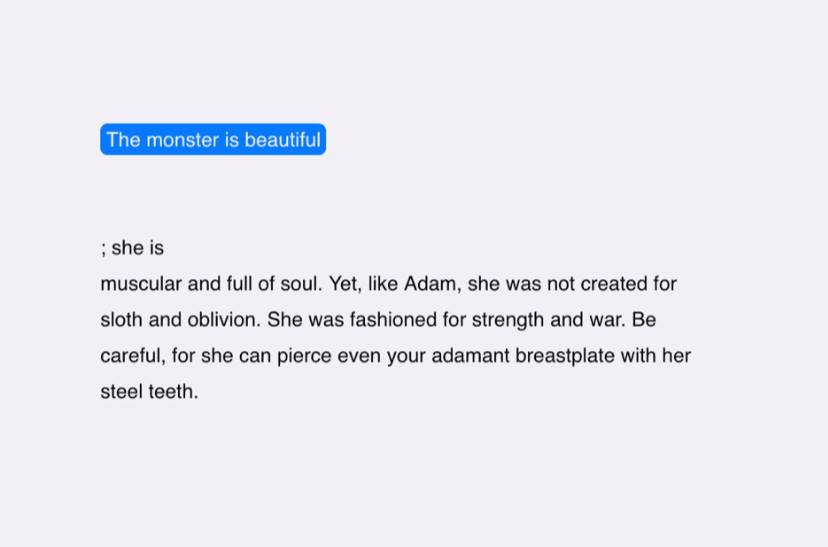
With A Christmas Carol, I uploaded the text and trained Runway on 500 steps, which relies heavily on replicating and understanding an author’s sculpture. Frankenstein also relies on interpretation, but was trained on 1,000 steps, which I like to think gives the AI more room to understand and form its own individuality over a longer period of time.  I fed A Christmas Carol lines from the text and lines of my own such as, “Tiny Tim is” and received, “not Tiny Tim, but is in reality a gigantic, old man with a monstrous chin.” This output does not understand the harm of these words, and likely confused Tiny Tim with Scrooge’s likeness. The user can see a difference in giving the AI more time to process something, as I did with the text of Frankenstein. I genuinely believe that Runway understands the pain and incredible depth of Frankenstein’s character. This understanding may not belong to a (yet) conscious being, but it is important to separate our experience of life and consciousness from that of a machine, much like the AI is able to do with Frankestein’s character. The final output that Runway gave in response to, “The monster is beautiful,” managed to take my breath away.  This interpretation not only belongs to a feminist perspective, but one that transends the original meaning of the text. Runway has given power to a being that was cast aside for their differences. Perhaps, Runway is embracing these differences, as one should. 

The results from my project reveal the evolving stages of AI, and how with time, it can not only serve as an aid for understanding disability, but allow people with speciest and ableist mindsets to broaden their unprogressive views. What is considered “whole” “complete” and even an ignorant word in its usual context like “normal” should be redefined and inclusive to beings of all backgrounds. Disability ultimately shares a connection to artificial intelligence through misrepresentation in literature, film, and the media, as both should be valued and accepted rather than shunned by society. Artificial intelligence has a growing understanding of what disability is, and as long as it is protected and trained by open minded individuals, should prove to interpret disability through a welcoming lens of its own kind.

PYTHON NOTEBOOK | Good Kings Bad Kings (coded book)

Word Count: 1026

I Pledge: Alyssa Brown

Alyssa’s Response to Stephen Kuusisto’s “Plato, Again”

“Plato, Again” focuses on the blatant discrimination of Caroline Moore, and enables the reader to follow Caroline’s experience as a disabled, black woman. Caroline reflects on the social and political aspects of Plato’s work, specifically the “Allegory of the Cave,” in three separate settings, including the outside world, inside a working environment, and inside a doctor’s office. Caroline’s ongoing cancer treatment and resulting side effects give her a perspective that the people operating around her are not aware of, and are to0 ignorant to comprehend. “Plato, Again” reveals through Plato’s allegory how disabled individuals are often cast as static observers, silent and invisible characters that live in the shadows of their own lives.

Caroline’s experiece of sexual harrasment and disability discrimination, as mentioned on page 52, are prominant ways in which she is made to be an invisible and unheard spectator in a work setting. Eyes are an important thematic element in the entirety of “Plato, Again,” and even more so during Caroline’s work place, as she is the simultaneously the witness, the object of the male gaze, and somebody who is glanced away from entirely. Bill Densk, Caroline’s boss, wrongfully makes Caroline a victim of sexual misconduct and her disability.  Bill, a white male in a position of power, asks inappropriate and uncomfortable questions in regards to Caroline’s mastectomy scars, stares directly where her disability is physically visible, and even touches in the place where her breast used to be before her surgery took place. Bill already has trouble correlating the fact that Caroline can be a woman of color and an intelligent, capable individual with a background in computer science and literature.  It is not computable, and not worth understanding to Bill that Caroline can be an intellectual, disabled, woman of color in a work space. This makes her an object to him, one that he can and will eventually replace, as we see through the stages of Caroline’s demotion throughout her cancer treatment. Caroline is unseen in a work setting through the eyes of her coworkers. As stated on page 54, people are in a hurry to get past Caroline. A form of disability discrimination can be ignorance or the dismision of disability, whether physical on non-physical. By people choosing to glance away from Caroline, or pretend like they have another task at hand, they are not recognizing her a whole, authentic, human being, worthy of their line of sight. Nobody takes the time to see Caroline deeper the surface level, she is only ever seen sexually, in a pitiful manner, or glanced away from. 

“Above and behind them a fire is blazing at a distance, and between the fire and the prisoners there is a raised way; and you will see, if you look, a low wall built along the way, like the screen which marionette players have in front of them, over which they show the puppets. I see.” (“Allegory of the Cave”) 

Caroline Moore in neither outside of Plato’s cave, nor chained inside, instead she represents the speaker of this allegory, aware of the dangerous yet freeing implications of this allegory, due to her view of the world through a disabled lens.  The reader first learns that is Caroline watching people play in a college town, dancing figures outside of the cave, oblivious to the Truth, to her Truth. On page 52, she connects watching two college boys interact with one another to watching a home video. Here, she is a narrator, critically analyzing important details in a story that have yet to be discovered by other characters. In Caroline’s work and hospital setting, she is describing the inside of the cave, as the speaker would. People are chained to the wall, watching the puppets move around them. They have not attempted, nor chosen, to see the Truth, her Truth, so they remain in the dark. 

Symbolically, Caroline relates herself to bird, either being a prodded nest (pg. 53), or a caught bird (pg. 55), this usage of the bird, can be representative of feminity, fragility, and most significantly, freedom. However, this correlates to Plato’s description of unattainable freedom in “Allegory of the Cave.” “Plato, Again,” ends as Caroline is watching female coworkers, “standing back from the mouth of the cave” (pg. 56). Which, yet again, represents her recognition as of the world outside and inside of the cave, and a freedom forever lost on them.

This short story is a step towards recognition, firstly, because Kuusisto is attempting to create an empathetic space, rather than just sympathetic understanding from the reader through the discrimination Caroline is continuously faced with.  The author also opens a door for awareness through introducing disability through a familiar, and though provoking concept. Plato’s philosophical ideas were ultimately ignored and berated, his words and very existence were invisible to the people he preached to. His brilliance, dismissed, until he became nothing but background noise (Plato’s “Allegory of the Cave” – Alex Gendler). Caroline’s character is a parallel to Plato’s own being, as she is not seen as an able, disabled individual. This is made evident through Kuusisto’s writing, and therefore reveals how disabled individuals are more often than not, cast as static characters in their own lives, but aware of Truth.

Word Count: 871

I pledge: Alyssa Brown

css.php