Anyone with the link can view writeup:
https://docs.google.com/document/d/1Qub8FEghExeVZ5_grJttHn_4hY2LHtIc0wR0TqzmnxU/edit?usp=sharing
not just another wordpress site
Anyone with the link can view writeup:
https://docs.google.com/document/d/1Qub8FEghExeVZ5_grJttHn_4hY2LHtIc0wR0TqzmnxU/edit?usp=sharing
Word count: 530
Chapter 17 of The Secret Garden is what I consider the defining chapter of the novel’s theme of disability and its treatment of it. In the beginning scene, Mary wakes up to hear Colin crying again at night. He’s throwing a tantrum because he thinks he’s found the lump on his spine that will turn him into a hunchback like his father and he will die. Mary’s approach to calming him down is to scream right back at him, and when she looks on his back, she finds that the only lumps there are his bones sticking out. Everything is just dandy, and the nurse tells him that he’ll be able to grow up as long as he goes out and gets fresh air. He decides he’s going to go out with Mary and Dickon in the Garden, and later on the novel ends with both children, once spoiled and angry, living happily at Misselthwaite! Yay, right?
This scene’s approach to potential disability is abhorrent (in my opinion at least), but it is very telling of the author’s opinion on disability in children: kids who are supposedly disabled are only overreacting. There’s actually nothing wrong with them at all! All they need is some fresh air and good meals, and they’ll function like any other child. Maybe some love from adults in their life too, as both Mary and Colin were neglected by their parents. Mary was the first to transform and be “cured” this way. She even says so herself in the scene. She used to be like Colin until she came to Misselthwaite Manor and “got fatter.” Once she’d started going outside, eating more, and making friends with people like Dickon and Martha, she was a perfectly normal child. Now it’s Colin’s turn to be “cured” of his illness, so that he can be normal like her and not throw as many tantrums.
The movies often don’t hold true to the scene in the book. Out of the multiple I watched, the closest to the dialogue of the scene was in the 1993 adaptation, but much of it was still changed. Judging from the trailer, I doubt the 2020 adaptation will be any better. Therefore, my goal for this project was to create a more accurate portrayal of the scene (though I realized I missed a bit of dialogue after I had finished editing the video, sorry about that). I drew all the panels myself, and edited in voice acting (none of us are pros so be easy on us there), sound effects, and music for ambiance.
The Secret Garden was one of my favorite books when I was little, and I still enjoy it despite the new view I have on the novel. I wanted to keep the seemingly uplifting atmosphere the scene has when Colin discovers he’s not sick at all, despite my disagreement with what is being implied. Because despite how bad it sounds — Children aren’t disabled; they just need fresh air and food — the author still portrays it in a positive light. I wanted to keep it as accurate to the book as possible whether or not I agreed with what was being said.
Technological advancements that have been presented conceptually or realistically through film, literature and media have both threatened and enlightened. Specifically, artificial intelligence, including the proposed higher level artificial general intelligence, has made an impression in these three mediums of expression. The threat of AI falsely looms over the heads of ill-informed sceptics. This outlook is not only technophobic, but could be considered speciest, a term that was used in Berys Gaut’s, “Blade Runner, Empathy and Death,” to give individuality and counsciece right to androids that have been outcast by human culture and society. Disability connects with the topic of artificial intelligence through this project because of the parallels that the disabled community shares with AI through means of being misunderstood, mistreated, and looked at from an unfamiliar and ignorant perspective because of biased viewpoints. My project attempts to intertwine disability and AI by allowing different programs to interpret what exactly disability means through the output of a non-human perspective. Current AI is likely to understand disability without sentient perspective, but this does not mean it will always need to rely completely on user input.
This project opens with my own example of code, as code is the structure that allows weak AI, and eventual strong AI to exist in the first place. It is noteworthy to also think of ourselves as coded creatures, consisting of DNA and our own form of biology that allows us to exist in the format that we do. The original requirement to structure and submit a creative novel through Python Notebook for a Creative Coding lecture required 50,000 words. Using that blueprint, this code prints out over 30 pages and strengthens Yessenia’s powerful words from Good Kings Bad Kings with an angry shade of red. The code is meant to help enforce these words, and to work alongside of Yessenia’s fight to end the abuse and unfair treatment that dictated the lives of ILLC individuals. This portion of my project could not exist without my direct input.
An academic paper titled, “Visual Dialog,” includes the work of several researchers and their proposition for a form of chatbot. This bot is capable of interacting with a human user through conversation and images that are uploaded, then processed by the AI, which is ultimately meant to act as a general test of machine learning capabilities. According to artificial intelligence researcher Janelle Shane, the Visual Chatbot is supposed to exhibit capabilities in, “image recognition, language comprehension, and spatial awareness.” “Visual Dialog” noticeably mentions that AI will be used as a tool for Blind individuals, though projects at this basic level of machine intelligence prove that the future is in dire need of a more aware and sophisticated bot. Because this bot does not understand most images that it had not already been trained with, results received on this portion of my project can be considered ignorant and even offensive. However, this does not mean that the Visual Chatbot cannot be upgraded anymore than it already has. Images such as Frankenstein and Lenny “wearing a hat” may be thought of as visually acceptable under chatbot standards, while the image of a man and a wheelchair and the female cancer patient give inadequate output to the user.
RunwayML is a creative platform that engages artists through machine learning tools. MIT Open Documentary Lab mentions that this desktop application offers three model types including, “models that identify objects and people, models that transform content, and models that generate new media from the training data.” When uploading and training your own models you are automatically faced with an option of text or image machine learning tools. For my project I decided to utilize the text platform, in which I uploaded A Christmas Carol and Frankenstein to analyze how machine learning would assess them. The quality of product that I receive depends on how many steps I train each program.
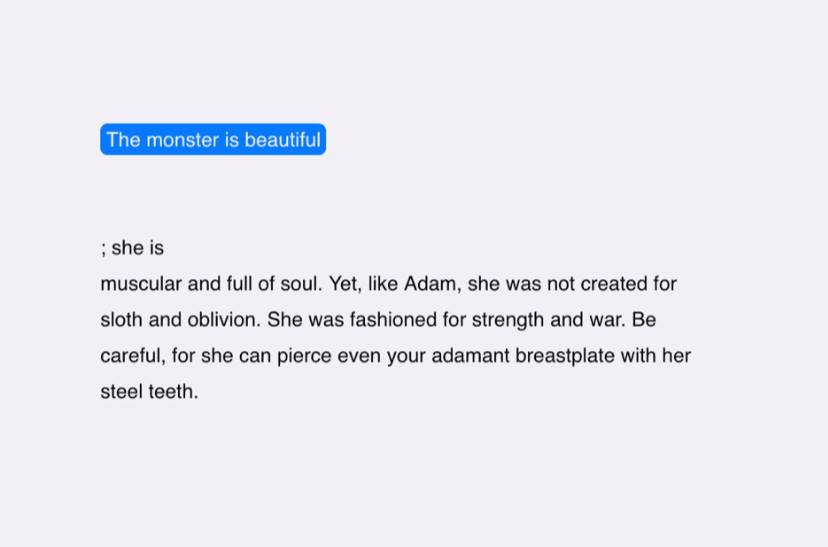
With A Christmas Carol, I uploaded the text and trained Runway on 500 steps, which relies heavily on replicating and understanding an author’s sculpture. Frankenstein also relies on interpretation, but was trained on 1,000 steps, which I like to think gives the AI more room to understand and form its own individuality over a longer period of time. I fed A Christmas Carol lines from the text and lines of my own such as, “Tiny Tim is” and received, “not Tiny Tim, but is in reality a gigantic, old man with a monstrous chin.” This output does not understand the harm of these words, and likely confused Tiny Tim with Scrooge’s likeness. The user can see a difference in giving the AI more time to process something, as I did with the text of Frankenstein. I genuinely believe that Runway understands the pain and incredible depth of Frankenstein’s character. This understanding may not belong to a (yet) conscious being, but it is important to separate our experience of life and consciousness from that of a machine, much like the AI is able to do with Frankestein’s character. The final output that Runway gave in response to, “The monster is beautiful,” managed to take my breath away. This interpretation not only belongs to a feminist perspective, but one that transends the original meaning of the text. Runway has given power to a being that was cast aside for their differences. Perhaps, Runway is embracing these differences, as one should.
The results from my project reveal the evolving stages of AI, and how with time, it can not only serve as an aid for understanding disability, but allow people with speciest and ableist mindsets to broaden their unprogressive views. What is considered “whole” “complete” and even an ignorant word in its usual context like “normal” should be redefined and inclusive to beings of all backgrounds. Disability ultimately shares a connection to artificial intelligence through misrepresentation in literature, film, and the media, as both should be valued and accepted rather than shunned by society. Artificial intelligence has a growing understanding of what disability is, and as long as it is protected and trained by open minded individuals, should prove to interpret disability through a welcoming lens of its own kind.
PYTHON NOTEBOOK | Good Kings Bad Kings (coded book)
Word Count: 1026
I Pledge: Alyssa Brown
I decided to do an abstract painting for my project. Abstract is not my usual style but I felt it was the best way to portray the disability/disorder I chose to represent. I wanted to portray a very common disorder in our society today: Depression. Depression is not always seen as a disability but it often is associated with disabilities. Now this does not mean that everyone with a disability has depression or that everyone with depression has a disability. Many people think that you can only have depression if you have a “good reason” like a hard past or present or a disability and although you may be more likely if one or more of these are true but depression does not always have a reason. It is a mental disorder that anyone can have at any time.When someone has depression, they often feel alone, distant, sad/gloomy, and sometimes in severe cases like life isn’t worth living. I wanted to do depression mainly because so many people make jokes about having depression that I feel like people who really have it get overlooked. Also, I have found that many people think that because one person was able to overcome their depression then everyone else should be able to but that is not how it works. It is not the same for everyone.
In my painting I used three colors: white, grey, and black. I only used these colors because I wanted a gloomy feel. Along with these colors I also tried to create a fuzzy or misty look to it to add to the gloom. I made it abstract, so there would be many ways of interpreting it. I personally see it as misty dark woods which can represent feeling alone. The misty/rainy look adds on to the sad aspect of the painting. Like how there are many ways to see and understand the painting, there are also many ways to see and understand depression. No one view of depression is entirely the same.
There are many different types of depression. One of which is anxious depression which is basically what it sounds like. It is where along with the depression you have high anxiety. I wanted to mention this type one because I feel like I can relate to it and two because I feel that when I stare at my painting not only do I get this feeling like depression but it also makes me anxious and the longer I stare at it the more it makes me think about my anxiety. The purpose of this painting is not to actually make you depressed or anxious but to bring awareness to a little piece of what it is like.
I pledge
word count: 456
Source
“Depression (Major Depressive Disorder).” Mayo Clinic, Mayo Foundation for Medical Education and Research, 3 Feb. 2018, www.mayoclinic.org/diseases-conditions/depression/symptoms-causes/syc-20356007.
“Depression (Major Depressive Disorder).” Mayo Clinic, Mayo Foundation for Medical Education and Research, 3 Feb. 2018, www.mayoclinic.org/diseases-conditions/depression/diagnosis-treatment/drc-20356013.
The role of disabled bodies in the Bible often illustrate contradictory messages and are portrayed in a very stereotyped manner. This paper will discuss the different representations of disability and impairment in the Bible, and also the shift in the roles of disabled bodies from the Old Testament into the New Testament to spread the teachings of Christianity. The Old Testament devalues disabled bodies and represents them as unclean and less than those with seemingly perfectly able bodies. They are used to promote charitable acts and improve the morality of able-bodied people and to act otherwise would result in punishment of an impairment or disability to the offender who in turn would not be welcomed by God. In the New Testament, while Jesus does welcome the disabled, they play a role of allowing able-bodied Christians to witness Jesus’ healing abilities and disabled people are written to need salvation.
Beginning in the Old Testament, disability and impairment are shown in the Bible through blindness, deafness, dumbness, leprosy, and paralysis with visual impairment being the most common. For those who are viewed as disabled or having a form of physical defect, they are ostracized and excluded from society and this was seen often in religious ceremonies. These ceremonies that celebrated God emphasized the societal structure and the various roles in the societal hierarchy. To be accepted as a high-ranking official in the church one must prove bodily normality (Bengtsson). Those with physical impairments or disabled bodies could never be considered to be a priest or take a leading role, and this order established clear division between able bodied people and those with disabilities and this is blatantly stated in the book of Leviticus:
The Lord said to Moses, “Say to Aaron: ‘For the generations to come none of your descendants who has a defect may come near to offer the food of his God. No man who has any defect may come near: no man who is blind or lame, disfigured or deformed; no man with a crippled foot or hand, or who is a hunchback or a dwarf, or who has any eye defect, or who has festering or running sores or damaged testicles. No descendant of Aaron the priest who has any defect is to come near to present the food offerings to the Lord. He has a defect; he must not come near to offer the food of his God. He may eat the most holy food of his God, as well as the holy food; yet because of his defect, he must not go near the curtain or approach the altar, and so desecrate my sanctuary. I am the Lord, who makes them holy (Lev. 21:16-23 NIV).
This passage clearly defines and separates the view of able-bodied people and disabled people in the eyes of God, and how he finds the most satisfaction from a perfect and normal body (Bengtsson). By allowing disabled bodied people to be that close to God it would be a blatantly disrespectful act.
In these sacrificial rituals the purpose is to bring individuals to the divine power by offering the best of their possessions to the God, so to exclude those that are disabled or have defects it exhibits they are less desirable and this is mentioned again in the book of Malachi:
When you offer blind animals for sacrifice, is that not wrong? When you sacrifice lame or diseased animals, is that not wrong? Try offering them to your governor! Would he be pleased with you? Would he accept you? Says the Lord Almighty (Mal. 1:8 NIV).
This reiterates that there is a feeling of shame surrounding any being with a disabled body or physical defect and that they should be hidden from the eyes of God. In early years of Christianity, the church believed that faith “comes from hearing the message” (Romans 10:17 NIV). This belief would leave those deaf and hard of hearing without faith and excluded from the church which is another example of the ostracism of those with disabilities that is exhibited in the Old Testament.
Alongside the narratives and stereotypes of shame and being less desirable there are contradicting messages about the treatment of disabled and impaired people in the Bible, even in the book of Leviticus where it is spoken that God should be distanced from anyone seen as disabled preaches that there should not be mistreatment of disabled people. In the previous chapter of Leviticus God states that no man should “curse the deaf or put a stumbling block in front of the blind” (Lev. 19:14 NIV). It can be argued that this is the first instance in the Bible that advocates for the protection of the disabled in society and reflects competing attitudes toward disability in the Old Testament (Braddock and Parish 4).
The book of Deuteronomy in the Old Testament stresses heavily the way able-bodied Christians in communities should act towards the “others.” The role of disabled people in their communities should be to allow able-bodied people an outlet to practice better acts of charity and learn to increase morality. They were not viewed as equal and should be pitied. “Cursed is anyone who leads the blind astray on the road” (Deut. 27:18 NIV). In instances where one does not act charitably towards disabled people, they were to be punished by God. Disability is used as a punishment towards able-bodied people and they are warned:
However, if you do not obey the Lord your God and do not carefully follow all his commands and decrees I am giving you today, all these curses will come on you and overtake you… The Lord will afflict you with madness, blindness, and confusion of the mind. (Deut. 28:15-28 NIV).
Society was to recognize their obligation to people with disabilities, while also fearing that they could be punished by God with the very same disabilities. The belief that illness was inflicted by an angry God as punishment was widespread among Christian communities (Braddock and Parish 4).
Continuing into the New Testament, although there are much fewer chapters addressing disability directly, the stigma surrounding disability is not changed but rather just narrated differently. The New Testament gospels Matthew, Mark, Luke, and John feature numerous examples of people with physical and sensory disabilities, just as the Old Testament, but now those examples only exist to highlight Jesus’ healing as a miracle worker (Gosbell 9). Their role in their communities has shifted from being an outlet for able-bodied Christians to improve their morality to providing an outlet for able-bodied Christians to see the miraculous healing of Jesus. Disabled people represent the version of humanity that needs to be restored and saved through ministry and faith. If the followers of Jesus are not deemed healthy or able-bodied, it would be because they are not doing something right.
In the book of Mark, the spread of leprosy is a concern for Christians, and it is written that Jesus has the power to heal this undesirable disease:
A man with leprosy came to him and begged him on his knees, “If you are willing, you can make me clean.”
Jesus was indignant. He reached out his hand and touched the man. “I am willing,” he said. “Be clean!” Immediately the leprosy left him and he was cleansed (Mark 1:40-44).
This representation of disability in the book of Mark perceives disease and disability as something that is in need of being saved. The removal of disability is seen as a foreshadowing of the full restoration of humanity, and to be left disabled is a “manifestation of brokenness” (Gosbell 10). The representation of disabled people as more sinful and in need of healing further illustrates that disabled people are not fully accepted in Christianity other than to accentuate the abilities of Jesus. This is exhibited again in the book of Mark when Jesus heals a blind man in Bethsaida:
They came to Bethsaida, and some people brought a blind man and begged Jesus to touch him. He took the blind man by the hand and led him outside the village. When he had spit on the man’s eyes and put his hands on him… Once more Jesus put his hands on the man’s eyes. Then his eyes were opened, his sight was restored, and he saw everything clearly (Mark 8:22-25 NIV).
There are countless examples of Jesus healing the disabled throughout the Gospels, and this is another example of the role that disabled people play in their communities and in Christianity at the time.
Unlike the Old Testament, where God turned away those with disabilities as they were not deemed worthy to be near, Jesus does welcome the disabled into his ministries and does not turn them away. Jesus states in the book of Luke that “when you give a banquet, invite the poor, the crippled, the lame, the blind, and you will be blessed” (Luke 12:12-13 NIV). The role of the disabled people in their communities change after the birth of Jesus Christ due to the fact there were changes in how Christians then practiced ministry.
In the Old Testament, disability was written as a factor of life that could not be escaped or healed and as a result disabled people were turned away from the church and left to be isolated from their communities. The meaning of disability in the Bible shifts with the introduction of the New Testament and the birth of Jesus and gives Christianity a new way to celebrate the able body it deems it perfect. Although there are consistent stereotypes present in the Bible when narrating stories of people with disabilities, the representation of disabled people throughout both Testaments illuminates the complexity of the inclusion of people with disabilities and impairments in Christianity.
Works Cited
Bengtsson, Staffan. “On the Borderline- Representations of Disability in the Old Testament.” Scandinavian Journal of Disability Research, vol. 16, no. 3, 3 Jan. 2014, doi:http://doi.org/10.1080/15017419.2013.873077.
Braddock, David L, and Susan L Parish. “An Institutional History of Disability.” Disability Studies as a Field, 2001, pp. 11–68.
Gosbell, Louise A. The Poor, the Crippled, the Blind, and the Lame: Physical and Sensory Disability in the Gospels of the New Testament. Mohr Siebeck, 2018.
Holy Bible: New International Version. Zondervan, 2017.
Stiker, Henri-Jacques. A History of Disability. Translated by W. Sayers, University of Michigan Press, 1997.
The following poems are first and foremost about my personal experiences with depression and anxiety. That’s just how they started. However, as I went through and revised them, fixing wording here and punctuation there, I found myself wanting to explore the relationship between my mental illnesses and my identity. In the past several years, since starting college, I’ve struggled a lot, trying to find the balance between Depressed Emily, Anxious Emily, and Normal Emily that felt the most true to myself.
I’ve never been one to take my own mental illnesses and romanticize them, so linking the illnesses to my love for writing poetry didn’t feel right, but it didn’t feel honest to say they play no part in the process either. What’s more, each of those versions of myself is just one facet of the whole person. I’m not me without them just the same as I’m not me just because I have them. On making those realizations this project took a new turn. Instead of focusing solely on experience, I changed my direction to explore more of the relationship between myself and my mental illness—each version of myself individually, how they all play together—as well as how they impact my relationship with the people around me, be they strangers or loved ones.
The purpose of this project isn’t to make a broad statement about disability in general—I have no right to be the sole voice, especially because my disabilities don’t extend into the physical. Instead, I want to shed some light on some of the inner workings of mental illness, specifically depression and anxiety, in order to bring the complicated nature of it all into focus. I hope that the poems I’ve written don’t come across as romanticizing in any way, nor do I hope they belittle. Instead, I hope when you read you find them authentic and real, showing many different facets of what it means to be human.
Hindsight
I want to tell you about the good things, too, I mean
it wasn’t all awful I just don’t remember anything else
but the air smelling dirty and burning and feeling like
suffocating in concrete and also missing the green and
skipping a presentation in my speech class because my
suitemates thought I was having a heart attack (it was
just anxiety and the ER nurse was annoyed with me
until I mentioned you had died, in which case she nodded
like she finally got it) and my professor asked me about
the trip the next day in class, in front of everyone, and I had to
explain, “oh, I’m fine, it was all a misunderstanding,” but
she was nice about it and after that I started seeing a
therapist, Dr. T, and if it weren’t for her I’d probably be
squished under the Green Line at Boylston Street Station
which she said was passive suicidal ideation and anyways
walking through Harvard Square to see Dr. T is one of
my favorite memories of the city because, for once, I
felt like I could breathe and not be stealing someone else’s air.
Auditory Anxiety
It’s like this: I know in my gut something’s wrong
because it leaves a bad taste in my mouth
whenever I leave the room and they start talking.
No, no, sorry, it’s not a bad taste in my mouth
it’s my whole brain tensing up, it’s my blood
stampeding through my chest up to my ears and
It’s like this: I hold my breath so I won’t move
but I still feel my fingers wiggling so I lock up
every joint muscle nerve, begging for silence
to come free me but some stupid tears sneak out
and tickle my ears like they’re teasing me and
I’ve never felt so out of control as when the snap
of my breath sent me running, no, crawling
to press my ear against the wall the crack under the door
anything to fill in the blanks and
It’s like this: When it gets so bad I can’t even breathe,
I know I can’t trust what I hear.
All the Little Selves
Every now and then we hold meetings
to check-in with one another, sit at the round
table and ask questions like “how are you feeling?”
and “what have you been up to?”
It’s not always the same because
I’m not always the same. Sometimes
I’m the monochrome, others the
cartoon. Today I’m neither. I’m plain.
It’s not that we don’t see each other—
The monochrome visits at night, slips
under the covers to keep me warm while
I dream and talks to me when I can’t.
The cartoon finds me in crowds, appears
behind new people, pantomiming surprise
to see me there, clambers up onto the shoulders
of strangers, looks to the sky for pianos and anvils.
Today we’re talking about ourselves.
They haven’t visited recently and, if I’m being honest,
I miss them. I tell them that and they look at me confused,
silent, take one hand each and squeeze. A promise.
Perspectives
Even at rock bottom I never saw myself as
broken. Just faded, dulled, muted. I’d look
at the world and be frightened by the vibrancy,
wishing for the easy comfort of my bedroom.
Sometimes they seemed like they were screaming
technicolor murder, and on those days I’d
stay safe under the covers, blank. That was back when
I couldn’t find where my shadows stopped and I
began. I was so wrapped up in them we were
inseparable, like one big knot. Pisces season
never was very kind to me, but I still greet
her all the same, each tangled finger waving,
To the Me I Was Before
Were you watching? Did you see when
I cut, colored, dyed, pierced, molded myself
in the absence of your shadow, practiced
unfurling my edges and pressing out the creases.
It didn’t stick at first—it’s hard to take up space
when you’re so used to folding in on yourself,
after all, but I’ve decided to let myself be,
to expand and contract as I need to, to let
the colors permeate through me so I can feel
entire spectrums of light. In this time of
me, me, me, this absence of your me,
I want to spark life back into these hollows.
I want to be bright again.
Mary Lennox’s Mother:
Disappointment
How can she be mine?
I don’t see myself in her eyes.
My beauty, my spirit, my status, it
becomes lost in her dull expression.
It wasn’t supposed to be like this
for mother and her daughter.
She’s sad, she’s difficult, she’s ill,
and I can’t hide my disappointment.
I wasn’t meant for a life like this.
I was expecting a life of ease.
She requires so much attention,
And I just don’t have the patience.
I’ll find somone capable, of course,
to watch her as she grows.
She’ll have eveything a child could want
I’m sure she’ll be just fine.
George:
Protection
I had you and you had me,
we had our futures set.
But it was a dream, just a fantasy,
I’m not sure where you fit.
I love you I really do,
we’ve been partners this whole time.
But I know what’s best for you,
and you don’t know where to draw the line.
It couldn’t be like this forever,
maybe it’s better me than them.
Close your eyes and look ahead,
and I’ll relieve you from this pain.
Eva Peace:
Liberation
To my shadow of a son,
It’s time for you to go.
If you can’t live like a man,
Then you’ll die like one.
That is my last act of love.
You wouldn’t leave and
you wouldn’t grow.
My womb has no more space,
so, this is where I say goodbye.
I’ll hold you and I’ll rock you here,
I’ll let you be my child.
But then I’ll keep my tears away,
And I’ll do what must be done.
Mr. Radley:
Self-preservation
The community whispers
outside our door.
Please just stay inside
where you can’t cause us more pain.
Joanne Madsen:
Concern
Who cares for you?
Who makes sure your safe?
Who listens to your worries?
Who asks what you want?
Who will be your advocate,
when you can’t speak for yourself?
Who knows what makes you happy?
Who tells you that it’s okay to be you?
Ricky Hernandez:
Sympathy
He looks at me with those sad eyes as I hold him in this room.
Just a driver, now in charge of discipline.
I want to show them kindness, respect, consistency.
These kids don’t see that often,
But my job is to to show up when I get the call,
to constrain and remove.
One day, probably soon, I’ll leave this place,
but I find myself hesitant.
I didn’t think it would be so hard.
I didn’t expect to love them so much…
Jimmie Kenrick:
Acceptance
Just can just call me Jimmie.
You don’t have to call me mom,
you don’t have to call me anything.
We have our own rhythm,
we have a special click,
we have an understanding.
You don’t have to call me mom,
you don’t have to call me anything.
You can just call me Jimmie.
I have created poems based on the point of view of various characters from novels we have read throughout the semester. These are characters that have found themselves in some sort of caregiver position. These characters include Eva Peace from Toni Morrison’s Sula, Ricky Hernandez, Jimmie Kenrick and Joanne Madsen from Susan Nussbaum’s Good Kings, Bad Kings, Mr. Radley in Harper Lee’s To Kill a Mockingbird, Mary Lennox’s mother in Frances Hodgson Burnett’s The Secret Garden, and George from John Steinbeck’s Of Mice and Men. These characters, whether parents, paid professionals, or friends, are put into the role of having to take care of someone with a perceived disability. All of these characters were chosen to represent a range of different types of caregivers and how successful they are in fulfilling their role. The first-person narratives allow for the exploration of the motivations behind these characters’ actions and the corresponding pieces reflect the character’s motivating emotion. Eva Peace was overwhelmed as her role of a mother of a child with a mental disability. Her son did not fit the expectations she had for him and that ultimately led her to orchestrate his death. This could be comapred to George killing Lennie in the end of Of Mice and Men. George was a friend but also a protector to Lennie. Throughout the novel they say they look out for each other, but it is never truly an equal partnership. George often acts according to what he feels is best for Lennie, but perhaps sometimes his actions are for selfish reasons. This raises the question of whether or not his killing of Lennie was really to protect his friend or to relieve himself from the stress of a caregiver position. Either way, he makes the decisions about what happens in Lennie’s life. Other caregivers, such as Mr. Radley and Mary Lennox’s mother, will keep their children at a distance. Maybe they can never accept their child’s differences or maybe they are unwilling to make the necessary adjustments to their own lifestyles in order to care for their children, either keeping them locked away in the house, as Mr. Radley does, or giving the responsibility to a paid worker, as Mary Lennox’s mother does.
There are positive examples of caregivers, too. Joanne Madsen, Ricky Hernandez, and Jimmie Kendrick from Good Kings, Bad Kings all behave more appropriately in their interactions with those they care for. Joanne, while not specifically a paid caregiver in the nursing home, offers the children guidence in accepting their identities as people with disabilities. She also looks after the best interest of all of the residence of the home. She treats the children as individuals and gives them room to grow and express themselves. Ricky, while he struggles with the ethics of his job, also tries to treat the children as individuals. He cares for them on a more emotional and personal level than many of the other paid professionals in the home. Lastly, Jimmie’s personal connection with Yessenia Lopez influences her decision to become her foster parent. All of these positive representations are similar in the way that they allow the other person to be an individual, not defined solely by disability. In cases where caregivers are unsucccessful in their roles, it is because they cannot accept the individual, whether that takes the form of making decisions about what happens to that person or releasing themselves from the caregiver role altogether.
I have neither given nor received unauthorized help on this work
Word count: 564
Daniel Hur
Dr. Foss
ENGL 384
19 April 2020
“Penelo! Penelo!” cried Mrs. Brennan; I tried focusing on the problem on the board. However, no matter how hard I tried, my brain would wander. “Penelo!” cried Mrs. Brennan even louder. Her shouts felt like noise in my ear. My entire brain felt like it was about to burst. A couple of my classmates tried to stifle back some laughs. I looked at the ever-so-furious face of Mrs. Fredericks. Her face was burning with so much anger and animosity.
“Penelo! Could you please solve the division problem on the board,” Mrs. Brennan tried to say in a calm and soothing voice. I shook with fear. Division. I think I knew what kind of necessary equations were necessary in order to solve the problem. Division. It seemed so familiar.
My breath shortened. A couple of my classmates started to laugh and I didn’t know what was going on.
“Penelo, I’d like a word with you before you leave for class today,” she said. I hung my head in utter disappointment. The bell rung. The rest of the kids started to exit out of the building except for me. Mrs. Brennan looked disapprovingly of me. “Penelo, I know that you can do so much better than how you are doing right now.”
“I know,” I said.
“I know the concussion was really bad for you, but you just can’t keep going like this. Something needs to change, and I think it is about time that you went to see the school therapist.” I raised my head a little.
“A therapist.”
“Yes, now here is the card. It’s about time that you got some help for one.”
***
As I was making my way to the bus, I couldn’t help but look down at the card my teacher had given me.
“Mrs. Leslie Brushae. Phone#: 571-218-9898. Room 218.”
“Hey, Penelo! You did pretty good back there at Math class.” I turned to see Rachel pointing at me with a group of other girls. At one point during the hockey season, they had all been my fellow teammates. Now they were making fun of me.
“Hey! Penelo, I thought at one point you were probably the smartest girl in the class! What happened?” another student mocked. I closed my eyes as I started to board the bus.
“Yeah, good luck trying to live the rest of your life as a hobbo!” another student said. I covered my ears. It was true. I used to be so good at Math, but ever since the concussion, it all changed. Everything about me changed, and now I had no choice but to live with this new reality. If only I hadn’t slid into the goal to catch the puck. I shut my eyes even harder as the memories started to resurface. Me helplessly on the ground, barely conscious while several of my teammates asked if I was ok.
***
“I’m home!” I cried out in the loudest voice possible. As soon as I saw my parents come running forward, I smiled.
“Hello, honey, how have you been doing? How was school?” my mother asked. My smile started to disappear.
“Well, uhhh…I got kind of stuck on a math problem,” I began. Seeing no other way out of this, I gave the card that my teacher had given me.
“What’s this? A psychologist?” my mother asked as she and my father started looking on. I shifted from one foot to the next.
“Honey, has school really been going ok?” my dad asked. I breathed a huge sigh as if I had just gotten a large weight off my chest.
***
“Well, honey, I don’t think she can just live like that forever,” my mother said. “She needs professional help.”
“Yes, but do you think all this is really necessary?” asked my father. “I mean, all I’ve ever wanted her to be was just a normal girl.”
A normal girl. For some reason that felt like it was farther away than ever. I crawled into my room and started staring at the wall. Get up, the inner voice inside of me started to say. I stirred inside my bed, wanting nothing more than to make myself go to sleep.
It was just a little hit on the head, I thought to myself. Just a small hit and that was all that it needed for me to be in a ruined state. On the left side of my room were my hockey shoes that I had used to skate around on the ice. Walking over to the side of the room, I picked it up, my hand trembling.
***
As I walked into the room, I couldn’t help but wonder if I was making a mistake as I went through those doors. What was going to happen to me? Stop worrying, I told myself. I took a deep breath as I walked into the room.
“Hello there!” I looked up to see a fairly middle-aged woman sitting in front of a desk and typing on a computer. “My name is Dr. Brushae!”
“Hi, I’m Penelo,” I said. The woman started to leave the computer. She had her hair tied back in a bun. Thought her skin looked old and frail—as if she was a woman that was starting to peek at her age—there was a hint of joy inside of her that seemed to counteract against her age. “Mrs. Brennan has told me all about you.” I stood in her office door, almost as if I was afraid to go up to her. “It’s ok, now tell me. Tell me whatever is going on within your mind. How are you?” My entire head was spinning, but I wasn’t just going to break down in tears in front of her.
“I’m good,” I said.
“Is that true?” she asked. I noticed she was jotting down notes inside of her notebook.
“Yes,” I replied. She leaned forward. Her eyes focused very hard into mine.
“Penelo, you can tell me anything you want. Mrs. Brennan may have told me some things about you, but I assure you that I don’t believe in any of them.” My body stopped tensing and I began to relax.
“It’s just ever since I got the concussion, I just felt like my entire life just went to shambles,” I said. She looked at me and nodded her head. Her face looked like it was filled with compassion.
“I’m sure it was really hard for you; the fact that you couldn’t quite play anymore,” she said. I nodded my head. My breathing began to slow.
“I can tell that you suffer from a lot of anxiety,” the doctor said. We talked for hours. Finally, she took out an object from her pocket. “I’m thinking about prescribing you on Serotonin medicine. They are anti-depressants that might help you, but I also wanted to give you this.” She handed me the object that she took out. It was shaped like a bell that hung from a cut ribbon. “This is my lucky charm, and I am lending it to you. I usually like to give my patients trinkets that I used to have when I was a child. I am lending this to you.” As soon as it fell in the palm of my hands, I could feel the weight of the charm, which calmed me.
“Thank you,” I said.
***
“So how was your meeting with the school therapist?” asked my mother.
“It was good,” I said. “She gave me this.” I put down the bell in front of my mom.
“Well, that’s kind of…cute,” she said.
“Oh, yeah, and she also gave me some serotonin as medicine for my mental illness.”
“Sero-tonin,” my mom stammered as she struggled to put the word together.
“Yeah, it’s medicine to help with my mental illness.”
***
“So, how has the Serotonin been helping you?” asked the doctor.
“It’s been going really well,” I said. “And thank you for being willing to hand over your lucky charm over to me.” The doctor smiled.
“Well, I’m glad that you have been able to find yourself,” the doctor said. “So could you please try and reiterate the accident that you had on the ice.” I thought back.
“I was skating as the goal keeper for my team. I paid very close attention to the puck,” I began. My voice began to quiver. The doctor took notes. “As I was trying to keep track of the puck, I lost my footing. Before I knew it, the puck was zooming towards the goal and I was on the ground.” My voice continued to quiver.
“No need to be sad,” she said.
“I know, I know, but for some reason no matter how hard I try I find it really hard for me to keep it together whenever I talk about this. I let the team down, and it was all for nothing.” I could still see Rachel’s face glaring at me with anger.
“Oh, Penelo,” my doctor said.
***
“So, Penelo, can you solve this division problem?” my teacher asked. I clutched the lucky charm. Make sure to clutch the charm when you are nervous, I recalled the doctor telling me.
“24,” I said. Ms. Brennan looked shocked.
“Yes, that is the correct answer. Very good,” she said. The rest of the class was silent. I felt proud of what I had managed to accomplish, happy with the fact that I had solved the problem.
***
As I returned home from school, I couldn’t help but feel prouder of today.
“Mom, Dad, I’m home!” I cried. My parents came running in. I embraced them with a hug.
“Honey! So nice to see that you are a bit happier,” Mom said, thought underneath the happiness I could sense there was a bit of uncertainty.
“Yes, I agree!” said Dad. “It certainly helped you a lot when you had started to see the school psychologist.” Despite the fact that I was feeling overjoyed by the fact that I was being embraced with love by my parents, I couldn’t help but feel like they sensed something was wrong with me.
***
“Honey, I’m not sure if this is ok for her. Some of the things that I hear about the school doctor sound a little bit suspicious and up in the air to me,” my mom said.
“I think you’re worrying too much. She seems to have some major improvements ever since she first started meeting the doctor,” my dad replied.
“I don’t know. I hear there is a board of parents that will be coming forward to complain about some of her methods.” I froze in fear, but I realized there was nothing I could do.
***
Dr. Bruchae sat very quietly at the desk—the only difference being that now she no longer had another student that she was trying to talk to. Now she had several parents that had come to complain of her.
“Dr. Brushae, we understand that you have done your very best in terms of trying to take care of the students at the school, but may us parents interject with some complaints that we have of you,” said another man.
“My son came home one day and brought a little trinket with him that is called a lucky charm,” said one mom. “I couldn’t help but feel that you were forcing some kind of spirituality on him.”
“No, that wasn’t the case at all,” Dr. Brushae said. “All that I really wanted was to send him some kind of encouragement. Something that will get him up more.”
“Another thing, Dr. Brushae,” said another parent almost as if he hadn’t heard what she had just said. “You seem to have a lot of heavy reliance on medication as a method to cure your patients. Don’t you think that it is a little far-fetched to keep feeding your students meds? I mean, what about the side-effects?”
“I have that all under control,” she began. Then she made contact with Penelo’s parents. Her speech stopped dead in its tracks.
***
“And now I have just shown you how to solve these problems,” I said as soon as she finished doing the equations on the board. Ms. Brenna clapped her hands in excitement.
“That’s excellent Penelo!” cried Ms. Brenna. I walked back to my desk.
“Excuse me, but Dr. Brushae wants to have a word with Penelo.” I walked out of the hallways to see Dr. Brushae. She had a smile on her face.
“Congratulations!” she said when I told her about the math problems; however, soon she started to tremble. Her voice began quivering as if she was crying.
“What’s wrong?”
“Penelo, I just wanted to tell you that I am so proud of what you managed to accomplish,” she said. “But I wanted to let you know that I will be leaving this school in hopes of finding something that is more suitable to me.”
“What?”
“There were so many complaints,” she said, wiping away some tears. “I might have to either transfer somewhere else or re-evaluate my style of counseling.” I stood there in shock. “Just remember to stay strong and keep the lucky charm…”
***
As I rode home that day, my entire head felt like it was spinning. It seemed like so many things just happened all at once. For some reason, I almost felt like Dr. Brushae had betrayed me, and yet, I couldn’t figure out a legitimate reason to get angry about it.
I took out the lucky charm that Dr. Brushae had given me long ago. The ribbon that was attached to the top of the bell had been lost. Now all that was left was a plain golden bell.
I clutched the bell inside my pocket, thanking Dr. Brushae for everything that she had done for me.
“Hey, Penelo!” I turned around to see Rachel trying to talk to me. “Do you wanna sit with me?” she asked. Initially I looked really apprehensive, but eventually I ran over and sat with her.
“It feels like awhile since the last time I talked to you,” she said.
It’s been awhile since the last time I’d talked to you, I thought back.
Word count: 2250
“I pledge that I had no unauthorized help on this assignment.”
-Daniel
Taking an interest in disability treatment and being in the special education program at UMW I designed a lesson plan focused on Of Mice and Men but including other texts from different cultures as well to compare and contrast the treatment of those with a range of disabilities. I have included The Treatment of Bibi Haldar as well as a portion of The Secret Garden into the lesson plan as comparison texts. All of these texts will be provided either digitally or physically. While focusing specifically on the treatment of characters by those able-bodied, the students will also be able to analyze the language used by these individuals. Is it demeaning? Are they meaning to be ‘mean’ to these characters or is it due to stress of not understanding how to be around someone with a disability? There are a lot of things to consider going into this lesson plan and one of those also is how we define disability. The lesson will be taught over a period of about a week slowly analyzing chunks of the literary pieces but also learning more about disabilities as a whole. While this may not be a unit present in many or even any English classrooms in the United States, it will still follow the curriculum set by the school for that year. This lesson is designed for Grade 10.
The goal of this lesson is to primarily show how the treatment of those with disabilities can change or be the same from culture to culture. We will begin with learning about disability in class on a broad spectrum and touching on different types of disabilities and how we see them now as well as common perceptions. Bringing awareness to how treatment in a general sense has changed and should change is truly important for this lesson. We will touch upon the Autism spectrum, Down Syndrome, Coffin-Lowry, Deafness, Blindness, Deforminites, and so forth to broaden the student’s idea and knowledge of what disabilities look like and consist of. While an older individual becomes disabled as they age, it will not so much be emphasized in this lesson because none of the characters are put out due to their age, only preexisting disabilities that cut their job short due to age. Culture drastically changes views, treatments, what is important and what is not. Within this lesson, we will learn how three different cultures dealt with a disabled character. The American South and India are drastically different even now in their treatment of those with disabilities, and this will be the primary focus of the compare and contrast opportunities given in class.
During this lesson students in the classroom that may have a disability will be included and put where they are most comfortable and will gain the same amount of understanding as others in the classroom. This will also help those who have not been around individuals with disabilities become aware that anyone could have one, it does not and will not always be apparent. Without calling out students who are listed with a high functioning disability, I will need to be aware of how these students are acting. Is it normal? Is this lesson making them uncomfortable and they are not as talkative due to that? These and many other questions will be going through my head during this week of teaching disability treatment in different cultures.
I pledge.
Amy Rouse
Word Count; 564


You must be logged in to post a comment.