Toni Morrison’s work often features myths and mythologization as a theme. While there are several instances of allusion and parallels to Classical mythology in Sula, I was struck by the similarities that can be drawn between the treatment of “madness” (or, realistically, mental illness) and curses. Historically, mental illness has often been treated as a kind of moral failing on the part of the person afflicted, making them dangerous to even associate with, as one does not want to find themselves similarly disposed. There is also significant evidence that many psychiatric disorders have a genetic component, allowing them to run through family’s generationally, similar to many mythological curses. The purpose of assigning a moral valuation to people with mental illness and equating it with a curse is twofold: on the one hand, presenting mental illness as a result of tampering with forces outside of one’s control and subsequently being punished by a higher power functions as a very effective scare tactic in regards to keeping people in line with societal norms. On the other hand, it serves to isolate them from society by presenting them not as a victim, but rather as a perpetrator, and instigator, and someone undeserving of sympathy.
Of all the curses in Classical mythology to choose from—because the Greeks were viciously bloodthirsty, and very fond of punishment—the one I thought most reminiscent of Eva Peace was the tale of Lycaon, the twisted King of Arcadia who tested the god Zeus and paid dearly for it. Lycaon, in an attempt to trick Zeus, tried to feed the god King the entrails of Lycaon’s own son, Nyctimus, to see if the god was truly omniscient; the end result was, of course, that Zeus recognized the treachery, and as a punishment turned Lycaon and all his children aside from poor Nyctimus into wolves. Eva Peace, the matriarch of the Peace family with a questionable understanding of ethics, is similar in many ways to Lycaon. She falls under a similar role of a person who, while powerful in their own right, does not possess the grand influence that they perhaps believe they do. In the end, both Eva and Lycaon are the victims of their decisions in life, with Eva being left in a nursing home, and Lycaon roaming the wilderness in Greece. She also, like Lycaon, makes multiple sacrifices by way of the flesh, both her own and her son Plum’s, as well as possibly her daughter Hannah’s. While not all of her actions were bad, Eva’s influence deeply affected the lives of her children and grandchildren, and the general misfortune and mediocrity they find in life can, in many ways, be attributed to Eva. She is the first of the ravening wolves, but no one who is under her influence escapes entirely unscathed. While Eva is never explicitly described as being mentally ill in the novel, Sula doesn’t scrimp on showing her as someone with delusions of grandeur (subconsciously placing herself as a God-like figure in the Bottom community), as well as someone fully capable setting her own son on fire and murdering him in cold blood while fully believing it to be the right thing to do.
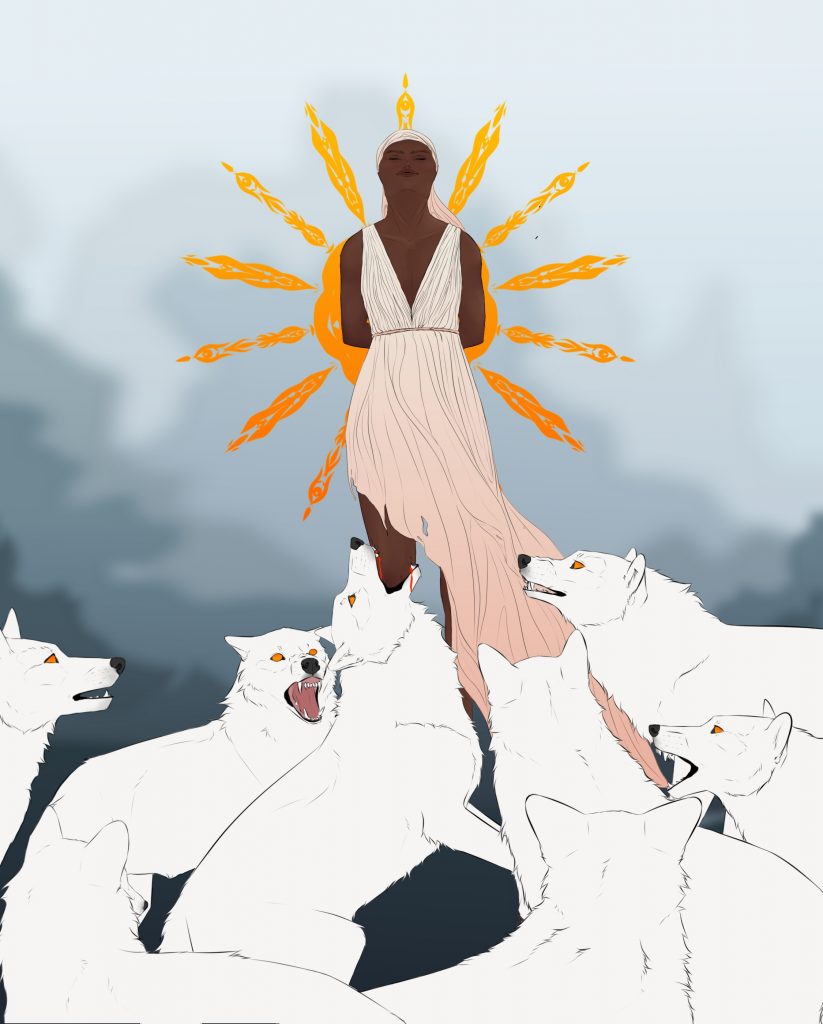
In my art, I wanted to present the vision of Eva, torn between two sides; her internal vision of herself as a divine figure, and the monstrous external consequences of her actions. I also wanted to tie in the myth of Lycaon in a rather obvious way. The end goal was to encompass the parallels between mythology, curses, mental health, and Eva’s own story in a way that expresses not only the violence, but also the underlying tragedy and sense of ruination that Eva brings nipping at her heels.
Word Count: 621
Sources:
Ovid, and Rolfe Humphries. Ovid: Metamorphoses. Indiana University Press, 1971.
Hergenhahn, B. R., and Tracy B. Henley. An Introduction to the History of Psychology. Cengage Learning, 2019.
Donaldson, Elizabeth J. Literatures of Madness: Disability Studies and Mental Health. Palgrave Macmillan, 2018.
