Saunders Major Project: Poetry Collection

The following poems are first and foremost about my personal experiences with depression and anxiety. That’s just how they started. However, as I went through and revised them, fixing wording here and punctuation there, I found myself wanting to explore the relationship between my mental illnesses and my identity. In the past several years, since starting college, I’ve struggled a lot, trying to find the balance between Depressed Emily, Anxious Emily, and Normal Emily that felt the most true to myself.

I’ve never been one to take my own mental illnesses and romanticize them, so linking the illnesses to my love for writing poetry didn’t feel right, but it didn’t feel honest to say they play no part in the process either. What’s more, each of those versions of myself is just one facet of the whole person. I’m not me without them just the same as I’m not me just because I have them. On making those realizations this project took a new turn. Instead of focusing solely on experience, I changed my direction to explore more of the relationship between myself and my mental illness—each version of myself individually, how they all play together—as well as how they impact my relationship with the people around me, be they strangers or loved ones.

            The purpose of this project isn’t to make a broad statement about disability in general—I have no right to be the sole voice, especially because my disabilities don’t extend into the physical. Instead, I want to shed some light on some of the inner workings of mental illness, specifically depression and anxiety, in order to bring the complicated nature of it all into focus. I hope that the poems I’ve written don’t come across as romanticizing in any way, nor do I hope they belittle. Instead, I hope when you read you find them authentic and real, showing many different facets of what it means to be human.

Hindsight

I want to tell you about the good things, too, I mean

it wasn’t all awful I just don’t remember anything else

but the air smelling dirty and burning and feeling like

suffocating in concrete and also missing the green and

skipping a presentation in my speech class because my

suitemates thought I was having a heart attack (it was

just anxiety and the ER nurse was annoyed with me

until I mentioned you had died, in which case she nodded

like she finally got it) and my professor asked me about

the trip the next day in class, in front of everyone, and I had to

explain, “oh, I’m fine, it was all a misunderstanding,” but

she was nice about it and after that I started seeing a

therapist, Dr. T, and if it weren’t for her I’d probably be

squished under the Green Line at Boylston Street Station

which she said was passive suicidal ideation and anyways

walking through Harvard Square to see Dr. T is one of

my favorite memories of the city because, for once, I

felt like I could breathe and not be stealing someone else’s air.

Auditory Anxiety

It’s like this: I know in my gut something’s wrong

because it leaves a bad taste in my mouth

whenever I leave the room and they start talking.

No, no, sorry, it’s not a bad taste in my mouth

it’s my whole brain tensing up, it’s my blood

stampeding through my chest up to my ears and

It’s like this: I hold my breath so I won’t move

but I still feel my fingers wiggling so I lock up

every joint muscle nerve, begging for silence

to come free me but some stupid tears sneak out

and tickle my ears like they’re teasing me and

I’ve never felt so out of control as when the snap

of my breath sent me running, no, crawling

to press my ear against the wall the crack under the door

anything to fill in the blanks and

It’s like this: When it gets so bad I can’t even breathe,

I know I can’t trust what I hear.

All the Little Selves

Every now and then we hold meetings

to check-in with one another, sit at the round

table and ask questions like “how are you feeling?”

and “what have you been up to?”

It’s not always the same because

I’m not always the same. Sometimes

I’m the monochrome, others the

cartoon. Today I’m neither. I’m plain.

It’s not that we don’t see each other—

The monochrome visits at night, slips

under the covers to keep me warm while

I dream and talks to me when I can’t.

The cartoon finds me in crowds, appears

behind new people, pantomiming surprise

to see me there, clambers up onto the shoulders

of strangers, looks to the sky for pianos and anvils.

Today we’re talking about ourselves.

They haven’t visited recently and, if I’m being honest,

I miss them. I tell them that and they look at me confused,

silent, take one hand each and squeeze. A promise.

Perspectives

Even at rock bottom I never saw myself as

broken. Just faded, dulled, muted. I’d look

at the world and be frightened by the vibrancy,

wishing for the easy comfort of my bedroom.

Sometimes they seemed like they were screaming

technicolor murder, and on those days I’d

stay safe under the covers, blank. That was back when

I couldn’t find where my shadows stopped and I

began. I was so wrapped up in them we were

inseparable, like one big knot. Pisces season

never was very kind to me, but I still greet

her all the same, each tangled finger waving,

To the Me I Was Before

Were you watching? Did you see when

I cut, colored, dyed, pierced, molded myself

in the absence of your shadow, practiced

unfurling my edges and pressing out the creases.

It didn’t stick at first—it’s hard to take up space

when you’re so used to folding in on yourself,

after all, but I’ve decided to let myself be,

to expand and contract as I need to, to let

the colors permeate through me so I can feel

entire spectrums of light. In this time of

me, me, me, this absence of your me,

I want to spark life back into these hollows. 

I want to be bright again.

James Pryor’s Major Project: Visual Art Piece; Glass Press

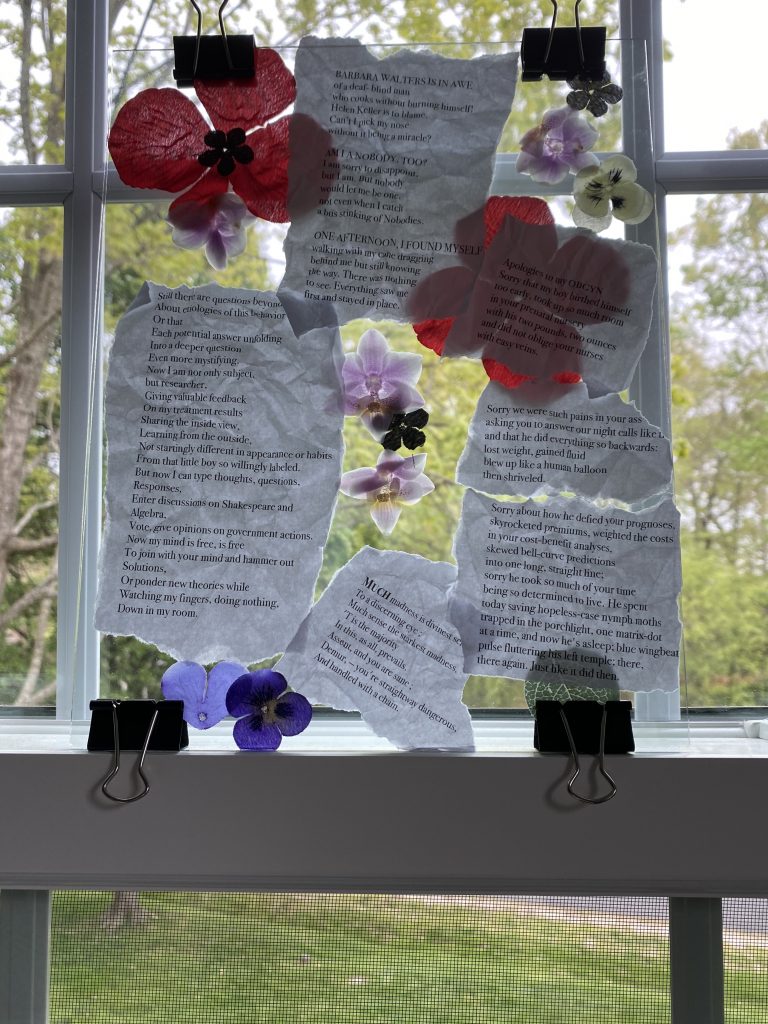
For my final project I chose to do a visual art piece. The physicality of the piece is two panes of 8×10 glass compressed together with excerpts of poetry from our class, along with both fabric and real flowers in between said pieces of glass. The compression on the glass is caused by the symmetrical placing four of heavy-duty binder clips against the glass.

The metaphorical ideas behind the creation of this piece stem from the ideas of preservation. By using excerpts from the following poems; Rebecca Foust’s “Apologies to my OBGYN,” Craig Romkema’s “Perspectives,” John Lee Clark’s, “Deaf Blind: Three Squared Cinquain,” and Emily Dickinson’s “Much Madness is divinest Sense,” the viewer sees art created by disabled authors, who are often forgotten in art. Whether it be the art of a disabled person being invalidated, or straight up destroyed due to living in a violently ableist society, the reality is that nondisabled people choose to overlook the art created by disabled artists. However, while there is an unmeasurable amount of art that has been lost due to ableism, the art that remains is preserved eternally. Placing the poem excerpts between two panes of glass ensures the security of not being tossed aside. This metaphor of fighting for visibility is continued with the intentional strain that has been placed on the paper the poems are on. An ableist society is one that attempts to crumple up the art made by disabled people and throw it aside, because they do not value it with the same weight as their own art.

The ugly truth is that nondisabled individuals do not want to hear about the personal experience of those with disabilities. Often when a disabled person is recounting their own personal struggled, nondisabled peers will berate them for complaining or whining, implying that talking about these ableist interactions in life are the fault of the disabled person, not the oppressive structure society has been founded on. On the other side of this doubled edged sword, if a disabled person views their disability in a positive light, they are also berated by nondisabled people who push the ideas that anyone who is not inside their definition of normal needs to be “fixed” or “cured.” The use of the flowers in this piece coincide with the wishes of the Disabled Rights Movement, where flowers are seen as beautiful, disabled individuals should not automatically be considered worthless or seen as eyesores to the greater idea of humanity as a whole. The use white and blue pansies, alongside the red rose petals stand for the beauty of each individual. However, the inclusion of the pink and yellow orchids calls attention to the issue of death against disabled people. This applies specifically to Foust’s poem, where she recounts the neglect her son faced from medical professionals who deemed her son not worth the effort to keep alive, unfortunately a common prejudice held by doctors and nurses alike.

Preserving the art made by disabled individuals, and by extension the disabled community, is a key factor in creating a society that will not overflow with ableist prejudices. Nondisabled people need to learn empathy for those who do not fall into their rigid categories of normal; exposure to art made from every point of view is the best way to teach others to care about humanity as a whole, not just those within their line of sight.

I pledge.

Word count: 569

Tale as old as Time

Kevin sighed as he looked at the report card which had been handed to him earlier that afternoon before he left school. Though it was only the end of the second quarter, he had already amassed two report cards this year which showed him continuing to fall behind many of his classmates. Indeed, the average was three and a half weeks late for assignments now, and several classmates had been ridiculing him for being lazy and stupid if he could not keep up with his peers. Yet, he could take that, but not what he knew he would have to face at home. For facing his parents was the biggest challenge of them all.

His parents, Greg and Judith, both loved Kevin greatly, yet they also placed great emphasis on him to do his work as they believed that he could achieve more greatness if he only tried a bit harder. Ever since he had been a young child, they knew he was bright and gifted, but he never put it to good use academically.

You see, whenever Kevin would be given an assignment by one of his teachers, be it back in Elementary school or even now in Middle school, he would hide it from his parents and ignore the problem, wanting to do things such as watch TV or play video games. During classes, he would simply glance at the clock or be so bored, that he would daydream about other matters which would be apparent to his teachers when they would call upon him to answer a question, and Kevin would behave like a deer caught in the headlights, struggling to come up with an answer as he hadn’t been paying attention. For in-class assignments, he would either not hand them in straight away, or else he would just write gibberish on a piece of paper and turn that in, which also frustrated his teachers.

Yet, whenever his parents would take him for testing as a child to see if he had a disability, the tests always had come back normal, with the person administering the test telling them that their son was extremely bright.  It was frustrating thus for his parents because they would then have to go into parent-teacher conferences and try to argue that he wasn’t in need of special education, something many teachers had argued he needed to be placed in, and so people would assume that he was simply just lazy and would be lazy for the rest of his life, completely disinterested in things around him which didn’t appeal to him.

Opening the envelope, Kevin took out the folded piece of paper and looked at it. As he suspected, it listed over and over that he had missed deadlines for assignments and was struggling in each of his classes. He knew all too well what the outcome would be when his parents saw the repot card. No TV or video games until he had caught up and shown improvement in each course. A punishment he felt was worse than death. Thus, he dreaded going home. He was tempted to just throw out the report card, yet that wouldn’t be helpful as he already had tried that sort of stunt as  a child and it had backfired when he overlooked that his parents would simply contact the school if they hadn’t received the report card after a certain length of time.

As he made his way home, albeit going a very long way around instead of his usual direct path, Kevin came across one of his classmates named Sean. Like himself, Sean was a bit of a loner with their classmates, although in Sean’s case, it was due mostly to being bound to a wheelchair as a result of a minor case of spinal bifuda which  he was suffered his entire life. He was still a nice person to talk to, but many of their classmates sadly shunned Sean due to his physical impairment and would ridicule hm behind his back for needing a wheelchair to get around. Kevin had not really talked much to Sean outside of classes, so he really did not know him that well, and yet on this somewhat fateful day, that was all about to change.

He really did not have a need to go and talk to him, and yet something inside of Kevin pushed him forward. To this day, he never understood what it was that actually made him walk over, yet if one were to ask Kevin, he was certainly glad that it was allowing him to avoid arriving home sooner than he wanted. Especially given that he was still unsure as to what he would do with the report card to lessen the blow. And although they were ridiculed by their classmates for different things, it seemed something that they might possibly be able to connect of as fellow human beings, let alone classmates.

Sean was busy reading a book titled ‘How the Cobbers Started’ when Kevin approached him. A book all about the Concordia College in Minnesota and its athletics program.

“Hey” Kevin said nonchalantly as he walked up to Sean.

Sean glanced up from his book and saw Kevin, before putting on a cheerful smile. “Hey there. How did you do on your report card” he asked. It wasn’t as a stab at Kevin like it would be taken from other students who wanted to use it as fuel to proclaim Kevin as stupid, but rather just a genuine question of interest. However, because of how their classmates would ridicule him, Kevin at first was somewhat wary of the question and partially took it the wrong way, shoving the report card into his jacket pocket as a defense.

“Meh, I can’t complain about it. Not the best report card I have ever had, although not the worst either.”

While this was certainly true, as the worst had been in the fifth grade when Kevin had been forced to repeat the year as a result of not having met the requirements to move on to the sixth grade on his first attempt. That had been a punch in the gut which he had not wanted, but which at this point, he felt had probably been for the best.

“I hear ya,” Sean replied. “It’s been a weird quarter at school.”

“What’s that you’re reading” Kevin asked, interested more as he did not recognize the image on the front cover of the book, which was apparently of a college corn cob mascot.

“Oh, this? Well, my parents want me to start thinking of my future now, even if we are only in the seventh grade, and so they want me to start looking at colleges for my future. So, I was looking through this book to see what the life is like at Concordia College in Minnesota. Their sports mascot is an angry ear of corn named Kernel, and they have several programs which might work out for me. But still, it is early days really as we’re not even in high school yet.”

“Do you think that I have what it takes to go to college,” Kevin asked. He wasn’t sure what he wanted to do this weekend outside of TV and video games, let alone what he wanted to do after high school was over. That was way too far out, but it was still something to ponder, he supposed.

“That depends. Do you want to go to college?”

Sean’s question brought up a great point in Kevin’s mind. Why worry about the future, instead of just living in the here and now, was how Kevin perceived it, even if that wasn’t what Sean had asked.

“I don’t know really. I honestly haven’t thought about it much at all. I know that as a child, my parents started pushing me, saying that I needed to go to university to have a good paying job. But, in all honesty, I just don’t know what I would want to do. I mean, it’s not like you can make a living simply watching television or playing video games.”

“Is that what you do in your spare time away from school?”

“Yeah, although my mom keeps nagging me to get off the TV and focus more on my schoolwork. She insists that I have a limit of 30 minutes a day for one or the other, and that I need to do my work.”

“Why don’t you do your work though? In class, you always seem dazed and completely out of it.”

“I don’t know. I just find the classes to be boring and not entertaining to me. I just want to be able to do my own thing, and not have to be stuck doing what others want me to do in such a prison-like environment, I guess. Especially as I hate being stuck in those rooms with teachers who just want to lecture in their usual monotone-like voices as if just saying something without any interaction is going to help the students.”

Sean chuckled.

“What?”

“No, no. It’s nothing. Please, continue.”

Kevin shrugged, and continued his spiel. “Another thing is how I’m sure that the clocks in schools are deliberately designed to slow down in the last 5 minutes of class, so that those few minutes become an eternity in and of themselves. It’s agonizing to watch the clock and be wishing that the bell would ring already so that I can get out of that room, even if it is only to be tortured by going to another classroom during the day.”

Sean burst out laughing at that confession regarding the clocks in school. “As they say, a watched pot never boils.”

As they continued to chat, the sun began to wane off in the distance, and Frank had completely forgotten about his own dilemma regarding the report card with his parents. When it came time to head home for real, he waved goodbye to Sean, who himself started wheeling home, and turned to head back, his report card still in his jacket pocket where he had placed it earlier.

Upon arriving home after dark, Kevin took off his jacket and shoes before hearing his mother call out to him from the kitchen.

“Kevin? Is that you?”

“Yeah, sorry. I was chatting with a classmate after school and lost track of the time.” Which was completely true, although not the entire truth at that.

“Well, come into the kitchen as your father and I would like to talk to you about something.”

Oh boy,’ he thought to himself. ‘Here we go.’

Trudging into the kitchen, but without his report card, which was still in his jacket pocket, Kevin sat down with a somewhat dejected look upon his face.

“How was your day today,” his mom asked. “And who were you chatting with? Was it a girl, by chance?”

“MOM!” Kevin went beet red Though it certainly was neither a girl, nor someone he was romantically interested in, it was simply the notion that his own mother would jump the gun and assume that it was a girl he liked. While there was a girl in the class whom he did fancy, it wasn’t Haylee whom he’d been talking to, although he was certain that Haylee wasn’t interested in him due to how most of the class treated him for his lack of participation in school.

“Sorry sweetie. It’s just that you are at that age where boys really start liking girls, and I was just wondering if that was the case.”

“No, it was Sean. We just ended up chatting about random stuff near the bus terminal, and lost track of time as a result.”

“Anything in particular you talked about?” his father asked.

“Uh, well, he was looking over information for a college in Minnesota, which I found surprising that for someone in the seventh grade, he would already be thinking well into his future like that.”

“That’s great. It shows real commitment to his own future.” His mom Judith said before patting her son’s hand. “Listen, Kevin. Your father and I have been talking, and we’ve decided to have you go through a new round of testing.”

Kevin’s eyes rolled in annoyance at the idea of having to undergo yet more testing by a specialist, given all the tests he had previously had, all of which turned out negative for intellectual disabilities.

“Now, don’t roll your eyes. We’re doing this for your own good. After all, we want what is best for you. It’s been quite a while since you were last tested, and although those all came back to say that you were completely bright, as I’ve always insisted that you are, newer tests have come out which may help shed some light on what your situation truly is. Don’t you want to be able to find out what it is that’s holding you back from getting your homework and in-class assignments done on time?”

Kevin thought for a moment about what his mom had just said. “What if the results all come back the same as they had before?”

“Then we’ll cross that bridge when we come to it.”

There was a brief pause, during which Kevin thought deeply about the whole situation. “Alright, fine. I’ll do it.” Though partly it was the thought that he would be able to get out of school in order to do said testing, that made him more accepting of the idea of getting tested.

“Oh, I almost forgot,” his mom then added. “Where’s your report card?”

There was a painful groan by Kevin before he got up and made his way back into the hallway to grab it from his jacket which was hanging up in the closet. Upon returning to the kitchen, he handed the report card to his mom who looked over it, before handing it to his father.

“Well, hopefully after getting this testing, we’ll be able to see you get away from such abysmal grades as these are,” his dad said, all while biting his lower lip in frustration.

*****

A couple of months later, while Kevin certainly hadn’t improved his grades in readiness for the next quarter’s report card, he sat in preparation for the meeting between himself, his mother, and the child psychologist who had carried out the testing, Dr. Roubache.

“Well now Kevin, I have some good news for you based upon what we have looked over with both your schoolwork and your testing with me over the past couple of months. Not only are you truly bright, but I understand what has been causing you to be feeling spaced out in the classroom. You see, while you had previously been tested for Attention Deficit Disorder, up until recently we only had a diagnosis for the condition with the hyperactivity aspect, which you don’t possess. It wasn’t thought that a person could have the condition without being hyperactive. So, while you met all the other markers even as a child, it was that one thing which has unfortunately become a barrier for you over all these years. Now that the field has a broader understanding and has determined that it is possible to have Attention Deficit Disorder without the hyperactivity, and based on my observations and the testing which was carried out, it would certainly be a perfect match to what you have been experiencing.”

A part of Kevin felt better at knowing how they finally had something of an answer, even if another part of him worried about what it would mean for him going forward.

“The most important thing to keep in mind, is that this isn’t your fault, and that you don’t need to be placed in a special education program. Instead, I’m going to refer you to a doctor who can run a few additional tests in order to determine what medications and strengths can be used to  help raise your concentration levels and thus fix this matter once and for all.”

“Wait! You mean to say that there’s a magic pill that can make me smarter than all of my classmates?”

“Now, I didn’t say that. All I said is that there are medications out there which can help people such as yourself, to overcome the obstacles which are distracting them and allowing them to go on impulse throughout their daily lives. But as far as which one, if any, will be prescribed to you, I cannot say myself. It could be a stimulant such as Ritalin, or Adderall, for example. But that will have to be determined by the medical doctor, Dr. Corazon.”

“Isn’t that wonderful news, Kevin? We finally have answers to help you going forward,” his mom said with some relief in her own voice. All those years of having to insist to his teachers that he truly is a bright student, and now she felt vindicated on his behalf for the past.

I pledge…

Richard Yeomans.

Word Count: 2827.

**********

Word Count for Write-up: 453

Project Write-up

For my Major Project assignment, I actually partially referenced my own past in the story with regards to it having been the seventh grade that I was diagnosed with Attention Deficit Disorder after years of testing at the bequest of schools who would then be notified that I was too bright for the Special Education classes which they’d been trying to push me into. I also took reference from both John Steinbeck’s Of Mice and Men with how Lennie and George interacted, as Kevin has times where his internal mentality struggles between the two sides of a coin. The Lennie side of his mind (which drew on impulse), would try to do things such as hiding his homework to avoid doing it instead of playing video games or watching television, and George’s more logical side of the mind having to rein in such impulsivity to remind him of what happened the previous time he’d tried that. It also refers to Collin Craven from Frances Hodgson Burnett’s The Secret Garden for the character of Sean who is trapped in a wheelchair (although in Sean’s case it was the result of spinal bifuda). Both Kevin and Sean are ostracized by their classmates for their perceived weaknesses.

I began with a rough layout after setting a character spreadsheet of who would be included, and then a general idea of the plot. Once that was completed, I then started on the rough draft of the story, typing it out before proofreading (I used the “Read Aloud” script reader on Microsoft Word to do this so as to remain impartial) and editing to see what worked and what needed to be tweaked/dropped. After that, I then retyped the final version for everyone’s enjoyment.

I enjoyed working on Kevin, because it gave me a chance to look at things from my past through not just the eyes of my own self, but from the eyes of others who had experienced it at the time, with even seeing the old reports from the school board in regards to my testing as a young child when the teachers would be pushing for me to be put in Special Education because they felt that they couldn’t handle me due to issues like frequent daydreaming and not wanting to do assignments (and the Special Education teacher at my most notable Elementary school hated her job and would sadly talk down about her students in front of the regular students all the time (frequently saying that her students were the “stupid kids of the school”)). And as there is always more than one lens to look at an issue through, it was certainly beneficial for me healing some of the wounds of the past.

I pledge…

Richard Yeomans.
The Contemporary Freak Show

For many, unfortunately, the cartoon freak show is the first interaction one ever has with the concept of disability; a passing joke in a film where characters blatantly and derogatorily designated as ‘other’ chanting “one of us, one of us”. It’s not hard to see that the concept of the disabled body is one largely treated as a joke, and this is due in no small part to past depictions of disabled bodies as spectacle in ‘freak shows’, or their continued negative representation in popular contemporary media; from children’s shows like Johnny Bravo and the Fairly Oddparents to major motion pictures like the Greatest Showman, which leave controversial films like Freaks perfect pictures of positive representation in comparison.
To understand the way disability is understood and portrayed in modern media requires one to first understand the way disability has been depicted throughout the history of media. While this essay does not have the capacity to examine each and every differing cultural perspective towards disability throughout history, the three that are the most relevant will be discussed. Firstly, one of the most common ways the able bodied tried to rationalize the disabled body was religiously/morally. A child’s cleft palate could be seen as a divine punishment for the gossiping nature of a parent, a birthmark covering one’s face, a symbol that they were chosen by a higher power. This moral association with disability places the responsibility of the reactions of the able bodied onto the disabled individual; they are at fault for the way in which they are ‘othered’ by society, freeing said society from blame.
It was also common throughout history for the wealthy to collect relics of deformity as curios, one of the most well known examples being the caricature of the English explorer whose study is decorated with pygmy bones and shrunken heads; this form of the disabled body as spectacle also ties disability to savagery, which was often used to further white supremacist goals; “Learned gentlemen of the early Enlightenment collected relics of the increasingly secularized monstrous body in their eclectic cabinets of curiosities, along with an array of oddities such as sharks’ teeth, fossils, and intricately carved cherrystones,” further dehumanizing the disabled body (RGT). However, the most relevant othering of the disabled body to this essay is that of the pet freak: “For example, Egyptian kings, Roman aristocrats, and European royalty kept dwarfs and fools as amusing pets,” (RGT). This was, in a sense, the earliest from of the freak show.
My first exposure to the concept of the “freak show” was in the Fairly Oddparents episode “The Grass Is Greener”. The main character, a child named Timmy Turner, is feeling neglected and runs away from home, to go live at the carnival, populated by ‘freakish’ Carnies: an alligator man covered in scales, a man full pins that he claims he can’t feel, and even the classic bearded lady. In this cartoon, all of these characters are clearly meant to be presented as undesirable, a crowd this child does not want to partake in. Each can be linked to a historic sideshow act, the most obvious being the bearded lady. However, in a twist, it is revealed in the end that they were all actors, posing as freaks to present an environment so hostile and foreign that it would take on a sort of “scared straight” approach in getting Timmy to return home, thus linking the moral of the story to the earlier association of disability and morality. Freaks, Carnies, whatever they may be called, are a group that one finds themself in when they make bad choices; that is the lesson children are taught.
The Johnny Bravo episode “Carnival of the Darned” is perhaps an even worse example of the freak show used as a comedic/moral device in children’s media, because not only is the presence of the ‘freaks’ meant to teach a lesson to the child, of gratitude and humility, but one of the ‘freaks’ is actually the first woman in the entire run of the show that the titular Johnny does not romantically pursue, meant to be a joke at the woman’s expense. As icing on the cake, the freaks end up quoting the film of the same name, Freaks, chanting “one of us, one of us,” as they reach towards Johnny, before he flees in terror. This is not even the only children’s program to quote the 1932 film; 2009’s Astro Boy uses the same line while a gang of rusted, deformed robots reach out towards a shiny, new android in an old junk yard, furthering associations of freakhood with two things: fear and humor, in the process foregoing the controversial yet sympathetic message of the original film and denoting the concept of a society of “freaks” as something to be mocked.
And now we come to P. T. Barnum, the man who popularized the idea of the freak show in North America. It would be both inaccurate and unfair to place all of the blame of these freak shows solely onto Barnum; he was as much at fault as those who paid to gawk at disabled bodies, after all. It would be equally unfair to those he exploited, however, to make a film in 2017 that sanitizes and romanticizes the story of P. T. Barnum’s freak shows for a modern day audience, and Disney still did that, so I will, in no uncertain terms, be placing quite a lot of blame on him.
Though there is no concrete proof of this, it is widely believed that P. T. Barnum is the man who coined the adage “there is a sucker born every minute”. This is in keeping with P. T. Barnum’s nature as a proud capitalist and businessman, with little he wasn’t willing to do to “fill his own coffers” in the words of his enemies. But he is relevant to this discussion because of his treatment of and exploitation of disabled bodies, the best known example likely being Charles Stratton, better known as General Tom Thumb. At the ripe age of 4, Stratton was sold by his family to P. T. Barnum’s sideshow, where Barnum would dress him up in humorous adult attire, claiming he was a minimum of 11 years old to further the spectacle of such a small man. At age 5, Stratton was given his first cigarette, simply because P. T. Barnum thought it would be funny, and thus the man was turned onto a life of nicotine addiction and alcoholism. Quite possibly the worst thing to come from this relationship, however, is the twisted gratitude Stratton felt towards Barnum, from whom he received an admittedly generous wage. When Barnum fell into debt later in life, an adult Stratton would bail him out with a loan, considering himself a business partner to the man. Not long after, Barnum would arrange a “munchkin wedding”, available for spectatorship to the public for a modest sum, between Stratton and another little person, even going so far as to make the best man and bridesmaids little people, for the gag. Barnum didn’t even care that the best man he chose was a known enemy of Stratton’s; he just wanted it to be funny.
Though Barnum’s misdeeds were egregious, there are too many to go over here. It should just be known that Barnum was very much the kind of man to succeed in profiting off of the othering of the disabled body, utilizing “contrived mystery”, a term used by Sharon Snyder in the same piece in which she goes into the different perspectives literary figures often hold towards disability; “While Bill would reference James’s accident as a humorous example of literary myth-making, Jake soberly contemplates wounds as a constitutive feature of postwar identity.” (Snyder).
From Barnum’s legacy was spawned a film, a pop-ballad musical with a half-baked message about self acceptance, which painted P. T. Barnum as a charismatic, swashbuckling hero, with women tripping over themselves to be with him as he rescued people from burning buildings. In the film, though Barnum initially seeks out the ‘freaks’ to cash in on the value of their spectacle, he begins to respect them as friends, and even family, and helps them to take advantage of the othering of their own bodies. While it is true that many of the freaks led more luxurious lifestyles under Barnum’s employment than they would have otherwise, there is no attempt at nuance in the film, which simply paints his ‘freak shows’ as a net positive, further watering down the cultural impact had by his freak shows.
There is irony in the title of the 1932 film Freaks, because it humanizes the divergent-bodied characters that star in the film more effectively than The Greatest Showman ever could. The fact that the piece of media which handled the subject of ‘freaks’ with the most tenderness, not only for its time but compared to the majority of media even today, is also the most controversial, is very telling about the way we as a society view the disabled body. Like the life P. T. Barnum, there is more nuance in this film than I can adequately cover, and the climax of the story in which the ‘freaks’ physically assault the antagonist, resulting in her deformity and conversion into another freak is one I am not equipped to analyze, but what I can do is discuss the way the film treats its disabled characters up to that point. Now, I have gone this far without saying so, but it is difficult deciding what terms to use in describing the titular ‘freaks’. Even “disabled person”, seemingly the most sensitive term possible, is more complicated than it would seem at first glance; “As typically used, the term disability is a linchpin in a complex web of social ideals, institutional structures, and government policies.” (Linton) So, I will be using the term freaks, as they are called in the film and were referred to at the time.
This film, in 1932, was the first time disabled characters were ever depicted on screen living normal lives; the first third of the film shows the titular freaks going about their day to day lives, interacting with their coworkers, buying groceries, returning home to their apartments. This meager chunk of a movie does more to humanize the freaks of the film than anything The Greatest Showman even attempts, especially when the freaks converse with their able-bodied peers, blurring the line between the othering. Browning “begins to undercut the voyeuristic aspects of the traditional freakshow by showing the freaks engaged in the activities of everyday life, dispelling the initial shock and revulsion, and encouraging the viewer to see the freaks as individuals who have overcome their disabilities” (SHC), all of which would be absolutely necessary in familiarizing a 1932 movie-going crowd with these characters, although the idea that these characters ‘overcame’ their disabilities is rather contentious.
Another innovation of the film is the dichotomy of the freaks and the able-bodied characters; while media has historically coded disabled characters as villainous, it is the able-bodied Cleopatra and Hercules who scheme to murder one of their fellow circus performers, while the naive and trusting freaks accept the two into their society. In the iconic “one of us” scene, the initiation rites performed to allow Cleopatra into their tight-knit family set her into a rage, because she cannot possibly conceive of a world where she needs to be accepted into a group of freaks rather than the other way around; she is the ‘normal’ one, and the freaks should be grateful that she is gracing them with her presence. The film ends with the freaks receiving Hans’ inheritance money, Cleopatra’s drive for attempting to seduce and murder him, and going on to live rather lush, priveleged lives, almost as if they are being rewarded for the struggles they have had to overcome their whole lives. The way the perceptions of the freaks and able-bodied characters are flipped, Cleopatra and Hercules being vile, conniving murderers with hearts blackened by greed and the freaks being innocent, ‘normal’ people, was revolutionary for the time.
Of course, this film is not the holy grail of positive disability representation – it’s called Freaks, for crying out loud – but it deserves to be lauded for the steps it took towards un-othering the freaks, especially for its time. The fact that The Greatest Showman, a film that came out nearly a century later, is so misguided and naive in its attempts to push a moral of self acceptance, shows the damage a joke as simple as having a group of ugly characters chant “one of us” in a cartoon can have. Mocking the freaks becomes normalized when it occurs from the point that a child first turns on Nickelodeon, and now The Greatest Showman will further contribute to this normalizing of viewing the disabled body as spectacle, despite the fact that Freaks took the first step 88 years ago.

Alternate Ending to “Of Mice and Men”

Alternately titled, what could’ve happened if Curley’s wife had noticed. I really liked this book and how it played with morality, but one thing that really stuck with me about it was Curley’s wife and her death scene. To me, it seemed obvious that Lennie had been scared (of course it did, I was reading the scene), but to someone being held like that, I know it’s much harder to notice someone else in the midst of your own terror, but I couldn’t help but think that if Curley’s wife had taken just a few seconds to pause and look up at Lennie, everything would have been different. So, I wrote it.

             Not only did I want to explore the idea of an ending where things don’t end badly for George and Lennie, but I also wanted to explore Curley’s wife’s character a little more. She is easily one of the most interesting characters in the book to me, and she is given such little representation, only to die at the end. She is an example of male jealousy, and how little power women had over their husbands at that time. She had no voice in the book, so in my creative writing project, I wanted to give her one. I tried to stay true to what little character we were given in the book and delve into her mind and what she may have been feeling while she was talking to Lennie and telling him her story. From what she told Lennie, she was very self-aware of what was happening with Curley and how he was treating her poorly but felt powerless to leave, and I wanted to expand on the idea of her past and what could have happened differently. While she was telling that story, she seemed almost obsessed with her past, like it is something that she thinks about and mulls over very often, and having no one to talk to, she would have a lot of time to think things over and obsess about what could have happened differently as well, so I took that idea and ran with it.

I wanted to highlight the power of decision in this piece. There are a few important decisions that I wanted to bring focus to, mainly Curley’s wife’s decision to listen to her mother when she said not to join the show, her decision to leave and marry Curley after not knowing him very well, her decision to stop struggling and notice Lennie’s fear aside from her own, and her decision not to tell anyone what had happened between her and Lennie. These decisions that she makes evolve as she moves through the piece, going from mainly self-serving to more empathetic towards Lennie the longer she talks to him, her last decision to not tell driven by both a self-serving motive, and one that takes Lennie’s feelings into account when she notes that not only would she not be able to talk to him again (which is all she really wants—someone to talk to), but if she told someone, Lennie could very easily be killed, and his dream of having a rabbit farm would die with him, just as her dream of being a showgirl died when she married Curley.

Here is a downloadable file of the alternate ending: it’s six pages and 2495 words.

Shelby and Libby’s Analysis of the Representation of Disability in the First Season of Glee

Libby Wruck & Shelby Steele

ENGL 384-01

Foss

April 27, 2020

Disability Representation in Glee

Since the start of media such as television shows and movies, the representation of disability has been few and far between. Many shows and movies would implement disabled characters, played by able-bodied actors, as side characters used to develop the main characters into better people. When Ryan Murphy’s musical tv show, Glee, came out in 2009, it was seen as “woke” or socially aware. It had a wide range of characters shows typically did not have during this time. Characters with physical or mental disabilities, characters part of the LGBTQ+ community, and many people of color. Despite the impression this show gave off, Glee used disabled characters, such as Artie, who is in a wheelchair, Emma, who has OCD, Tina, who has anxiety and a stutter, and a deaf high school choir, to further the able-bodied characters and to push forward a “woke” narrative without giving disabled characters real representation.

In Simi Linton’s piece, “Reassigning Meaning” she speaks of the overcoming and passing issue. This occurs in real-life and in fictional media. While the New Directions, the glee club in Glee, is all about embracing who you are, they also often speak of all the disabled characters as “overcoming” or the other characters as trying to help the disabled ones “try to overcome” it. Artie is often told he has “overcome” his disability because he knows how to get around the school in his wheelchair without problems, and embraces his chair. Throughout the entirety of the show, Will, the glee club teacher, tells Emma he will help her to “overcome” her OCD, and even tells her he will do what he can to “fix” her. 

Artie is a great character to contrast with Yessenia from Good Kings Bad Kings. Both are wheelchair bound high schoolers and yet their representation is vastly different. Yessenia never views herself as lesser, she views the able-bodied society as the only thing holding her back. Within the first three pages of the book she gets into a fist fight with another wheelchair bound girl(3). This is a great example of Yessenia not allowing anything to hold her back and having agency in her story. Artie on the other hand is only used in the first season of the show to talk about being disabled and make the other characters better through how they treat him. Finn, the main jock, shows he’s been changed by the glee club when he stops his fellow jock friends from bullying Artie. The scene focuses on how much Finn has changed, not how Artie must be feeling. Good Kings Bad Kings ends with Yessenia tying herself to a try to protest her mistreatment while Artie doesn’t even get any sort of solo in the sections performance. He is forced into a passive role despite being on the first and most loyal members of the club.

Fox Network’s Glee ran for a total of seven years with six seasons. It was wildly popular and only recently have people started to come out and address all the problems they have with the show. It is important for the past viewers to understand the treatment of these characters and how it was wrong because this show was so big and was said to be socially aware, watching it as a child puts a stigma in one’s brain that this show was ‘okay’ and there was nothing wrong. It was truly a show of the late 2000’s that would never air the same way today, as people become more politically correct in speech and expression.

Word Count: 606

We pledge, Shelby Steele and Libby Wruck

Meredith’s MPP

Meredith Miller

ENGL 384

Prof. Foss

April 22, 2020

BFRB

something tells me to begin

feeling my worries, feeling distraught

tracing the motions of my chin

BUMP, “try to ignore” I thought

not clean, even, solid, or smooth

they don’t understand it is how I soothe

trying to get my attention

I lose my authority, piercing, digging

because of the suspension

becoming weak, hyper focused, bleeding

most believe we are neat-freaks

yet here I am filling cardinal creeks

I push and squeeze

imperfections being made more severe

I drain with ease

covered in crimson, the evidence is clear

let your opinions remain, there is no glee

I have to tell you, I have OCD

my body builds a wall

attempting to heal what I have done

weeks of defense from it all

after all, I hold the smoking gun

I am sentenced to a few weeks 

hiding what I have done to my cheeks

a record of my crime

shown in the scars of my face

I will always serve my time

there will always be a trace

I will never win

something tells me to begin

Exposed

as I tear my wounds open 

revealing what is beneath

I show the world this secret side of me

bringing attention to the unrest of my brain

I wear my mind on my skin

my focus, my fear, my feelings

often you don’t ask 

using ‘acne’ 

I hide behind a mask

no, I do not do drugs

yes, I am bleeding

I thank you for your input 

without it I would forget 

the scars I wear on my chest

I know you try your best

looking away when I look at you

no, it is not contagious 

yes, it is my fault

Impulses and Compulses

unable to stop myself

from either the tasks I can’t escape 

or the tasks that they replace

without any thought

I rip the hair from my scalp

without any thought

I ran out of my second grade class

I used to get these two confused

when I continued to make myself bald

I am following the urges

when I speak out of turn and without thought

I follow the instincts

often these interact

resisting my impulses

heightens my compulses

fighting my compulses

worsens my impulses

they are working together

to overthrow my mind

using my body.

Drugged

I was not myself

sitting still, staying quiet

methylphenidate

Medicated

I was a robot at school

most days by dinner

I was a human again

Ritalin, Concerta

when they try

to make me a robot again

I will refuse

Zoloft, Prozac

I would rather have

compulsion than lose myself

rather than help me

they attempt to fix me

I could not eat

I could not sleep

I could not smile

methylphenidate took seven years

I obeyed, I sat still

my grades did not change

who was this drug for?

doctors, coaches, teachers, parents

because I was broken 

and Ritalin would repair me

My major project took the form of poetry. While I have never created poetry for anything other than meaningless high school assignments, I found it to be a good way to express my personal experiences. I focused on my two diagnoses of Attention Deficit Hyperactivity Disorder and Obsessive Compulsive Disorder. While there is some representation of lived experiences of both of these conditions, I wanted to enhance the conversation on both disorders by adding my own experiences of the two interacting. 

The first poem I have presented “BFRB” is describing the pattern of my unique form of OCD. Body-focused repetitive behavior is a term that represents a multitude of types of OCD. Personally I have Excoriation Disorder, but others struggle with Trichotillomania (hair pulling), some extreme cases of nail biting also fall under this blanket term of BFRB. While describing my thoughts as I am affected by compulsions, I intertwine some of the discussion we have had in this course. I use language such as ‘neat-freaks’ to show the misconceptions of OCD and the impact of the public understanding of the disorder. I touched on Rosemarie Garland-Thomson’s concept of “The Body” through the expectations that society has given women to have flawless skin and how that makes me feel about my own skin and body. I also enlist the theories of Elizabeth Brewer’s “Coming Out Mad Coming Out Disabled” by admitting to the reader that I have OCD. I realize I do not have to tell anyone, that is my privacy, but somehow I gain credibility by labeling myself and allowing others to understand this complex part of my life.

The next poem is “Exposed”, I wrote this poem referring solely to how I felt about releasing this extremely private information of my condition to you all. I have included some of the dialogue that I have experienced both in my mind and in interactions with others. I encapsulate the general feelings I have about the disorder through my final line by taking responsibility for my appearance and mental state. Although I do understand that I am not at fault for my condition, I often struggle with this because it can be difficult to separate my mind and body. My body acts seemingly without the influence of my mind, yet I know my brain is in control of this condition. I also add a sequence of ‘yes’ and ‘no’ replies to common questions of why I look like this. I understand that it is easier to hide my self-inflicted blemishes as acne or scratches rather than other conditions that affect the body in a more difficult way to hide.  

In my next poem “Impulses and Compulses” I discuss the interactions of my impulses from ADHD and my compulses from OCD. I describe some of my past behavioral issues before either diagnosis, having both impulses and compulses made my younger self believe that I was somehow not in control of my actions and constantly disappointing myself and others. I have often felt a real struggle in the deciphering of my impulses and compulses. Currently my impulses take the form of unprepared thoughts and a lack of judgement in conversations, but my compulses have not changed. As of now I separate the two as the compulses relieve stress and the impulses cause more stress.

I wrote my first ever haiku “Drugged” out of sheer luck. I was googling the name of the most recent medication I was prescribed and found that it was five syllables. I decided what better way to describe my experiences with medication than with the most unnatural sounding word in a haiku. In my personal experiences ADHD medications were not effective in treating my condition. This haiku is just the beginning of my expression of personal experiences on ‘brain meds’ as I often call them. 

The final poem I have written for this assignment is called “Medicated”. Once again I am comparing my experiences of OCD and ADHD. While I agree that the medications listed in my poem do help many people and are not inherently bad, I show my distaste for them because of my ADHD experiences. I deduced after 7 years of various ADHD medication, it was in my best interest to stop taking them before college. I struggled with my appetite and ability to sleep as well as a more significant disconnect from myself while on the medication. I realized the medication was no benefit to myself, but rather to everyone around me. I make a similar connection with my BFRBs. I do not think I would be helped by an antianxiety or antidepressant medication as I have a way to make myself feel better through my BFRBs. I realized the only person benefiting from my taking another medication would be everyone else because it would help their discomfort. 

I hereby declare upon my word of honor that I have neither given nor received unauthorized help on this assignment. 

Meredith Miller

Word Count: 804

Mackenzie’s MMP. Poetry: The Motivations of a Caregiver

Mary Lennox’s Mother:

Disappointment 

How can she be mine?

I don’t see myself in her eyes.

My beauty, my spirit, my status, it

becomes lost in her dull expression.

It wasn’t supposed to be like this 

for mother and her daughter.

She’s sad, she’s difficult, she’s ill,

and I can’t hide my disappointment.

I wasn’t meant for a life like this.

I was expecting a life of ease. 

She requires so much attention,

And I just don’t have the patience.

I’ll find somone capable, of course,

to watch her as she grows.

She’ll have eveything a child could want 

I’m sure she’ll be just fine.

George:

Protection

I had you and you had me,

we had our futures set. 

But it was a dream, just a fantasy,  

I’m not sure where you fit. 

I love you I really do, 

we’ve been partners this whole time.

But I know what’s best for you,

and you don’t know where to draw the line. 

It couldn’t be like this forever,

maybe it’s better me than them. 

Close your eyes and look ahead,

and I’ll relieve you from this pain.

Eva Peace:

Liberation

To my shadow of a son,

It’s time for you to go.

If you can’t live like a man, 

Then you’ll die like one.

That is my last act of love. 

You wouldn’t leave and 

you wouldn’t grow.

My womb has no more space,

so, this is where I say goodbye. 

I’ll hold you and I’ll rock you here,

I’ll let you be my child. 

But then I’ll keep my tears away,  

And I’ll do what must be done. 

Mr. Radley:

Self-preservation 

The community whispers 

outside our door.

Please just stay inside

where you can’t cause us more pain.

Joanne Madsen:

Concern 

Who cares for you?

Who makes sure your safe?

Who listens to your worries?

Who asks what you want?

Who will be your advocate,

when you can’t speak for yourself?

Who knows what makes you happy?

Who tells you that it’s okay to be you?

Ricky Hernandez:

Sympathy

He looks at me with those sad eyes as I hold him in this room.

Just a driver, now in charge of discipline. 

I want to show them kindness, respect, consistency. 

These kids don’t see that often, 

But my job is to to show up when I get the call,

 to constrain and remove. 

One day, probably soon, I’ll leave this place,

but I find myself hesitant. 

I didn’t think it would be so hard. 

I didn’t expect to love them so much… 

Jimmie Kenrick:

Acceptance 

Just can just call me Jimmie.

You don’t have to call me mom,

you don’t have to call me anything.

We have our own rhythm,

we have a special click,

we have an understanding.

You don’t have to call me mom,

you don’t have to call me anything.

You can just call me Jimmie.

I have created poems based on the point of view of various characters from novels we have read throughout the semester. These are characters that have found themselves in some sort of caregiver position. These characters include Eva Peace from Toni Morrison’s Sula, Ricky Hernandez, Jimmie Kenrick and Joanne Madsen from Susan Nussbaum’s Good Kings, Bad Kings, Mr. Radley in Harper Lee’s To Kill a Mockingbird, Mary Lennox’s mother in Frances Hodgson Burnett’s The Secret Garden, and George from John Steinbeck’s Of Mice and Men. These characters, whether parents, paid professionals, or friends, are put into the role of having to take care of someone with a perceived disability. All of these characters were chosen to represent a range of different types of caregivers and how successful they are in fulfilling their role. The first-person narratives allow for the exploration of the motivations behind these characters’ actions and the corresponding pieces reflect the character’s motivating emotion. Eva Peace was overwhelmed as her role of a mother of a child with a mental disability. Her son did not fit the expectations she had for him and that ultimately led her to orchestrate his death. This could be comapred to George killing Lennie in the end of Of Mice and Men. George was a friend but also a protector to Lennie. Throughout the novel they say they look out for each other, but it is never truly an equal partnership. George often acts according to what he feels is best for Lennie, but perhaps sometimes his actions are for selfish reasons. This raises the question of whether or not his killing of Lennie was really to protect his friend or to relieve himself from the stress of a caregiver position. Either way, he makes the decisions about what happens in Lennie’s life. Other caregivers, such as Mr. Radley and Mary Lennox’s mother, will keep their children at a distance. Maybe they can never accept their child’s differences or maybe they are unwilling to make the necessary adjustments to their own lifestyles in order to care for their children, either keeping them locked away in the house, as Mr. Radley does, or giving the responsibility to a paid worker, as Mary Lennox’s mother does.  

There are positive examples of caregivers, too. Joanne Madsen, Ricky Hernandez, and Jimmie Kendrick from Good Kings, Bad Kings all behave more appropriately in their interactions with those they care for. Joanne, while not specifically a paid caregiver in the nursing home, offers the children guidence in accepting their identities as people with disabilities. She also looks after the best interest of all of the residence of the home. She treats the children as individuals and gives them room to grow and express themselves. Ricky, while he struggles with the ethics of his job, also tries to treat the children as individuals. He cares for them on a more emotional and personal level than many of the other paid professionals in the home. Lastly, Jimmie’s personal connection with Yessenia Lopez influences her decision to become her foster parent. All of these positive representations are similar in the way that they allow the other person to be an individual, not defined solely by disability. In cases where caregivers are unsucccessful in their roles, it is because they cannot accept the individual, whether that takes the form of making decisions about what happens to that person or releasing themselves from the caregiver role altogether. 

I have neither given nor received unauthorized help on this work

Word count: 564

Abigail’s MPP: The Princess and the Fearless Youth

Abigail Weber

Dr. Foss

ENGL 384

April 22, 2020

Once upon a time, in a faraway land, there lived a powerful king and queen. Although they had every luxury and ruled a vast kingdom, they were childless for many years. At last, the queen gave birth to a daughter to great fanfare and celebration in the kingdom.

But the couple’s joy was soon replaced by horror as they beheld their child. Her tiny legs were uneven and twisted. Her little face had wide apart eyes and a crooked mouth. Purple and red blotches swirled around her body.

As she grew, each milestone seemed to only deepen their revulsion. When the little princess learned to walk, her parents could only lament the limping of her uneven legs. When her smile first revealed a tiny tooth, her parents recoiled. When she first spoke, her parents forgot that all children’s first words are clumsy and cursed the twisting of her lips. But as she was their only heir, they did their best to cure her.

For years, an endless procession of clergymen, physicians, and conmen made their way to the grand palace, each attempting to curry favor by fixing the unsightly babe. Prayers and charms, relics and salves, potions and spells–all failed. 

Finally, when the princess was seven years old, the king and queen gave birth to a son. His limbs were even and straight. His eyes were close, but not too close. The royal couple cooed over the baby, marvelling at his perfectly sculpted tiny limbs and features. They rejoiced at his birth, and told their most trusted servant to get rid of their loathed firstborn. This man could not bring himself to kill her, so he sent her to live with his mother, a weaver in a small river village far away from the castle.

The elderly woman adored the child as a granddaughter, and taught her all she knew of navigating the world. Years passed, and the princess acquired a reputation as a wise and clever woman. The people of the village came to her to solve their disputes, and eventually people began to come from all along the river.

When the princess realized this, she begged Grandmother to spin her a veil to hide herself.

“Whatever for?” 

“Oh Grandmother, Grandmother, they will hate me when they see me.” 

“Everyone here has already seen you,” Grandmother argued, but when she saw how distraught her granddaughter was, she finally agreed.

And so the princess continued to pose riddles and answer questions, never revealing her body. Her legend only became more fabulous for the mystery, and many a questioner came simply to ask to see her. She laughed at each and sent them on their way, telling them “oh my dear, oh my dear, you will fear me when you see me.” Some of the cleverer ones brought gifts of food to tempt her to lift her veil, but she would thank them for helping her to feed her good Grandmother and give it to her elder to eat instead.

One day, a scarred young man about the princess’ age came down the road to her little cottage, muttering to himself. The villagers stayed well away from him, and as he drew closer, the princess could hear his hoarse words.

“If only I could shudder, if only I could shudder!”

The princess asked what he wished to know.

“Oh, my lady, I will give you fifty thalers, which is all I have in the world, if you will teach me how to shudder!”

“How to shudder? However do you not know how to shudder?” The princess asked in disbelief.

“My father said I could never learn anything, but the only thing I ever wanted to learn was to shudder. At campfires, when people told stories about spirits and the devil, they would say ‘oh, that makes me shudder!’ But I have never shuddered, and I only wish I could.”

At this the princess laughed, but he looked so forlorn that she soon stopped. After much thought, she said,

“Listen. At the edge of town is a gallows where a murderer was hanged last night. Go there and spend the night, and you will learn how to shudder.” 

The boy obeyed, and returned the next day.

“Have you learned how to shudder?” The princess asked.

“How could I?” The boy rasped. “The murderer made poor company. When I set him by the fire to warm himself, he let himself burn up, and I didn’t want to burn with him so I hung him back up!”

The princess marvelled at this, but quickly came up with another plan. “There is a place on the riverbank where a young boy drowned, and his ghost is still there. A girl I dared to stay there for five minutes as a child fled in terror. Surely he can teach you how to shudder.”

The boy obeyed, and returned the next day.

“Have you learned how to shudder?” The princess asked.

“How could I?” The boy rasped. “A little boy fell into the water, and so I jumped in and saved him. As soon as I had done so, he fell in again! I had no time to learn to shudder!”

“That was the ghost of the little boy!” The princess said. 

“Well, if he died by falling in the river, he should know better than to do it again!” The boy said hotly.

The princess laughed, and so did the boy, but inevitably he returned to saying “if only I could shudder!”

“Come back tomorrow, and I will teach you how to shudder,” the princess promised. The boy agreed, and left.

“Oh Grandmother, Grandmother, he will fear me if he sees me!” The princess cried to her guardian. “And I so want him to shudder, for he is kind and funny and determined, and I cannot bear to see him so sad! If I am truly so horrifying, he will finally shudder when he sees me, and so I will be happy. If he does not shudder, I will be glad that at least one person does not see me as a monster, but I will be sad for him.”

So resolved, she met him the next morning and invited him into her cottage. She drew the curtains and lit candles. At last, she removed her veil.

He did not shudder or look on in fear, but even more, he was not confused or revolted by the sight of her, and his eyes didn’t linger on her as something to be picked apart, examined, fixed. She could no sooner imagine him among the procession of physicians than she could imagine him shuddering.

“How are you going to teach me to shudder?” The boy asked, oblivious to the princess’ self-consciousness.

“Lay down on that mat and go to sleep,” the princess ordered. “When you wake up, you will have shuddered.”

Once he was asleep, the princess opened his shirt and poured the flopping tadpoles all over him. He awoke shuddering.

“Oh my lady, my lady, look how I shuddered! You’ve taught me how!” He embraced her with joy and spun her around, setting her back down carefully so she could balance on her wobbly legs.

The boy never shuddered again, but it mattered not, for he was satisfied. In time, he and the princess were wed, and when the royal family died and left the kingdom without a ruler, the faithful servant retrieved the princess and invited her back to the throne. She was a kind and wise queen, and she was never cured as long as she lived.

Word count: 1262

Writeup:

In my project, I decided to combine my love of fairy tales, particularly The Youth Who Went Forth To Learn What Fear Was, with disability studies. The result is a retelling that aims for the style similar to traditional fairy tales while avoiding the ableist tendency of such stories to cure disability. In this piece, I wanted to particularly engage with the ideas introduced during this course of freakery, societal expectations of ability, the cure narrative, and the way disability and neurodivergency affect relationships.

The story primarily engages with freakery through the character of the princess. The theory piece for this consideration was Rosemarie Garland-Thomson’s Introduction: From Wonder to Error–A Genealogy of Freak Discourse in Modernity from Freakery: Cultural Spectacles of the Extraordinary Body. As a child, her highly visible disability horrifies those around her and is highly emphasized by her parents’ desire to fix her. Her difference is exploited and speculated about both by physicians and clergymen, capturing both scientific interest and religious wonder as described by Garland-Thomson. The throng of people attempting to cure her makes the palace itself into a freak show with one exhibit, objectifying and exoticizing the princess even as the gawkers attempt to remove her disability. As an adult, the princess interacts with freakery again as her fear of prejudice drives her to cover her disability. Here, again, people flock to the strange and unknown, her fame growing in part because of the mystery surrounding her body. Even though she is engaging in the opposite of the traditional freak show by covering instead of revealing and leaving things to mystery instead of describing a fictionalized backstory in elaborate terms, her deviation from an expected norm is still greeted with curiosity, and her petitioners’ desire to see her face is an effort to categorize and understand–an entitlement to knowledge of her body that also defines the attitude of a freak show audience.

The story engages with the cure narrative and societal expectations of ability through both main characters. The princess’ experience of a cure is inherently negative, and she views escaping those who seek to cure her as a triumph, to the point that it is a part of her happy ending. Her parents had a clearly defined expectation for their child that did not allow disability, and so the princess labored under the pressure of an unattainable expectation. Like many cure-focused parents of disabled children, the king and queen view disability as stealing their child: a cure will return to them the child they should have had and that they actually want. On the other hand, the boy’s main goal throughout the story is to find a cure for one of the symptoms of his neuroatypicality. He is highly aware of his difference from other people, and sees his inability to shudder mainly through a social lens; he talks about how he cannot fully enjoy the social experience of campfire stories because he does not shudder at them with others. In the end, his happy ending is found in the satisfaction of experience. He has shuddered without truly changing his inability to feel fear, achieving satisfaction without a real cure to his disability.

Finally, my last goal with this story is to offer a nuanced relationship between a neuroatypical boy and a physically disabled girl. The main struggle was the constraints of the genre. Fairy tales are not long enough for nuanced and deep love stories, and often rely on instantaneous love and telling instead of showing. Despite these constraints, I set out with two goals: to portray how the two main characters’ disabilities bring them together, and to show they have reasons to love each other beyond those similarities. In particular, as the focus is on the princess, I wanted to make sure I did not simply portray her as falling for the first man who was not afraid of her. She falls in love with the boy for his compassion toward the drowning ghost, his sense of humor, and his determination. Although he cannot be afraid of her, he does not negatively react to her appearance in any of the many ways he still could. As with any fairy tale romance, it happens quickly from the audience’s view, but I believe I successfully included nuance and insight into their relationship.

Word count: 721

I pledge that I have neither given nor received unauthorized help on this assignment. -Abigail Weber

Daniel’s MPP: Penelo’s Struggle with Depression

Daniel Hur

Dr. Foss

ENGL 384

19 April 2020

“Penelo! Penelo!” cried Mrs. Brennan; I tried focusing on the problem on the board. However, no matter how hard I tried, my brain would wander. “Penelo!” cried Mrs. Brennan even louder. Her shouts felt like noise in my ear. My entire brain felt like it was about to burst. A couple of my classmates tried to stifle back some laughs. I looked at the ever-so-furious face of Mrs. Fredericks. Her face was burning with so much anger and animosity.

“Penelo! Could you please solve the division problem on the board,” Mrs. Brennan tried to say in a calm and soothing voice. I shook with fear. Division. I think I knew what kind of necessary equations were necessary in order to solve the problem. Division. It seemed so familiar.

My breath shortened. A couple of my classmates started to laugh and I didn’t know what was going on.

“Penelo, I’d like a word with you before you leave for class today,” she said. I hung my head in utter disappointment. The bell rung. The rest of the kids started to exit out of the building except for me. Mrs. Brennan looked disapprovingly of me. “Penelo, I know that you can do so much better than how you are doing right now.”

“I know,” I said.

“I know the concussion was really bad for you, but you just can’t keep going like this. Something needs to change, and I think it is about time that you went to see the school therapist.” I raised my head a little.

“A therapist.”

“Yes, now here is the card. It’s about time that you got some help for one.”

        ***

As I was making my way to the bus, I couldn’t help but look down at the card my teacher had given me.

“Mrs. Leslie Brushae. Phone#: 571-218-9898. Room 218.”

“Hey, Penelo! You did pretty good back there at Math class.” I turned to see Rachel pointing at me with a group of other girls. At one point during the hockey season, they had all been my fellow teammates. Now they were making fun of me.

“Hey! Penelo, I thought at one point you were probably the smartest girl in the class! What happened?” another student mocked. I closed my eyes as I started to board the bus.

“Yeah, good luck trying to live the rest of your life as a hobbo!” another student said. I covered my ears. It was true. I used to be so good at Math, but ever since the concussion, it all changed. Everything about me changed, and now I had no choice but to live with this new reality.  If only I hadn’t slid into the goal to catch the puck. I shut my eyes even harder as the memories started to resurface. Me helplessly on the ground, barely conscious while several of my teammates asked if I was ok.

   ***

“I’m home!” I cried out in the loudest voice possible. As soon as I saw my parents come running forward, I smiled.

“Hello, honey, how have you been doing? How was school?” my mother asked. My smile started to disappear.

“Well, uhhh…I got kind of stuck on a math problem,” I began. Seeing no other way out of this, I gave the card that my teacher had given me.

“What’s this? A psychologist?” my mother asked as she and my father started looking on. I shifted from one foot to the next.

“Honey, has school really been going ok?” my dad asked. I breathed a huge sigh as if I had just gotten a large weight off my chest.

       ***

            “Well, honey, I don’t think she can just live like that forever,” my mother said. “She needs professional help.”

            “Yes, but do you think all this is really necessary?” asked my father. “I mean, all I’ve ever wanted her to be was just a normal girl.”

            A normal girl. For some reason that felt like it was farther away than ever. I crawled into my room and started staring at the wall. Get up, the inner voice inside of me started to say. I stirred inside my bed, wanting nothing more than to make myself go to sleep.

            It was just a little hit on the head, I thought to myself. Just a small hit and that was all that it needed for me to be in a ruined state. On the left side of my room were my hockey shoes that I had used to skate around on the ice. Walking over to the side of the room, I picked it up, my hand trembling.

            ***

            As I walked into the room, I couldn’t help but wonder if I was making a mistake as I went through those doors. What was going to happen to me? Stop worrying, I told myself. I took a deep breath as I walked into the room.

            “Hello there!” I looked up to see a fairly middle-aged woman sitting in front of a desk and typing on a computer. “My name is Dr. Brushae!”

            “Hi, I’m Penelo,” I said. The woman started to leave the computer. She had her hair tied back in a bun. Thought her skin looked old and frail—as if she was a woman that was starting to peek at her age—there was a hint of joy inside of her that seemed to counteract against her age. “Mrs. Brennan has told me all about you.” I stood in her office door, almost as if I was afraid to go up to her. “It’s ok, now tell me. Tell me whatever is going on within your mind. How are you?” My entire head was spinning, but I wasn’t just going to break down in tears in front of her.

            “I’m good,” I said.

            “Is that true?” she asked. I noticed she was jotting down notes inside of her notebook.

            “Yes,” I replied. She leaned forward. Her eyes focused very hard into mine.

            “Penelo, you can tell me anything you want. Mrs. Brennan may have told me some things about you, but I assure you that I don’t believe in any of them.” My body stopped tensing and I began to relax.

            “It’s just ever since I got the concussion, I just felt like my entire life just went to shambles,” I said. She looked at me and nodded her head. Her face looked like it was filled with compassion.

            “I’m sure it was really hard for you; the fact that you couldn’t quite play anymore,” she said. I nodded my head. My breathing began to slow.

            “I can tell that you suffer from a lot of anxiety,” the doctor said. We talked for hours. Finally, she took out an object from her pocket. “I’m thinking about prescribing you on Serotonin medicine. They are anti-depressants that might help you, but I also wanted to give you this.” She handed me the object that she took out. It was shaped like a bell that hung from a cut ribbon. “This is my lucky charm, and I am lending it to you. I usually like to give my patients trinkets that I used to have when I was a child. I am lending this to you.” As soon as it fell in the palm of my hands, I could feel the weight of the charm, which calmed me.

            “Thank you,” I said.

            ***

            “So how was your meeting with the school therapist?” asked my mother.

            “It was good,” I said. “She gave me this.” I put down the bell in front of my mom.

            “Well, that’s kind of…cute,” she said.

            “Oh, yeah, and she also gave me some serotonin as medicine for my mental illness.”

            “Sero-tonin,” my mom stammered as she struggled to put the word together.

            “Yeah, it’s medicine to help with my mental illness.”

            ***

            “So, how has the Serotonin been helping you?” asked the doctor.

            “It’s been going really well,” I said. “And thank you for being willing to hand over your lucky charm over to me.” The doctor smiled.

            “Well, I’m glad that you have been able to find yourself,” the doctor said. “So could you please try and reiterate the accident that you had on the ice.” I thought back.

            “I was skating as the goal keeper for my team. I paid very close attention to the puck,” I began. My voice began to quiver. The doctor took notes. “As I was trying to keep track of the puck, I lost my footing. Before I knew it, the puck was zooming towards the goal and I was on the ground.” My voice continued to quiver.

            “No need to be sad,” she said.

            “I know, I know, but for some reason no matter how hard I try I find it really hard for me to keep it together whenever I talk about this. I let the team down, and it was all for nothing.” I could still see Rachel’s face glaring at me with anger.

            “Oh, Penelo,” my doctor said.

            ***

            “So, Penelo, can you solve this division problem?” my teacher asked. I clutched the lucky charm. Make sure to clutch the charm when you are nervous, I recalled the doctor telling me.

            “24,” I said. Ms. Brennan looked shocked.

            “Yes, that is the correct answer. Very good,” she said. The rest of the class was silent. I felt proud of what I had managed to accomplish, happy with the fact that I had solved the problem.

            ***

            As I returned home from school, I couldn’t help but feel prouder of today.

            “Mom, Dad, I’m home!” I cried. My parents came running in. I embraced them with a hug.

            “Honey! So nice to see that you are a bit happier,” Mom said, thought underneath the happiness I could sense there was a bit of uncertainty.

            “Yes, I agree!” said Dad. “It certainly helped you a lot when you had started to see the school psychologist.” Despite the fact that I was feeling overjoyed by the fact that I was being embraced with love by my parents, I couldn’t help but feel like they sensed something was wrong with me.

            ***

            “Honey, I’m not sure if this is ok for her. Some of the things that I hear about the school doctor sound a little bit suspicious and up in the air to me,” my mom said.

            “I think you’re worrying too much. She seems to have some major improvements ever since she first started meeting the doctor,” my dad replied.

            “I don’t know. I hear there is a board of parents that will be coming forward to complain about some of her methods.” I froze in fear, but I realized there was nothing I could do.

            ***

            Dr. Bruchae sat very quietly at the desk—the only difference being that now she no longer had another student that she was trying to talk to. Now she had several parents that had come to complain of her.

            “Dr. Brushae, we understand that you have done your very best in terms of trying to take care of the students at the school, but may us parents interject with some complaints that we have of you,” said another man.

            “My son came home one day and brought a little trinket with him that is called a lucky charm,” said one mom. “I couldn’t help but feel that you were forcing some kind of spirituality on him.”

            “No, that wasn’t the case at all,” Dr. Brushae said. “All that I really wanted was to send him some kind of encouragement. Something that will get him up more.”

            “Another thing, Dr. Brushae,” said another parent almost as if he hadn’t heard what she had just said. “You seem to have a lot of heavy reliance on medication as a method to cure your patients. Don’t you think that it is a little far-fetched to keep feeding your students meds? I mean, what about the side-effects?”

            “I have that all under control,” she began. Then she made contact with Penelo’s parents. Her speech stopped dead in its tracks.

            ***

            “And now I have just shown you how to solve these problems,” I said as soon as she finished doing the equations on the board. Ms. Brenna clapped her hands in excitement.

            “That’s excellent Penelo!” cried Ms. Brenna. I walked back to my desk.

            “Excuse me, but Dr. Brushae wants to have a word with Penelo.” I walked out of the hallways to see Dr. Brushae. She had a smile on her face.

            “Congratulations!” she said when I told her about the math problems; however, soon she started to tremble. Her voice began quivering as if she was crying.

            “What’s wrong?”

            “Penelo, I just wanted to tell you that I am so proud of what you managed to accomplish,” she said. “But I wanted to let you know that I will be leaving this school in hopes of finding something that is more suitable to me.”

            “What?”

            “There were so many complaints,” she said, wiping away some tears. “I might have to either transfer somewhere else or re-evaluate my style of counseling.” I stood there in shock. “Just remember to stay strong and keep the lucky charm…”

    ***

As I rode home that day, my entire head felt like it was spinning. It seemed like so many things just happened all at once. For some reason, I almost felt like Dr. Brushae had betrayed me, and yet, I couldn’t figure out a legitimate reason to get angry about it.

            I took out the lucky charm that Dr. Brushae had given me long ago. The ribbon that was attached to the top of the bell had been lost. Now all that was left was a plain golden bell.

            I clutched the bell inside my pocket, thanking Dr. Brushae for everything that she had done for me.

            “Hey, Penelo!” I turned around to see Rachel trying to talk to me. “Do you wanna sit with me?” she asked. Initially I looked really apprehensive, but eventually I ran over and sat with her.

            “It feels like awhile since the last time I talked to you,” she said.

            It’s been awhile since the last time I’d talked to you, I thought back.

Word count: 2250

“I pledge that I had no unauthorized help on this assignment.”

-Daniel

css.php