Meg’s MPP: The Discomfort of Invisible Disability

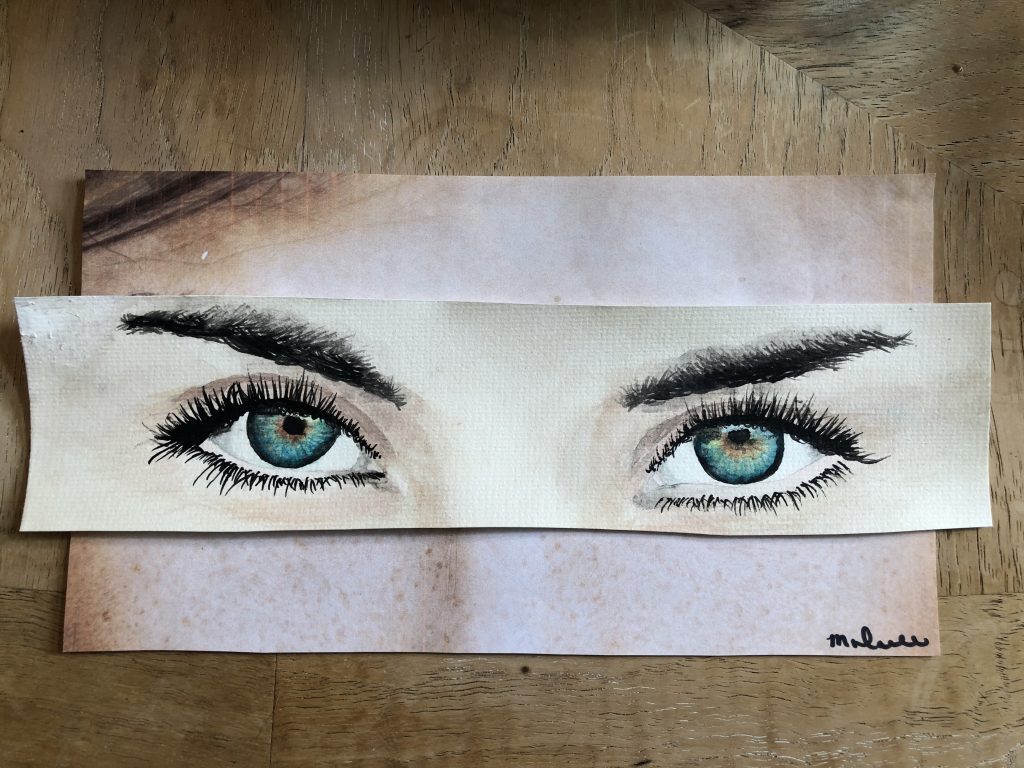
            I chose to do a painting, inspired by Jillian Weise’s poem, “Nondisabled Demands” for my project. The piece itself is a multi-media composition consisting of watercolor, completed in two 3 hour painting sessions, and a computer printed background photograph of a freckled young woman’s face. I painted a set of eyes that contain all possible eye colors, and arranged those colors to subtly reflect a sense of the natural world around us. I placed the painted eyes over the photograph of the woman’s eyes to symbolize a sort of mask. I imagined the viewer as the speaker of the poem, and wanted to have a clear set of eyes to stare back at that speaker, as a response to what is being said.

The poem begins, “It isn’t fair to us. You owe it to the reader. We’re trying to help. We have an uncle with a disability and he always says what it is […] you can’t expect people to read you if you don’t come out and say it […] ”. In one respect, the painting’s mask represents a choice made by the woman wearing it to conform outwardly to the neurotypical norms of larger society, to guard herself from being “othered”, and her dead-on stare informs the viewer that he/she is only entitled to see what the woman chooses to show. Is she judging the viewer, or is the viewer judging her? Does that make the viewer uncomfortable? Good.

The poem continues, “Everyone knows the default mode of a poem is ten fingers, ten toes […] When this is not true, it is incumbent on you to come out and say it” The mask, in another respect, represents invisible disability, the woman may not “look disabled” to the viewer, which challenges the viewer to question what disability “looks” like. As the poem’s speaker continues, demanding to know, “What do you have? What is it?” The woman’s eyes stare back at the speaker in defiance, her mascara’d lashes act as a sort of war paint in this interaction, and her furrowed brow as metaphorical battle armor.

The speaker goes further, “If you refuse to answer, then we call your doctor. Then we get to say You’re an inspiration.” The painted eyes stare back from atop the printed freckled face, daring the speaker to go ahead and try. The woman will not be moved to comply, her disabilities are her own to share or not share as she decides. The eyes will continue to stare, and make the viewer uncomfortable, despite the viewer/speaker’s demands, which are rooted in the need to feel a sense of order and to be able to appropriately label others, without which the viewer is left uncomfortable. The painting is made to challenge that sense of labeled, ordered, comfort. It is made to prolong the discomfort of the speaker/viewer, and to suggest that perhaps he/she should direct their questioning inward to discover what it is that truly makes them uncomfortable with another person’s invisible (or visible) disabilities in the first place.
Word Count: 506

I hereby declare upon my word of honor that I have neither given nor received unauthorized help on this work.

Death of Mel (Amanda) Baggs

I’m sorry to report the sad news that Mel (Amanda) Baggs died this past weekend. One of the most essential “voices” in communicating how autistics “speak,” in expressing how response to and interaction with sensory experience and patterns is a language of its own that so many of us simply do not notice or, worse, refuse to pay attention to, I have introduced my FSEM students to our topic with this video every time I’ve taught my Representations of Autism course for the past 12 years! (If you watch, there are no words for the 1st 3:15, at which point Baggs begins typing a “translation” with recourse to AAC [augmentative and alternative communication]).

Amanda Baggs’s video masterpiece, In My Language

Madison’s response to Ralph James Savarese’s “Prologue: River of Words, Raft of Our Conjoined Neurologies”

In Ralph James Savarese’s prologue to See It Feelingly, he details his son DJ’s autism as an important spectacle of human empathy, pushing back on the stereotype that autistic people do not feel the depth of emotion the way an able-minded person might. DJ is an important example of how the autistic mind is not closed to typical human emotions, but rather these emotions can be expressed in a neurodiverse manner. Also, Savarese is an important example of what can happen when the able-minded take the time to step into an atypical perspective. 

Savarese’s inclusion of DJ’s voice in his prologue begs the notion that just because a person does not communicate in a “typical” way doesn’t mean they don’t have something valuable to say. In the fifth grade, DJ wrote, “First, free people treat my people, very smart people who type to communicate, as mindless,” (17). A ten-year-old advocate already attuned to how he and “his people” are understood in the world. Along with his understanding of his placement in the world, DJ holds an amplified ability to relate to other people, real and fictional. Savarese goes on to point out the repetition of “breath” and the concept of breathing in his son’s writing, which is something he struggles to control as a result of intense anxiety. DJ’s anxiety is often the result of “channeling the traumatic injuries” (17) of the characters he reads about. He is easily overwhelmed by empathy, and he would communicate his understanding of people’s feelings through anxiety-ridden meltdowns. One meltdown in particular almost got him expelled from his middle school, to which he responded with a thoughtful letter to the principal asking for a second chance, but also demanding “respect for underestimated kids” (17). What was seen as a behavioral issue was really the result of a neurodiverse mind experiencing intense empathy.

It is obvious that Savarese takes the time to relate to DJ, really venturing into his territory. Both Savarese and DJ have to experience alien terrain as they try to grapple the world together, and in doing this, Savarese sets a sound example of the give and take that comes when you raise an autistic child. He highlights DJ’s empathy as a strength, saying, “DJ had taught me much about our deepest emotions and their centrality to literature- to all of the arts” (19). Understanding that DJ has a hard time with his readings, Savarese encouraged him to channel his focus on the reading process rather than the content. He even set a dedicated space for the two of them to read together, because as Savarese notes, “I wanted him to feel at home in literature” (20). Savarese says his son’s decision to become a writer was likely a result of him working with DJ to make reading more comfortable. It is important that this prologue not only breaks stereotypes surrounding autism, but highlights a critical relationship in which the abled is willing to step into a neurodiverse perspective. As Savarese and DJ both prove, “simply conforming to the dominant culture is not always a worthy goal.” 

I pledge. Madison Moyer

Word count: 517 

Tori Percherke’s Response and Reflection to Rebecca Foust’s “Apologies to my OBGYN”

For those who were curious like me, a OBGYN is two things: OB is short for obstetrician, a physician who delivers babies. GYN is shortened for gynecologist, a physician who specializes in treating diseases of the female reproductive organs.

In this story, readers can infer that the mother in this story is extremely sarcastic and hurt by physicians and how they don’t provide enough care to babies who are either premature or have a disability. Beginning in each stanza, Foust repeatedly says “Sorry” followed by a common human reaction or situation that is either out of hands or would be an expected emotion from a mother (line 1). Especially a mother who has given birth prematurely.

Beginning with the first stanza, the author states that it is the “duty” of her unborn son to be delivered on time. We know as humans, that that sentence is not true or humanly possible for a baby to decide that. As Fourst continues, she talks about her son’s weight, and how that fact made it hard for the doctors to take care of the other babies in the nursery. Seemed to Foust, that the doctors chose to take care of the majority rather than caring individually for the babies. As her rant continues, Foust states that she is again, “Sorry” for calling to check in on her son (line 7). And, for her son doing what he wasn’t supposed to do as a baby. Again giving a responsibility to a baby to act on a physical disability isn’t likely, obviously (line 13). This stanza gives us an insight on what happened to her son during testing. Which is understandably frustrating as a mother. I would be sassy and unapologetic too!

The baby was experiencing some serious changes in weight, and by Foust’s explanation of “doing everything backwards”, provides a possibility as to what the doctor might have told the mother at that time (line 9). Maybe, even to excuse why the baby wasn’t getting the treatment it deserves. The term, “doing everything backwards”, seems original and unique in that sense, and could be used as backfire words in Foust’s “apology letter.”

I feel like this poem especially has been very different from our other readings. This one is extremely dramatic in tone, and heart-felt because of the amount of lack her family received because her baby was disabled. Which is not the son’s fault, and shouldn’t be acted on differently than a baby without a disability. It hit home in a lot of ways personally, because this happens everyday even outside the hospitals. For example, teachers will get frustrated with those who have learning disabilities because they believe it takes up time with questions and failed tests. Personally, I have been told to not enroll into certain (high school) classes, mainly AP classes, due to the course being “fast-paced” and at a “college-level”. When my advisor told me this, I was confused why those two phrases were emphasized in our meetings. I would respond with, “okay, and?” Educators sometimes feel as if students should all demonstrate the same style and not allow for grades to be nothing other than a test. No projects, presentations, or visual representations. Learning is easier, for the teacher, by teaching everyone the same way. 

Relating my personal story to Foust’s Poem, I felt connected to the mother on how the doctor didn’t make sure her son got more care that he needed than the rest.  Just like I wanted more help from a teacher, the doctor wanted to focus on the majority of the babies (or in my case, classmates), in particular the ‘healthier babies’ rather than taking the time to help the disabled baby. It’s unfortunate how this world can look down on others with disability, because they might seem hopeless or “too much to handle.” Readers can take away from this poem by relating to an experience where they had with a professional and didn’t receive what was expected. But, got something where it wasn’t quite enough.

I pledge.

Word Count: 667

Amys Lesson Plan on Disability Treatment

Taking an interest in disability treatment and being in the special education program at UMW I designed a lesson plan focused on Of Mice and Men but including other texts from different cultures as well to compare and contrast the treatment of those with a range of disabilities. I have included The Treatment of Bibi Haldar as well as a portion of The Secret Garden into the lesson plan as comparison texts. All of these texts will be provided either digitally or physically. While focusing specifically on the treatment of characters by those able-bodied, the students will also be able to analyze the language used by these individuals. Is it demeaning? Are they meaning to be ‘mean’ to these characters or is it due to stress of not understanding how to be around someone with a disability? There are a lot of things to consider going into this lesson plan and one of those also is how we define disability. The lesson will be taught over a period of about a week slowly analyzing chunks of the literary pieces but also learning more about disabilities as a whole. While this may not be a unit present in many or even any English classrooms in the United States, it will still follow the curriculum set by the school for that year. This lesson is designed for Grade 10. 

The goal of this lesson is to primarily show how the treatment of those with disabilities can change or be the same from culture to culture. We will begin with learning about disability in class on a broad spectrum and touching on different types of disabilities and how we see them now as well as common perceptions. Bringing awareness to how treatment in a general sense has changed and should change is truly important for this lesson. We will touch upon the Autism spectrum, Down Syndrome, Coffin-Lowry, Deafness, Blindness, Deforminites, and so forth to broaden the student’s idea and knowledge of what disabilities look like and consist of. While an older individual becomes disabled as they age, it will not so much be emphasized in this lesson because none of the characters are put out due to their age, only preexisting disabilities that cut their job short due to age. Culture drastically changes views, treatments, what is important and what is not. Within this lesson, we will learn how three different cultures dealt with a disabled character. The American South and India are drastically different even now in their treatment of those with disabilities, and this will be the primary focus of the compare and contrast opportunities given in class. 

During this lesson students in the classroom that may have a disability will be included and put where they are most comfortable and will gain the same amount of understanding as others in the classroom. This will also help those who have not been around individuals with disabilities become aware that anyone could have one, it does not and will not always be apparent. Without calling out students who are listed with a high functioning disability, I will need to be aware of how these students are acting. Is it normal? Is this lesson making them uncomfortable and they are not as talkative due to that? These and many other questions will be going through my head during this week of teaching disability treatment in different cultures.

I pledge.

Amy Rouse

Word Count; 564

Erin Smith’s Response to The Yellow Wallpaper

The Yellow Wallpaper is a short story written by Charlotte Perkins Gilman about a woman with an unknown illness. She moves to a summer home with her husband, a physician who believes there is nothing wrong with her, where she is kept in a spacious room without much company besides her husband. She despises the peeling yellow wallpaper in the room, and during an episode she believes there is a woman trapped behind it and tears the rest of it off the wall. At the end of the story, she believes she has become the woman trapped, and her husband faints when he sees her scurrying around the room.

I’ve read this story before in high school and my class took the feminist approach at that time. My first thought after reading this story for this class was how much it reflected the treatment of mentally ill for years, especially women with mental illness. Just like the narrator, their issues were never taken seriously and it was often diagnosed as “female hysteria” which I think we all know is utter nonsense by today’s standards. Even her simple request to take down the wallpaper that bothers her a great deal is denied, her husband insisting that she was “letting it get the better of [her]” (Gilman). Not only that, but she is allowed very little to do while she is “recovering” from her illness. She cannot socialize, cannot write, and seemingly cannot leave the room with the yellow wallpaper. She is like a prisoner in her own home, and arguably the room invokes an image of a mental asylum, with the barred windows being the clearest example.

Being kept away from others only serves to worsen her condition. Humans are social, and we need to interact with more than just the same few people for long periods of time. From experience, you tend to get frustrated easier, like the narrator does with her husband. We also need stimulating activities, and the narrator says she needs it herself, “Personally, I believe that congenial work, with excitement and change, would do me good” (Gilman). She is not even allowed to write while she’s “recovering,” a basic human activity. Mentally ill people were considered unsightly and kept away from others, which often only worsened their illness like the narrator. It’s not really surprising she begins to hallucinate after who knows how long she’s been in that room, having no real activities to do. 

I also couldn’t help but think of current events while reading this short story, especially after seeing a post on social media that said something like, “Whatever you guys do, don’t read The Yellow Wallpaper right now.” I’m sure a lot of people are dealing with new issues during this quarantine (myself included; my mental health has tanked since we moved out of UMW). Cooped up in our own homes, unable to go out and interact with people besides our immediate family, not much to do besides complete school work, watch TV, and/or play some kind of game. “Stir crazy” is what a lot of people are experiencing, although for others there may be hidden issues that they never experienced before because they were stimulated and properly socialized. It may be a reach on my part, but I see a bit of a connection between the story and current events as well as how mentally ill people have been treated in the past.

Word count: 575

I Pledge, Erin Smith

Shelby Steele’s Response to “Good Kings, Bad Kings”

Susan Nussbaum’s “Good Kings, Bad Kings” is not only commentary on how disabled people are treated in institutions, but also how many of these institutions are run for profit, not for fair treatment of the disabled children living within them. They are focused on making another dollar and do not care for the residents as much as they should. 

    In this portion of the reading (pgs. 143-205) the character Michelle Volkmann, who works for Whitney-Palms, is tasked with assessing people who may have mental and/or physical disabilities to determine if they belong in institutions. She only has one chapter in this portion but it is very important in showing the reader how places such as ILLC, Illinois Learning and Life Skills Center, care more about the money than their residents. Michelle talks about Riverwood, another institution under the parent company Whitney-Palm, and the death of a girl who lived there. The girl was found tied to a wheelchair, though she had the ability to walk, and died because she suffocated from the tightness of her ties. Though she was said to have been frequently checked up on, it took the aides over six hours to realize she was dead. After mentioning this death, Michelle moves right into how money comes into play. She seems apathetic towards the girl and more focused on Tim, her boss, and his anger. He is angry about the fine Whitney-Palms will have to pay because the parents of the girl want an investigation. Michelle says there is no reason for him to be upset, as Whitney-Palms will most likely not pay the fine because “it’s not like anyone ever pays the fines anyway.” (188).  When she speaks to Tim about her ideas for updating their technology, he thinks it’s a good idea but he wants her to think of more ways to increase their revenue instead. They discuss the idea of putting three beds in each room instead of the normal two. They focus on how they can save money from this, but do not even mention how the residents would be negatively impacted. 

    Michelle then speaks of the Pine Hills case, in which a sexual predator was placed in a room with a child after the institution was given specific instructions to give him a room by himself. Though Tim says they fired the person responsible for the placement of the sexual predator, giving him his own room would have cost Whitney-Palms more money. Michelle mentions another fine Whitney-Palm will have to pay due to the Pine Hills case, saying “some politicians said it should be bigger than what we usually pay.” (191). The only sympathetic response Michelle ever has towards both of these instances is when she says “The thing that led to the fine was really sad.” (191). Besides this sentence, she is apathetic, except when she says Tim deserves to pay a fine because the little kid who was molested hung himself. 

    Michelle Volkmann, like the company she works for, is focused on getting her paycheck and moving on. She does not care for the residents, and simply does her job. Though this can be said for the majority of society, it is concerning she never has a thought to ‘rebel’ or speak up against the wrongdoings of Whitney-Palms. 

I pledge: Shelby Steele

Word Count: 556

Amys Response to Charlotte Perkins Gilman’s’ “The Yellow Wallpaper”

“The Yellow Wallpaper” by Charlotte Perkins Gilman follows the narrator through her struggles with mental health that can be characterized as schizophrenia. The narrator is confined to a top floor room and not being allowed to leave shows how her illness wasn’t taken seriously, enhancing that women are seen as weak-minded and unable to control themselves. Mental health in this story suggests that not only is it not taken seriously when related to women, it is also not properly treated; rest can not be the answer to everything that ails women.

The narrator gets “unreasonable angry with John sometimes,” and is sure she “never used to be so sensitive,” thinking it “due to [her] nervous condition,” (Gilman). Her nervous condition being schizophrenia. She hides her emotions from John, seeming as though he does not truly care about whatever is wrong with her, almost ignoring what is going on. The reason for these changes in emotion and lack of are related to schizophrenia, as the narrator, herself has also made this connection. 

Seeing faces and women stuck inside of the wallpaper trying to get out, is just one example of a schizophrenic hallucination in this short story. We have another where she sees the same women from the wallpaper creeping outside her window. None of this is said to John, even when he wakes up and she tries to talk to him about her condition after seeing the wallpaper move for the first time, he shuts it down stating how she is getting better. She makes a quick comment about how she is physically getting better before stopping short of what we can assume would mention her mental health declining. Not getting the proper treatment for any illness can have dire consequences, in this case, the narrator continues to become more delusional. 

By the narrator herself, we can see how the treatment of those who can be deemed ‘hysteric’ or ‘disturbed’ would be shut away and rarely dealt with even by their own husbands who had more serious cases to tend to during this time. It seems as though no one else is in the house, but the mention of the bars on the window could also lead to the inference of being at an asylum of sorts, even though in the beginning we hear it has not been used for years.

The disability status that comes with mental health, is one that is also denied. We see this here as well when the husband “assures friends and relatives that there is really nothing the matter […] but temporary nervous depression — a slight hysterical tendency — what is one to do?” (Gilman). Many, especially women, were undiagnosed and passed off as a case of hysteria. No one fought the doctors to truly find out what was wrong, and all doctors would do this. Along with the three mentioned in this story. Women were the only ones who were not so satisfied with the ‘diagnosis’ they received. The treatment of women in the medical field regarding mental disabilities has been one to put down a diagnosis just to keep them from saying anything further.

Schizophrenia has many different causes and symptoms. Relating all of these events in the story to the narrator having schizophrenia, all play an important role. Hallucinations, seeing women in the walls and also the same one woman outside of her windows, all point to some sort of psychosis. Her unstable emotions certainly play a role and are usually the first sign of any time of mental illness. Schizophrenia specifically makes sense because they are all together within the span of a few months, and her medications, that most likely are not designed for such conditions, are making it worse by treating the wrong illness. 

I pledge.

Amy Rouse

Word Count; 624

Zoom with Petra Kupper

The zoom meeting was interesting to say the least. Unfortunately it didn’t last very long so this will be a short response. She began the meeting by introducing herself and a little background on her. She talked a little about why she writes this newly found science fiction and why it is important. She believes in the surrealist lens. She started reading “Mercury Worms” and about 20 minutes into the reading there were a bunch of boys who interrupted the streaming with vulgar language and pictures. This went on for about 15 minutes until Kupper finally just canceled her meeting. I would check 5-6 times after to make sure she wasn’t back on, but by 9 p.m. I stopped and read a little more of Kupper’s “Mercury Worms” to get an idea.

Grace’s Response to “The Right Way to Be Crippled and Naked”

 When it comes to discussing disability and ableism it is important to pay equal attention to both visible and invisible disabilities. In Jonathan Mack’s The Right Way to Be Crippled and Naked it appeared as though the primary focus was on a visual disability, which was the absence of part of a leg. However, I believe that an argument could be made that more significantly than the leg itself is the impact it had on the author’s mental state.

As someone who is very open about my own mental health issues and has acted as an advocate for years, it immediately stood out to me that appeared to be an underlying mental health issue. Before continuing I would like to give a disclaimer that I am in no way qualified to give an official diagnosis, but am rather using my education and experience to approach this topic. A lot of what the main character is experiencing mentally stems from his physical disability with his leg. Within the first three paragraphs Mack describes his life as filled with “regrettable incidents.”  As the letter continues, he speaks more on his personal life and how it had been “promiscuous” and filled with a lot of sexual activity which leads me to believe these sexual encounters play a large role in said incidents. When someone is dealing with mental health issues there are a variety of healthy and unhealthy actions they can take to try and make themselves feel better. One of those actions is acting out with sex by having an exccesive amount of it. People will do this for a variety of reasons ranging from deep feelings such as the need to feel desired by someone, or just as general erratic behavior associated with some cases of mental health.

The other mental health disorder I thought would be relevant to bring up in regards to this piece was a form of body dysmorphia. This is when an individual cannot stop thinking about a specific part of their bodies they perceive as flawed. It is like a constant stream of self hatred that can consume the way one lives their life as well as their overall opinion on their self worth. The main focus for Mack would be how he views himself without part of his limb. Mack spoke about how he went out of his way to shape his body to have a “porn star chest with big erotic arms”, and in his message at the end of the reading, he states one of his biggest fears was that he would “never get laid.” The human body is often sexualized, and for people with body dysmorphia they will often times not deem themselves worthy of sex or love from another.

Though I am speaking more so on the disability that is mental health, it is important to acknowledge how the physical disability with the leg plays a large part in this as well. There may be other social or personal issues the author had been experiencing, but it looked like a majority of his dislike for himself came from his leg. It is mentioned in the passage how Americans are conditioned to suppress any negative thoughts which I found to be one of the most accurate things I have ever read. Men especially are given the stereotype of being tough that entails concealing all traces of emotion. Bottling up negative feelings and energy like this is one of the most unhealthy coping techniques because eventually you won’t be able to keep it in and there will be a spiral. Occasionally, this spiral can lead to clarity. You are at a point of an all time low, you hate how you’re feeling, and you cannot stand to live like this any longer. I feel as though the entirety of Mack’s letter, including his decision to become a Jain monk, was well written word vomit consisting of all he had suppressed for the last 20 years or so.  The result was hitting this bottom and being in a place where he wanted to make a real change for his life.

I pledge: Grace Bonaccorsy

Word Count: 686

css.php