Meg’s Final Analysis on the Birth of Frankenstein’s ‘Creation’, and Ableist Parent’s Autism Diagnosis Experience

Earlier in the semester, we focused quite a bit on the character of Victor Frankenstein, the titular character in Mary Wollstonecraft Shelley’s Frankenstein. We discussed how Victor could represent a character with depression, schizophrenia, or a number of other possible invisible disabilities. We touched on his ‘creation’ from time to time as well, in associate with Rosemary Garland Thompson’s Introduction: From Wonder to Error—A Genealogy of Discourse in Modernity” from Freakery: Cultural Spectacles of the Extraordinary Body, among other theories. But I think that we should circle back and revisit Dr. Frankenstein and his creation now that we have learned more about autism. By analyzing the passage in which Victor Frankenstein experiences the ‘birth’ of his ‘creation’ it is impossible to ignore the way in which his experience coincides with the depiction of   the experience of an ableist parent, such as Jenny McCarthy, discovering their child’s autism diagnosis, outlined in Julia Miele Rodas, “Introduction” rather succinctly, which shows us just how far we have left to go in deconstructing the rampant ableism in our own society.

            Shelley begins Dr. Frankenstein’s experience, at the moment the creature opens his eyes, “How can I describe my emotions at this catastrophe, or how delineate the wretch whom with such infinite pains and care I had endeavoured to form? His limbs were in proportion, and I had selected his features as beautiful. Beautiful!” (Shelley 37). It is clear that up until this moment, throughout the two years he had been working on his ‘creation’, he never once thought of him as anything less than his own beautiful summation of his blood sweat and tears. His ‘creation’ was exactly as he was intended to be, with, “limbs […] in proportion” and “beautiful” features (37). This mirrors what a parent typically sees in their child(ren): the most beautiful thing(s) they have ever created. We see similarities in Jenny McCarthy’s depiction of her son in the doctor’s office just before his diagnosis, as written in her book Louder Than Words, “Evan ‘had taken those ear cones the doctors use to look inside your ears and had made the most perfect row lined up across the room’”. McCarthy goes on to detail that she found this behavior ‘”cute”’ (Rodas 15). McCarthy’s choice of the words “perfect” and “cute” illustrate that prior to her son’s diagnosis, she, like Dr. Frankenstein and his ‘creation’, saw no problem with her child. The similarities do not stop here.

            Within the first line of this passage, the reader is aware of Dr. Frankenstein’s flurry of emotions upon witnessing the birth of his ‘creation’. His use of the words “catastrophe” and “wretch” illustrate the change in the doctor’s perception of his ‘creation’ from “beautiful” to seemingly grotesque. Frankenstein continues, “The different accidents of life are not so changeable as the feelings of human nature. I had worked hard for nearly two years, for the sole purpose of infusing lie into an inanimate body. For this I had deprived myself of rest and health. I had desired it with an ardour that far exceeded moderation; but now that I had finished, the beauty of the dream vanished, and breathless horror and disgust filled my heart.” (Shelley 37). In this passage Dr. Frankenstein acknowledges his change in feelings toward his ‘creation’. He, not unlike a parent, has put his all into his ‘creation’ for years until this point. But, the moment his ‘creation’ opens his eyes he no longer recognizes him as the “beautiful” being he was moments before.

            This, again, mirrors Jenny McCarthy’s own ableist reaction to the diagnosis of her son, “’Everything I had thought was cute was a sign of autism’” (Rodas 15). As we’ve just read, moments earlier McCarthy had seen her son’s behavior as “cute”, and she has now dehumanized them into strictly symptomatic behaviors, or as Rodas puts it, as “autism’s antihuman identity” (Rodas 16). McCarthy goes on, “The things I’d thought were character traits were in fact autism characteristics, and that was all I had. Where was my son, and how the hell did I get him out?” (16). McCarthy’s inability to see her son, and insistence upon seeing his once “cute” “character traits” as non-communicative autonomic compulsions that he needed saving from, illustrate the dehumanization of her own son due to her ableist blinders. This is further exemplified by McCarthy’s interaction with her own doctor, who states that her son “is still the same boy you came in here with”, and her response “No, in my eyes he wasn’t,” (16). Much like Doctor Frankenstein no longer sees his ‘creation’ as the same “beautiful” being that he had known for years, neither does McCarthy see her own son as the “cute” boy that she had raised until this point.

            Mary Wollstonecraft Shelley’s Frankenstein is chock-full of material to analyze through the lens of Disability Studies, from the Doctor’s many possible invisible disabilities, to the various possible physical and invisible disabilities that his ‘creation’ could be seen to represent. But perhaps more interesting, at least to me, is the way in which the interactions between the Doctor and his ‘creation’ or either character and the outside world, can be seen to represent interactions between the disabled community and the non-disabled community. How do we see things differently today, or do we? One example can be found in the problematic way that many ableist parents fear the diagnosis of autism for their children as most parents would fear a deadly illness. Which is ironic, given that this same fear pushes many to avoid modern medical treatments such as vaccines, under the misguided notion that they may cause autism; literally risking their children’s lives to avoid an autism diagnosis. This best illustration of this dehumanizing fear is Jenny McCarthy’s experience of the diagnosis of her son with Autism, and the succinct reflection of that experience within Dr. Frankenstein’s experience of witnessing the birth of his ‘creation’, which shows us that although we’ve come a long way in terms of we still have a very long way to go in dismantling the ableism in our society.

Word Count = 1014

Works Cited:

Rodas, Julia Miele, and Melanie Yergeau. Autistic Disturbances: Theorizing Autism Poetics from the DSM to Robinson Crusoe. University of Michigan Press, 2018. < https://www.dislit2020.chris-foss.net/blog/readings/>

Shelley, Mary Wollstonecraft, and Susan J. Wolfson. Mary Wollstonecraft Shelleys Frankenstein, or, The Modern Prometheus. Pearson Longman, 2007.

Thomson, Rosemarie Garland. Freakery: Cultural Spectacles of the Extraordinary Body. New York University Press, 1996. <https://www.dislit2020.chris-foss.net/blog/readings/>

I hereby declare upon my word of honor that I have neither given nor received unauthorized help on this work.
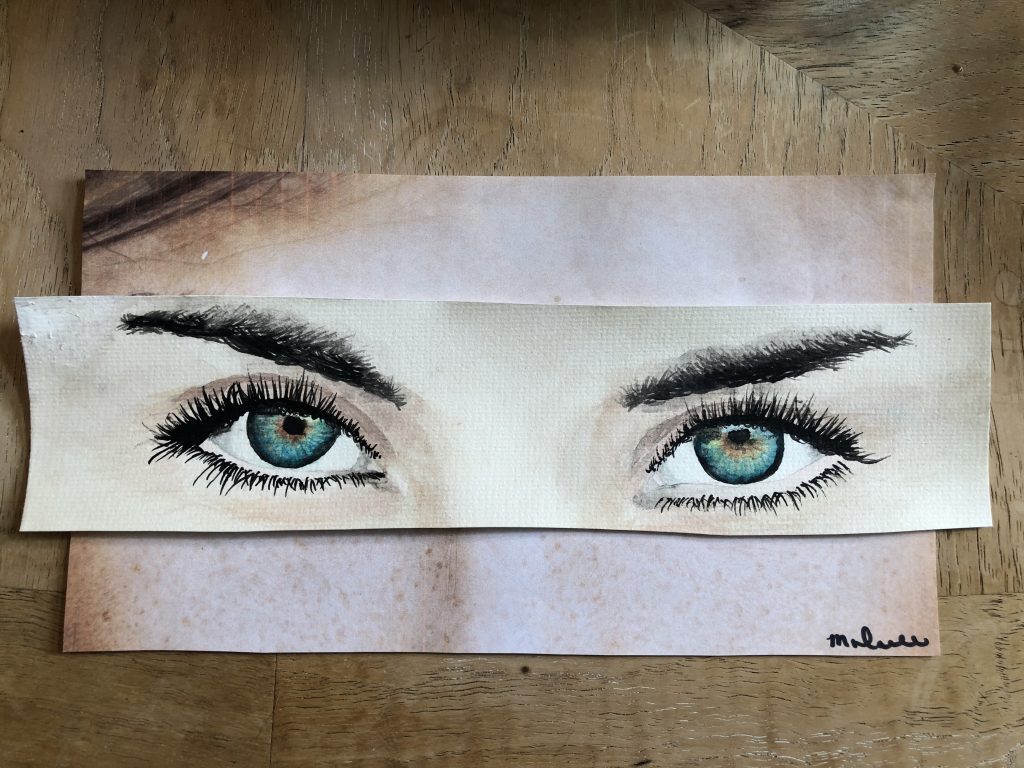
Meg’s MPP: The Discomfort of Invisible Disability

            I chose to do a painting, inspired by Jillian Weise’s poem, “Nondisabled Demands” for my project. The piece itself is a multi-media composition consisting of watercolor, completed in two 3 hour painting sessions, and a computer printed background photograph of a freckled young woman’s face. I painted a set of eyes that contain all possible eye colors, and arranged those colors to subtly reflect a sense of the natural world around us. I placed the painted eyes over the photograph of the woman’s eyes to symbolize a sort of mask. I imagined the viewer as the speaker of the poem, and wanted to have a clear set of eyes to stare back at that speaker, as a response to what is being said.

The poem begins, “It isn’t fair to us. You owe it to the reader. We’re trying to help. We have an uncle with a disability and he always says what it is […] you can’t expect people to read you if you don’t come out and say it […] ”. In one respect, the painting’s mask represents a choice made by the woman wearing it to conform outwardly to the neurotypical norms of larger society, to guard herself from being “othered”, and her dead-on stare informs the viewer that he/she is only entitled to see what the woman chooses to show. Is she judging the viewer, or is the viewer judging her? Does that make the viewer uncomfortable? Good.

The poem continues, “Everyone knows the default mode of a poem is ten fingers, ten toes […] When this is not true, it is incumbent on you to come out and say it” The mask, in another respect, represents invisible disability, the woman may not “look disabled” to the viewer, which challenges the viewer to question what disability “looks” like. As the poem’s speaker continues, demanding to know, “What do you have? What is it?” The woman’s eyes stare back at the speaker in defiance, her mascara’d lashes act as a sort of war paint in this interaction, and her furrowed brow as metaphorical battle armor.

The speaker goes further, “If you refuse to answer, then we call your doctor. Then we get to say You’re an inspiration.” The painted eyes stare back from atop the printed freckled face, daring the speaker to go ahead and try. The woman will not be moved to comply, her disabilities are her own to share or not share as she decides. The eyes will continue to stare, and make the viewer uncomfortable, despite the viewer/speaker’s demands, which are rooted in the need to feel a sense of order and to be able to appropriately label others, without which the viewer is left uncomfortable. The painting is made to challenge that sense of labeled, ordered, comfort. It is made to prolong the discomfort of the speaker/viewer, and to suggest that perhaps he/she should direct their questioning inward to discover what it is that truly makes them uncomfortable with another person’s invisible (or visible) disabilities in the first place.

Word Count: 506

I hereby declare upon my word of honor that I have neither given nor received unauthorized help on this work.

Meg’s Response to Toni Morrison’s Sula and Chris Bell’s “Introducing White Disability Studiesː A Modest Proposal”

In “Introducing White Disability Studiesː A Modest Proposal”, Bell lays out the ways in which Disability Studies have, “a tendency to whitewash disability history, ontology and phenomenology,” and that they would be more aptly namedː White Disability Studies (Bell 275). While the entire piece was thought provoking and well written, one point stood out more than any other for me – Bell points out that disability studies often focus on the disability without discussing the intersection of that disability and the subjects of race and ethnicity. This point made me pause and re-read Sula through a different lens. Within the community of Medallion, Ohio there are several characters who are disabled in one way or another, and each of their experiences both within, and outside of, their community is further shaped by their race and ethnicity. Shadrack’s treatment within the military hospital, and his treatment in the white town show not only the blatant racism of the time, but also a disparity in the treatment of African Americans with disabilities of the time, and through that disparity an entirely different experience of disability.

            Obviously, racism is rampant in Sula, and when reading a story of a segregated mid-western American town around the first World War, this is not shocking.But this doesn’t mean that we shouldn’t point out the obvious, and make it a conversation – we should heed Bell’s advice and talk about what isn’t being talked about, even when it does seem obvious. And when reading of Shadrack’s experience in a wartime hospital, it is impossible to not question if his race played a part in his treatment by his attending doctor. Would the doctor have told a white man with the same actions “Nobody is going to feed you forever,” or “pick it up, I said. There’s no point to this…” (Morrison 9)? While doctors certainly saw an unprecented number of young men experiencing shell-shock during World War One, and were undoubtedly at a loss for how to help them, one must wonder if there would be more preferential treatment towards a white male over an African American male with the same symptoms. Would a white man have at least been shown a mirror, or told his name or maybe some basic directions home?

            Another obvious example of a difference in experience and treatment is in the vaguely named “Midwestern town” which he comes to after leaving the hospital. As Shadrack breaks down, eyes closed, simultaneously untying and knotting his shoelaces, no one stops to help. No one asks if he’s alright. Instead the police arrive and arrest him for “vagrancy and intoxication” and lock him up in jail (Morrison 13). Had a white man been having the same non-violent break down while sitting on the curb, we have to ask ourselves – would he have had the same experience? Likely not. The charge of vagrancy has roots in the Civil War, and was aimed specifically at African Americans who appeared to be homeless (or even sometimes just appeared at all) within white communities (Tarter).

            Shadrack’s examples represent just one character’s experiences within the intersectionality of race, ethnicity and disability in Sula, a book which is ripe with characters who each have their own unique experiences of the same intersectionality. His treatment within the military hospital, and his experience in the white town are evidence of the obvious racism of the time and place of the story, but are also evidence of a disparity in the treatment and experiences of African Americans with disabilities and their white neighbors.

Additional Work Cited:

Tarter, Brent. “Vagrancy Act of 1866.” Encyclopedia Virginia. Virginia Humanities, 25 Aug. 2015. Web. 5 Feb. 2020

Word Count: 608

I hereby declare upon my word of honor that I have neither given nor received unauthorized help on this work.

css.php