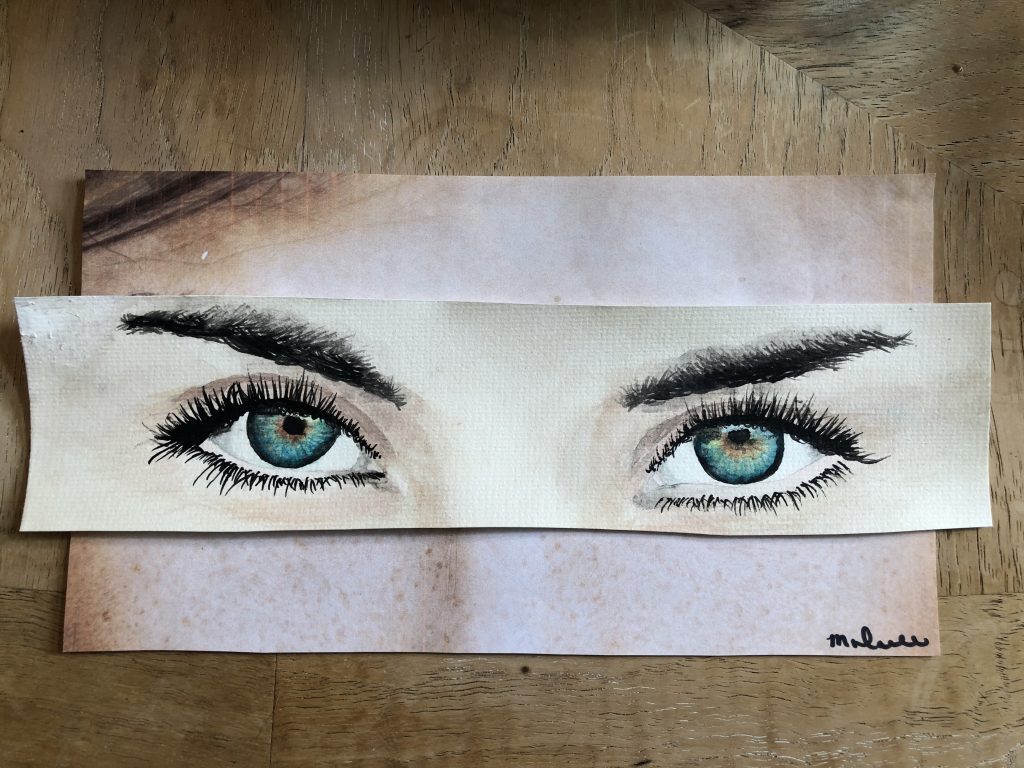
I chose to do a painting, inspired by Jillian Weise’s poem, “Nondisabled Demands” for my project. The piece itself is a multi-media composition consisting of watercolor, completed in two 3 hour painting sessions, and a computer printed background photograph of a freckled young woman’s face. I painted a set of eyes that contain all possible eye colors, and arranged those colors to subtly reflect a sense of the natural world around us. I placed the painted eyes over the photograph of the woman’s eyes to symbolize a sort of mask. I imagined the viewer as the speaker of the poem, and wanted to have a clear set of eyes to stare back at that speaker, as a response to what is being said.
The poem begins, “It isn’t fair to us. You owe it to the reader. We’re trying to help. We have an uncle with a disability and he always says what it is […] you can’t expect people to read you if you don’t come out and say it […] ”. In one respect, the painting’s mask represents a choice made by the woman wearing it to conform outwardly to the neurotypical norms of larger society, to guard herself from being “othered”, and her dead-on stare informs the viewer that he/she is only entitled to see what the woman chooses to show. Is she judging the viewer, or is the viewer judging her? Does that make the viewer uncomfortable? Good.
The poem continues, “Everyone knows the default mode of a poem is ten fingers, ten toes […] When this is not true, it is incumbent on you to come out and say it” The mask, in another respect, represents invisible disability, the woman may not “look disabled” to the viewer, which challenges the viewer to question what disability “looks” like. As the poem’s speaker continues, demanding to know, “What do you have? What is it?” The woman’s eyes stare back at the speaker in defiance, her mascara’d lashes act as a sort of war paint in this interaction, and her furrowed brow as metaphorical battle armor.
The speaker goes further, “If you refuse to answer, then we call your doctor. Then we get to say You’re an inspiration.” The painted eyes stare back from atop the printed freckled face, daring the speaker to go ahead and try. The woman will not be moved to comply, her disabilities are her own to share or not share as she decides. The eyes will continue to stare, and make the viewer uncomfortable, despite the viewer/speaker’s demands, which are rooted in the need to feel a sense of order and to be able to appropriately label others, without which the viewer is left uncomfortable. The painting is made to challenge that sense of labeled, ordered, comfort. It is made to prolong the discomfort of the speaker/viewer, and to suggest that perhaps he/she should direct their questioning inward to discover what it is that truly makes them uncomfortable with another person’s invisible (or visible) disabilities in the first place.
Word Count: 506
I hereby declare upon my word of honor that I have neither given nor received unauthorized help on this work.

You must be logged in to post a comment.